A WORLD IN CRISIS AT THE STRAIT
U.S. and Israel Strike Iran, Igniting a New Middle East War; Khamenei Reported Dead; Oil and Markets Brace for Shock. Reports of Supreme Leader's Death Denied by Tehran | Strait of Hormuz Closure Threatens Global Economy | Gold Surges Past $5,400

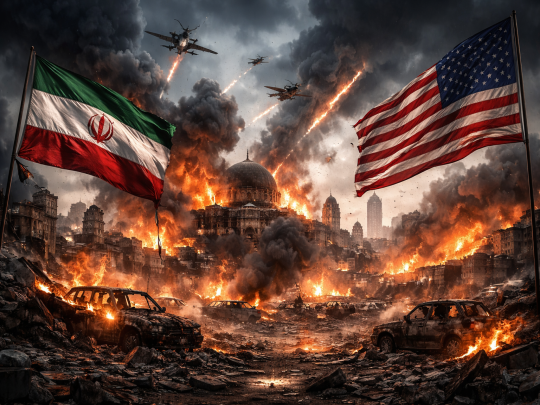
TheCoreQuant - In the early hours of Saturday, February 28, 2026, the world woke to a conflict that many had feared and few believed would truly materialize. United States and Israeli forces launched coordinated airstrikes against Iran in an operation the Pentagon named "Epic Fury" and Israel called "Lion's Roar" — a joint assault that within hours had shattered the fragile diplomatic overture of nuclear negotiations, sent tankers fleeing the Persian Gulf, propelled gold past $5,400 an ounce, and ignited a geopolitical firestorm whose full consequences remain, even now, impossible to fully calculate.
What began with Israeli F-35s and American Tomahawk cruise missiles raining down on Tehran before sunrise had, by nightfall Saturday, produced reports that Iranian Supreme Leader Ayatollah Ali Khamenei had been killed in a strike on his compound — a claim his own government furiously denied. It had produced reports that Khamenei's son-in-law and daughter-in-law had been killed in the attacks — claims attributed to a member of the Tehran City Council and corroborated by Iran's Jamaran news agency, though still officially unconfirmed by Iranian state media. And it had produced the sight of tankers anchored and adrift in the Gulf of Oman, their captains listening to radio broadcasts from the Iranian Revolutionary Guard Corps declaring that transit through the Strait of Hormuz was "not allowed."
By the time the sun set over the Arabian Gulf on Saturday, a new era had begun — one where the world's most critical oil chokepoint had become a battlefield, and the global economy was bracing for consequences it had not faced since the oil shocks of the 1970s.
A TIMELINE OF THE PAST 24 HOURS
The seeds of Saturday's explosion had been planted weeks, if not years, before the first missile was launched. But the decisive hours began in the early evening of Friday, February 27, when senior U.S. envoy Steve Witkoff briefed President Donald Trump at Mar-a-Lago on the latest Iranian counter-proposal in nuclear negotiations. According to a senior American official who spoke to Channel 12 of Israel, Trump was told the Iranian offer was, in the words of American negotiators, "bullshit" — a stalling tactic designed to buy Tehran more time.
Friday, Feb. 27 — Late evening (U.S. Eastern):
President Trump authorizes Operation Epic Fury. Oman's foreign minister — who had been serving as mediator — announces the two sides had made "significant progress." The announcement proves tragically premature.
Saturday, Feb. 28 — 8:15 A.M. Israel Standard Time (12:15 A.M. New York):
Israeli airstrikes begin. Explosions are reported across Tehran, including the Ministry of Defense, Ministry of Intelligence, the Atomic Energy Headquarters, and — critically — the district in the capital where Supreme Leader Khamenei normally resides. Seven missiles are confirmed to strike that area. Israeli Defense Minister Israel Katz publicly labels the campaign a "preemptive attack intended to remove threats to the State of Israel."
Saturday, Feb. 28 — 9:00 A.M. to Noon (Israel time):
U.S. officials confirm American strikes are underway. The New York Times is told by a senior U.S. official that "American military strikes on Iran are underway." The Israeli Air Force reports approximately 200 fighter jets striking around 500 targets in western and central Iran, targeting air defenses and missile launchers. The Pentagon describes it as "the largest single strike sortie in Israeli Air Force history." Additional nuclear facilities are reportedly attacked in Karaj and near Qom. Iranian state media reports 201 killed and 747 wounded across 24 provinces.
Saturday, Feb. 28 — Afternoon:
Iran retaliates. In what a former NATO Supreme Allied Commander, retired Admiral James Stavridis, describes as Iran believing it is on "death ground," the Islamic Revolutionary Guard Corps launches an unprecedented barrage of missiles and drones targeting U.S. bases in Bahrain, Qatar, Kuwait, the UAE, Jordan, and Iraq. Explosions are heard from the beaches of Dubai to the streets of Doha. The Pentagon later states that U.S. and allied forces repelled hundreds of Iranian missiles and drones, with no American casualties confirmed.
Saturday, Feb. 28 — 3:00 P.M. to 6:00 P.M.:
The Strait of Hormuz crisis begins. Ships in the Persian Gulf begin receiving radio broadcasts from the IRGC instructing them that passage through the Strait of Hormuz is "not allowed." Farhad Patel, director of Dubai-based Sharaf Shipping Agency, tells The National newspaper: "Some ships have been advised on VHF by the Iranian Navy to hold position." Iranian state media declares the waterway "practically closed." The UK Maritime Trade Operations (UKMTO) receives multiple reports from ship operators and issues a navigational advisory. Oil tankers begin diverting course.
Saturday, Feb. 28 — Evening:
Israeli Channel 12 reports that Prime Minister Benjamin Netanyahu was shown an image of what it described as the body of Supreme Leader Ali Khamenei, said to have been recovered from his compound. An Israeli official tells Israeli media: "Khamenei was killed in an Israeli-U.S. strike." Iran's Foreign Minister Abbas Araghchi immediately pushes back, telling NBC News that Khamenei is alive and that "all top leadership is alive." Iranian officials accuse Israel and its allies of "mental warfare." The head of public relations for the Supreme Leader's office states: "The enemy is resorting to mental warfare; all should be aware." Khamenei himself does not appear publicly.
Saturday, Feb. 28 — Late Night:
Reports emerge that Khamenei's son-in-law and daughter-in-law were killed in the missile strikes on Tehran. The claim is first attributed to a member of the Tehran City Council, citing Iran's Young Journalists Club, and subsequently reported by the Iranian Jamaran news agency and Reuters. The names of those killed are not officially released. Iranian state media does not confirm the report. Independent verification remains impossible as of press time.
Sunday, March 1 — Early Morning:
Iran fires approximately 150 ballistic missiles at Israel throughout the day; most are intercepted by Israel's Iron Dome and allied air defense systems. The OPEC+ group schedules an emergency meeting for Sunday to discuss supply implications. Asian markets prepare to open to potentially historic volatility.
THE KHAMENEI QUESTION: ALIVE OR DEAD?
The conflicting reports about the fate of Iran's 85-year-old Supreme Leader represent perhaps the most consequential uncertainty of the conflict's opening day. A senior Israeli official stated unequivocally to Israeli media that Khamenei had been killed. Channel 12, citing Israeli sources, reported Netanyahu was shown a photograph of the body.
Iran's government responded with categorical denials. Foreign Minister Araghchi told NBC News: "Khamenei is alive, as far as I know." Lebanese TV channel Al Mayadeen reported that Khamenei was at a military command headquarters, "leading the fighting." The Iranian public relations office accused enemies of conducting "psychological warfare."
What is clear is that the strikes directly targeted Khamenei's compound and official residence in Tehran, with seven missiles confirmed to have struck the area. What remains unresolved — and may not be resolved for hours or days — is whether the Supreme Leader survived.
The reported deaths of Khamenei's son-in-law and daughter-in-law in the strikes, reported by the Jamaran news agency and attributed to a member of the Tehran City Council, add further weight to the scale of the assault on the Supreme Leader's inner circle, even if the Supreme Leader's own fate remains contested. Iranian officials have not provided the names of the alleged victims, and no independent verification has been possible.
THE STRAIT OF HORMUZ: A CHOKEPOINT UNDER THREAT
At the mouth of the Persian Gulf, one of the world's most consequential waterways now sits in a state of suspended crisis. The Strait of Hormuz — a narrow passage barely 21 miles wide at its narrowest point — is the artery through which approximately 20 percent of global oil and 20 percent of the world's liquefied natural gas transits every year. More than $500 billion in energy moves through it annually.
On Saturday, ships began receiving radio broadcasts purporting to come from the Iranian Navy instructing them that transit was banned. The UK Maritime Trade Operations said it received multiple reports it could not independently verify. The UKMTO advisory stated: "VHF broadcasts or statements indicating closure of the Strait of Hormuz are not legally binding and do not constitute a lawful restriction on navigation under international law."
Nevertheless, ship operators are not waiting for legal clarity. Vessel tracking data shows significantly reduced ship movements. The BIMCO shipping association's chief safety officer, Jakob Larsen, said: "The US-Israeli attack on Iran dramatically increases the security risk to ships operating in the Arabian Gulf and adjacent waters." Ships already in the region are, he added, "expected to seek refuge in territorial waters of neutral states such as the UAE or Qatar."
Iran has long held this card in reserve. Tehran's parliament voted last year to authorize closure of the strait. Any final decision legally rests with the Supreme Leader — whose fate is itself now in dispute. What is not in dispute is that Iran possesses the naval capabilities — fast attack boats, submarines, and the ability to mine the waterway — to create serious disruption even without a full closure.
Retired Admiral James Stavridis told CNN on Saturday that Iran was potentially in "death ground" — the ancient military concept Sun Tzu described as a moment when there is nothing left to lose. "I think the Iranian leadership may feel they are on death ground," Stavridis said. "I'd look for them to go big."
OIL MARKETS: BRACING FOR THE MONDAY OPEN
The financial markets that normally price these risks were closed when the strikes began Saturday morning. But early signals from weekend trading paint an alarming picture of what Monday may bring.
On decentralized cryptocurrency exchange Hyperliquid — one of the few venues trading around the clock — oil-linked perpetual futures surged more than 6.2 percent on Saturday, touching $70.60 per barrel, while a separate contract hit above $86.00. Gold perpetual futures climbed more than 5 percent to approximately $5,464 per troy ounce. Silver surged over 8 percent to near $97.50 per ounce.
The last conventional trading session before the strikes closed with Brent crude — the global benchmark — up 2.87 percent at $72.87 a barrel. West Texas Intermediate (WTI), the American gauge, ended at $67.02, up 2.78 percent. Analysts at Lombard Odier, the Swiss private bank, had already warned before the strikes that a major Iranian response, particularly a prolonged disruption of the Strait of Hormuz, could send oil to $100 a barrel or beyond. Vandana Hari, chief executive of Singapore-based Vanda Insights, expects a "knee-jerk" surge to $80 per barrel when markets open Monday, should the conflict persist.
Patrick De Haan of market tracking firm GasBuddy has predicted a 5 to 10 percent increase in oil prices, which he said would translate to American gasoline prices rising from roughly $3.00 per gallon to at least $3.10 to $3.15 per gallon in the near term. Eurasia Group analysts, however, caution that supply disruption to global markets would be "limited even in the event that Iran retaliates against tanker traffic, given the expected U.S.-led efforts to maintain supply."
OPEC+ producers, led by Saudi Arabia and the UAE, have reportedly been building production capacity in anticipation of exactly this scenario. "Saudi, the UAE, etc., were already boosting production to cover for any disruptions. They can more than replace Iranian exports — of course as long as there are no Gulf disruptions," Robin Mills, chief executive of Qamar Energy, said.
The broader U.S. equity market had already been pricing in anxiety. In the week before the strikes, the Dow Jones Industrial Average (DJIA) fell 1.3 percent, the S&P 500 Index fell 0.4 percent, and the Nasdaq Composite (COMP) fell nearly 1 percent. When markets open Monday, investors will be watching the following U.S.-listed equities with direct exposure to these dynamics:
ExxonMobil (XOM) and Chevron (CVX), the two largest American oil majors, are expected to see significant opening gains if crude surges as anticipated. Halliburton (HAL) and Schlumberger (SLB), the oilfield services giants, may also benefit from a higher oil price environment. Conversely, airlines — Delta Air Lines (DAL), United Airlines (UAL), and American Airlines (AAL) — face a painful combination of surging jet fuel costs and a rapidly deteriorating Middle East aviation corridor: over a dozen airlines have already suspended or rerouted flights. Defense contractors — Lockheed Martin (LMT), Raytheon Technologies (RTX), and Northrop Grumman (NOC) — are expected to see interest from investors betting on sustained military demand. Shipping companies with exposure to the Persian Gulf are facing profound uncertainty.
GOLD, SILVER, AND THE FLIGHT TO SAFETY
Even before Saturday's strikes, gold had been trading near historic highs, breaking $5,000 per troy ounce in the weeks preceding the attack amid escalating tensions. The safe-haven demand driving that move now looks likely to intensify dramatically. Gold futures are expected to test resistance at the $5,450 level when markets reopen, according to analysts at TS2 Space.
Silver's trajectory has been equally dramatic. The metal, which serves a dual role as both a safe-haven asset and an industrial commodity critical to solar panels and electronics manufacturing, surged to near triple-digit territory on decentralized exchanges Saturday, trading around $97.50 per troy ounce. Ole Hansen, head of commodity strategy at Saxo Bank, had noted before the strikes that the geopolitical risk premium being built into commodities was unlike anything seen in years. The next phase of that premium building begins Monday morning.
Newmont Corporation (NEM) and Barrick Gold (GOLD), two of the largest gold miners with U.S. listings, stand to benefit directly. Silver miners including First Majestic Silver (AG) and Pan American Silver (PAAS) may also see significant interest.
THE SHIPPING SECTOR: INSURANCE, WAR RISK, AND THE NEW CALCULUS
For the global shipping industry, the Strait of Hormuz crisis is not merely a geopolitical abstraction — it is an immediate, existential business problem. The moment Iranian forces broadcast their warning over maritime VHF channels Saturday, the calculus for every ship captain, every shipping company, and every insurer in the world changed.
BIMCO, the international shipping association that represents vessel owners carrying about 65 percent of global tonnage, has advised ships already in the area to seek refuge in UAE or Qatari territorial waters. Ships bound for the region are "likely to stay away until the situation stabilises again," BIMCO's Larsen said.
War risk insurance premiums for vessels transiting the Persian Gulf — already elevated — are expected to surge when the London insurance market opens Monday. The last time Iran-related tensions spiked to comparable levels, premium spikes of 10 to 20 times normal rates were recorded. For super-tankers carrying millions of barrels of crude, even temporary premium surges can make the economics of a Gulf transit unworkable.
Major U.S.-listed shipping companies with relevant exposure include Teekay Corporation (TK) and International Seaways (INSW), both of which have tanker fleets with Middle East exposure. Frontline plc (FRO), listed in New York, operates one of the world's largest tanker fleets. These stocks will be closely watched when trading resumes.
The broader impact on global supply chains extends far beyond oil. Roughly 20 percent of all global LNG trade transits Hormuz — primarily from Qatar, which exports to Europe, Japan, South Korea, and beyond. Any sustained disruption would compound the already elevated energy prices European consumers and industries have endured since Russia's invasion of Ukraine.
WHAT COMES NEXT
As of the early hours of Sunday, March 1, neither side shows signs of standing down. Iran has declared it has "only targeted U.S. bases in the Middle East" in an attempt to signal a desire to avoid wider escalation, even as its missile barrages continue. Foreign Minister Araghchi told NBC News: "This is a war of choice by the United States, and they have to pay for that. But as far as we are concerned, we don't want war." He invited the U.S. to make contact if it wishes to end the crisis.
President Trump, speaking by phone to Israeli Channel 12, said Iran would take "several years to recover" from the joint assault. He said he could choose to make the campaign "as long as he likes or finish within a matter of days," threatening further strikes if Iran attempts to rebuild its missile or nuclear infrastructure.
The OPEC+ group is scheduled to meet Sunday to discuss the supply impact. European leaders — France, Germany, and the United Kingdom — have issued statements calling for a return to negotiations, though none have condemned the strikes outright. Russia and Pakistan have condemned the attack. Turkey's President Erdogan called the strikes "deeply saddening" and "unacceptable."
For the world's energy markets, shipping routes, and financial system, the stakes of the next 48 to 72 hours could not be higher. The Strait of Hormuz has never, in its modern history, been fully closed — not during the Iran-Iraq War, not during the tanker wars of the 1980s. Whether the current crisis becomes the first time it is truly shuttered — or whether diplomatic off-ramps emerge — may determine whether this becomes a contained regional war or the beginning of something far larger.
EDITORIAL NOTE ON SOURCING
Reports of Ayatollah Khamenei's death are based on statements from a senior Israeli official to Israeli media (Channel 12, Times of Israel) and have been categorically denied by Iranian Foreign Minister Abbas Araghchi and Iranian state media. Reports of the deaths of Khamenei's son-in-law and daughter-in-law are attributed to a member of the Tehran City Council cited by Iran's Young Journalists Club, corroborated by the Jamaran news agency and reported by Reuters; they have not been confirmed by Iranian state officials. The New York Times has been unable to independently verify either report. Readers should exercise caution in interpreting these claims, which are actively contested by the Iranian government and subject to significant information warfare by multiple parties