Citi, Wells Fargo Beat Earnings but Fell: Why JPMorgan and Goldman Held Firm
Citi and Wells Fargo beat estimates but fell on Tuesday, while JPMorgan missed and held firm. Four earnings calls show why guidance, AI worries and rates mattered more than the headline.


Key Highlights
- Citigroup and Wells Fargo beat EPS estimates but were down 4.1% and 2.0% by mid-afternoon on Tuesday, while JPMorgan, the only miss, and Goldman Sachs were roughly flat.
- Equities trading drove the quarter, with revenue up 14% to 72% year on year, but investment banking fell from the second quarter at all four banks.
- Guidance set the tone: Citi guided to a fourth-quarter Markets decline of about 20%, while JPMorgan raised its net interest income outlook.
- AI dominated all four calls, from agents that could move deposits to the financing of the data-center build-out.
- Credit remains calm, but higher rates, pending capital rules and a possible fourth-quarter slowdown are open questions.
Four Banks, Four Verdicts
A beat is not a verdict, and on Tuesday the market made the point four times. By mid-afternoon in New York, JPMorgan Chase, the only one of the four big banks to miss on earnings per share, was flat. Goldman Sachs, which beat by nearly a third, was up less than half a percent. Citigroup and Wells Fargo, both beats, were down 4.1% and 2.0%. By our estimate, the group's $1.63 trillion market value was about $11.6 billion lower.
The backdrop was uncomfortable. The Federal Reserve raised rates in September, yields reached multi-decade highs, oil rose with the conflict in the Middle East, and a bond sell-off in the final weeks of the quarter froze parts of the deal market. Equities desks thrived on repositioning. Dealmakers waited.
The Scoreboard: Three Beats, One Miss, Four Reactions
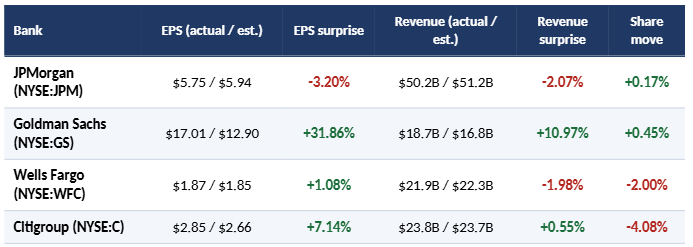
The pattern is not random. Wells Fargo's beat came with a revenue shortfall, Citi's with a guide for a fourth-quarter Markets decline of about 20% or more, and JPMorgan's miss with a higher net interest income outlook. Goldman's beat was so large that a flat reaction may say more about expectations than results.
Intraday swings were larger than the net moves. Goldman peaked about 4% above Monday's close before fading, and JPMorgan, down about 3% before the open, climbed about 3% above that close and drifted back to flat. Investors appear to have paid for the forecast rather than the report.
JPMorgan Chase (NYSE:JPM): A Rare Miss, Cushioned by Guidance
JPMorgan reported earnings of $5.57 a share, or $5.75 excluding a $658 million securities loss, against consensus estimates of $5.85 to $5.94. It is the first miss since the fourth quarter of 2023, market data show. Expenses rose 12%. Equities revenue rose 49% while fixed income fell 4%, and investment banking fees rose 14% year on year but fell 8% from the second quarter. Finance chief Jeremy Barnum said the slowdown began in the second half of September and expects deals to be delayed rather than canceled.
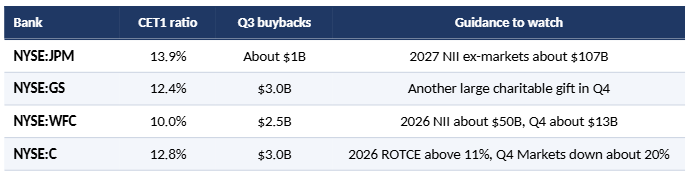
The offset was the outlook. JPMorgan lifted its 2026 net interest income forecast to about $106.2 billion and gave a 2027 central case, excluding markets, of about $107 billion. Jamie Dimon said buybacks, which an analyst put at about $1 billion against a normal $7 billion, rank behind organic deployment of roughly $30 billion of excess capital. He also said the bank is tightening credit terms and, unlike Barnum's base case of a normal seasonal decline in trading, suggested the fourth quarter may differ.
Goldman Sachs (NYSE:GS): A Blowout With Two Asterisks
Goldman posted net revenues of $18.7 billion, up 23% and the second highest in its history, and earnings of $17.01 a share against $12.90 expected. Equities revenue rose 72% to $6.44 billion, with financing up 96% to a record, while fixed income edged down 1%. Advisory revenue hit a record $1.7 billion, though investment banking fees of $3.22 billion fell 5% from the second quarter.
Two asterisks apply. An accelerated charitable contribution of about $450 million cost roughly $1 a share, with another meaningful gift due in the fourth quarter. And one analyst questioned how much of the industry's beats rest on equities trading, and how long that lasts. Chief executive David Solomon also addressed reports of a succession plan, saying no transition or timeline is under way.
Wells Fargo (NYSE:WFC): Loans Grew, Revenue and Margin Did Not Keep Up
Wells Fargo earned $1.87 a share, up 13% from a year ago and two cents ahead of consensus. Revenue of $21.87 billion missed the $22.31 billion estimate, and net interest income of $12.52 billion fell short of the $12.63 billion expected. Average loans and deposits each grew 11%, yet its taxable-equivalent net interest margin was 2.43% against 2.61% a year earlier. Markets revenue was 17% below the second quarter and short of the mid-single-digit growth management had flagged in September, as the sharp rise in rates in the final weeks cut client activity.
Credit and outlook were the positives. The net charge-off ratio of 38 basis points was lower than a year ago, though commercial charge-offs rose eight basis points from the second quarter to 18. Management guided to about $13 billion of net interest income in the fourth quarter and about $50 billion for 2026.
Citigroup (NYSE:C): A Good Quarter, a Cautious Fourth
Citigroup earned $2.85 a share against $2.66 expected, on revenue of $23.8 billion, up 8% and its best third quarter in a decade. Services and Wealth revenue each grew 15%, Banking and Markets 6%. Return on tangible common equity was 11.5%. Cards were the soft spot, with flat revenue and profit down 8%, according to news reports.
The shares appear to have fallen on what comes next. CFO Gonzalo Luchetti said Markets revenue should fall by about 20% in the fourth quarter, or possibly more, and that the arithmetic implies a fourth-quarter return in the high single digits, well below the 11.5% reported. Chief executive Jane Fraser told analysts not to read too much into it, but one pressed the point.
Equities Boomed, Deals Cooled
Clients repositioned around rates and energy prices, so equities desks had a bumper quarter, with revenue up 14% to 72% from a year earlier. Fixed income was flat or lower at JPMorgan and Goldman. Investment banking rose year on year everywhere but fell from the second quarter at all four, as a jump in yields in the final weeks of September stalled IPOs and left buyers and sellers disagreeing on valuations.
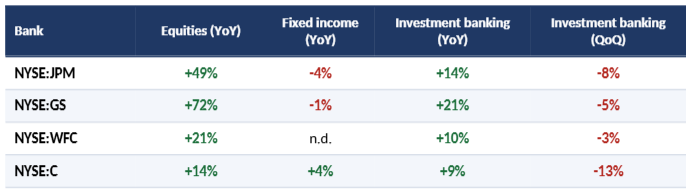
JPMorgan, Goldman and Citi called their pipelines strong, framing the slowdown as delay rather than cancellation. The fourth quarter will test that.
The Question on Every Call: What Does AI Do to Banks?
The first worry is deposits: could software agents shift cash to higher-yielding accounts? Charlie Scharf of Wells Fargo called the prospect of mass movement "completely overdone" for the foreseeable future, noting that customers keep money with banks for payments as well as yield. Dimon said JPMorgan will not let just any outside agent inside the bank, and Barnum said it blocks credential sharing. Citi's Fraser said she was not worried about deposit flight in Services.
The second worry is financing. Asked whether funding the data-center build-out could become the choke point, Solomon said he did not know, and that nobody does. Barnum called JPMorgan's exposure quite modest, but said no bank would be immune to a change in sentiment. Citi offered the upside case: AI savings already exceed its spending this year, with technology vendor spend down 30%.
Credit Is Calm, Capital Is Being Rationed
None of the four reported broad credit deterioration, and Citi and Wells Fargo said losses fell year on year. Yet both raised provisions, and the warnings were specific. Barnum said a long rate cycle designed to cool the economy would almost by definition raise unemployment and credit losses. Dimon said some credit terms have become a little loose. Santomassimo said higher rates mean lower commercial real estate valuations, "just math," though stress is too early to see, and Fraser flagged a coming three-year maturity wall.
On capital, the rules are the swing factor. Goldman hopes Basel III endgame and surcharge rules will be finalized by year-end, while Citi expects clarity only next year. Citi's requirement rises to 12.1% in January 2028 under current rules, and Wells Fargo estimates the proposal could cut its risk-weighted assets by about 7%.
What to Watch Next
Bank of America reports on Wednesday, and US consumer price data are due the same day. Three questions frame the fourth quarter. Will deals delayed in September return if yields stabilize? Will trading follow Citi's guided seasonal decline of about 20% or Dimon's hunch of a different pattern? And will final capital rules free up capacity or raise requirements?
The Bottom Line
The quarter showed healthy franchises, calm credit and an industry leaning unusually hard on one business at an unusually favorable moment. On Tuesday's evidence, the market was less interested in marking the quarter than in pricing the next one. Whether that caution proves justified will depend on rates, deal timing and capital rules, none of which the banks control.