Compass Group Wants to Trade in America. Here's What the Listing Switch Means for US Investors.
Compass Group has opened a shareholder consultation on moving its primary listing from London to the US by 2028. The case is strong, with three-quarters of profit earned in North America, but free cash flow, leverage and pricing-led growth deserve as much attention as the new ticker.

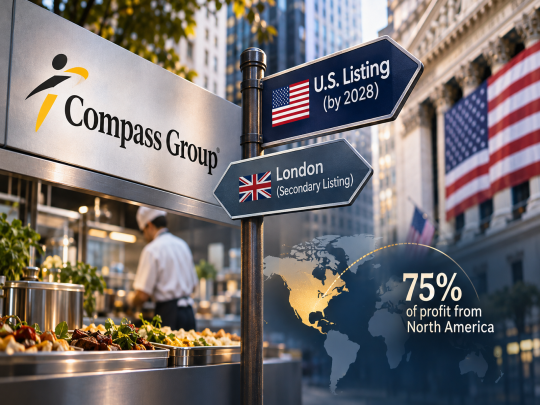
The world's largest caterer plans to move its primary listing from London to the US by 2028. Behind the move sits a business that is now three-quarters American, growing at nearly 8% a year, and spending more than it earns.
On Tuesday, Compass Group opened a shareholder consultation on shifting its primary stock market listing to the United States while keeping a secondary listing in the UK. If investors approve, the switch would happen in 2028.
The company's case is straightforward. North America generates 75% of underlying operating profit, employs around 325,000 of its 600,000-plus people and hosts its largest clients. Chair Ian Meakins said that as Compass has evolved, so has "the centre of gravity of the business."
But the announcement arrived alongside full-year results, and the results complicate the story. Compass is growing fast and profitably. It is also spending more than it generates, and winning new business more slowly than a US rival. A new ticker will not fix either. Here is what US investors should understand about the company behind the headline.
A British Company With an American Center of Gravity
Compass reports in dollars, and the numbers explain the board's thinking. Revenue for the year to September 30 reached $50.8 billion, up 10.4%. Underlying operating profit rose 12% to $3.75 billion, with the margin edging up 20 basis points to 7.4%.
North America supplied 67% of revenue but 75% of profit. The gap reflects margins: 8.3% in North America against 6.4% internationally.
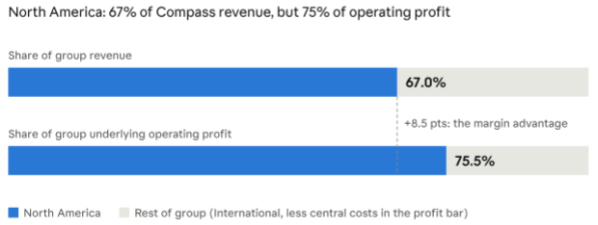
Source: Compass Group FY26 results announcement, regional review. North America: $34,067m of $50,848m revenue; $2,827m of $3,746m underlying operating profit.
International is no laggard. Revenue there rose 11.2% at constant currency and underlying operating profit climbed 15.2%, helped by acquisitions in the Netherlands and Germany. The company stresses it remains committed to the UK and its other overseas markets, and the plan to keep a secondary London listing sits alongside that pledge.
Still, North America's weight is the heart of the argument for relocating. Chief Executive Dominic Blakemore said the move "would better align our capital markets presence with our scale and geographic profile." The board also argues that a US primary listing would bring Compass closer to its biggest clients and open the world's deepest pool of capital.
US investors can already buy the stock, but only through over-the-counter lines. The company's shares trade on the OTCQX market under CMPGY and CMPGF, alongside the primary London listing under CPG. Many institutional funds cannot hold over-the-counter shares, and ordinary brokerage accounts often make them harder to trade. An exchange listing in the US would remove those frictions.
The Growth Engine: Sticky Contracts, Modest Volume
Compass runs contracts for corporate cafeterias, hospitals, universities, military sites and sports venues. Its pitch is that outsourcing food service saves clients money and hassle. The company puts the global food-services market at about $380 billion, estimates its own share at around 13%, and says almost three-quarters of the market is still self-operated or served by regional players.
Compass organizes its operations by sector, from defense and offshore sites to business and industry, healthcare and education, and says that specialization helps it win contracts. In North America, defense, offshore and remote, and business and industry both grew at double-digit rates. First-time outsourcing, where a client hands over a kitchen it previously ran itself, remains a significant share of new wins.
Fiscal 2026 organic revenue growth was 7.5%. The mix matters. Net new business, meaning contract wins minus losses, contributed 4.3 percentage points. Pricing added 2.6 points. Like-for-like volume, the number of meals actually served at existing sites, added just 0.6.
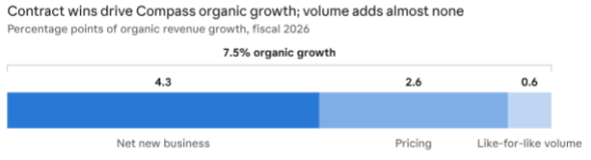
Source: Compass Group FY26 results announcement. Net new business 4.3 + pricing 2.6 + like-for-like volume 0.6 = 7.5% organic revenue growth.
Client retention was 96%, and new business wins totaled $4.4 billion, up 16%. Growth also accelerated through the year: second-half organic growth was 7.8%, with net new business at 4.7%. For fiscal 2027, management guides to organic growth of around 7% and high single-digit profit growth.
The caution for investors is the pricing component. It is large relative to volume, which means part of the growth depends on clients accepting price increases.
Spending Ahead of Cash
The less comfortable story sits in the cash flow. Underlying free cash flow was $2.02 billion, up 2.3%. Against that, Compass spent roughly $2.46 billion on acquisitions, net, including $1.6 billion on Vermaat, a premium food-services business in the Netherlands, and paid $1.16 billion in dividends.
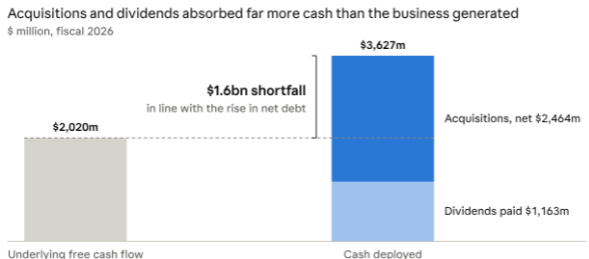
Source: Compass Group FY26 results announcement. Net cash spent on acquisitions and disposals $2,464m; dividends paid $1,163m; underlying free cash flow $2,020m. Net debt rose $1.6bn to $8.0bn.
The result: net debt rose $1.6 billion to $8.0 billion. Leverage reached 1.5 times underlying earnings before interest, tax, depreciation and amortization (EBITDA), the top of the company's 1-to-1.5 target range, and management expects to stay at the top end next year. Cash conversion slipped to 79.7% from 87.8%, and return on capital employed fell to 16.9% from 18.2%. The company attributes the drop in returns to acquisitions.
None of this looks alarming on the balance sheet. Compass holds strong investment-grade credit ratings (A from S&P, A2 from Moody's), its debt covenant leverage ratio was 1.3 against a 3.5 limit, and interest cover was 18 times. The point is not distress. It is that the cushion for further large deals has thinned.
Management's answer is to slow down. With its European build-out largely complete, acquisition spending should moderate, and the company is resuming buybacks of up to $1.5 billion over two years. The annual dividend rose 12% to 74.0 cents.
A back-of-the-envelope check shows how tight this is. Dividends at the new rate plus half of the buyback program come to about $2 billion a year, almost exactly this year's free cash flow. The plan works only if the acquisition pause is real.
The Valuation Question
Here the listing story meets the market's verdict. Compass has long commanded a premium to rivals such as Sodexo, and the question for the next few years is how much of that premium is still justified. Consensus-based data from MarketScreener puts its price-to-earnings multiple at about 22 times for fiscal 2026 and about 20 times for fiscal 2027, a modest rerating as earnings grow.
The growth comparison with its closest US rival gives one reason. Aramark's own fiscal 2026 results, reported on November 16, showed organic revenue up 10% and net new business equal to 6.8% of prior-year revenue. Compass's comparable figures were 7.5% and 4.3%. The two companies may define net new business slightly differently, so treat the gap as indicative, not exact. Risks worth weighing include tougher competition in North America and the possibility that changes in office work, including the spread of artificial intelligence, could soften demand for white-collar catering.
Would a US listing help? Its supporters say a larger pool of buyers and a US peer group could narrow any valuation gap with American rivals. Skeptics would point out that the board itself frames the move as aligning with the business, not as a valuation fix, and that earnings drive multiples over time. Compass is also following others out of London. Flutter and CRH have already moved their primary listings to the US, and equipment rental group Ashtead has announced plans to follow. For British boards, the argument increasingly reads the same way: the biggest pool of investors and the most valuable peer group sit in America, even for companies that have done little wrong at home.
What Changes for US Retail Investors, and What Doesn't
Nothing changes yet. The board will consult shareholders over the coming weeks before deciding whether to seek formal approval at a general meeting, and the transition is not expected until 2028.
Several important details are still unknown. The company's statement refers to a US primary listing, and press reports point to New York, but the announcement does not name an exchange. Nor has it said what reporting standards, filing regime or index implications would follow. Index inclusion is not automatic. It depends on each provider's own eligibility rules, including domicile.
One practical point for current holders: the final dividend of 48.5 cents goes ex-dividend on January 7. Dividends are paid in sterling by default, with an option to elect dollars by February 1.
What to Watch
-
Shareholder consultation: whether the board proceeds to a formal vote, and what listing venue and structure it proposes.
-
February 2 trading update: whether net new business holds near the second-half pace of 4.7%.
-
Leverage: whether net debt to EBITDA stays within 1.5 times as the buyback begins.
-
Volume versus price: whether like-for-like volume growth improves from 0.6%.
-
May 12 half-year results: the first read on whether acquisition spending has really slowed.