Dell's Borrowed Rally: A Lift From AI, a Test From Earnings
Dell's shares rose more than 20% on Monday without any news from the company, after Nvidia brought Jensen Huang back as chief executive. The jump shows how closely Dell now trades with the wider AI trade. Tuesday's earnings will show how much of its price reflects its own business.

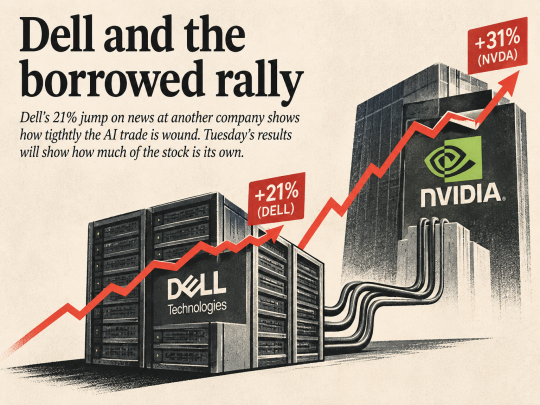
Monday's surge in the server-maker's shares owed little to Dell. Tuesday's results will show how much of its price is its own
For a company with nothing to say, Dell Technologies (NYSE:DELL) had a remarkable Monday. The server-maker published no results, issued no guidance and launched no product. Yet its shares closed more than 20% higher. The news came from Santa Clara, where Nvidia (NASDAQ:NVDA) reinstated Jensen Huang as chief executive 11 days after he had resigned. Nvidia's shares rose by 31%. The S&P 500 gained 4.7% and the Nasdaq 6.5%, their best days since April 2025.
Set against the slump that preceded it, the rebound looks modest. Dell's shares closed at a 12-month high of $588.40 on September 17th. By Friday they had lost more than half their value, and most of the damage was done before Mr Huang quit. Even after Monday they sit more than 40% below their peak. On Tuesday, after the American market closes, Dell reports results for the third quarter of its financial year. They will help settle an awkward question: how much of the company's share price is about the company?
One Factor, Many Tickers
This month Dell's shares have moved by 7% or more on at least six trading days. They fell by 14.9% on November 5th in a broad sell-off, rose by 11.8% on the 11th after CoreWeave's results eased fears about AI spending, and dropped by 7.2% and 7.0% on the 13th and 16th as turmoil at Nvidia spread. They lost about 11% last Friday and gained 20% on Monday. Not one of those days brought results or guidance from Dell. The stock has become a gauge of sentiment about AI, and Nvidia's boardroom is merely the latest thing to move the needle.
It moved it a long way. Mr Huang quit on November 12th amid questions about his private life and their bearing on national security. Strong numbers did not steady Nvidia's stock. On November 17th the firm reported record quarterly revenue of $115.8bn, ahead of forecasts, and its board said in the same breath that it did not intend to bring him back. By Friday the shares had fallen to $125.53. When the board relented, saying it was satisfied with his candour and that his return posed no national-security risk, the stock regained in one session nearly everything it had lost since his exit.
The rest of the complex followed. CoreWeave (NASDAQ:CRWV), which rents out computing capacity, gained 22%. Micron (NASDAQ:MU), Seagate (NASDAQ:STX), Western Digital (NASDAQ:WDC) and Sandisk (NASDAQ:SNDK), which make memory and storage, all rose by double digits. These firms sell different things to different customers at very different margins. Hendi Susanto of Gabelli Funds told CNBC that Mr Huang's return "restores and rebuilds confidence in the AI ecosystem". That describes a common factor, not any one company's prospects.
The tide did not lift every boat equally. The chart shows how much of each stock's fall from its 52-week high Monday repaired.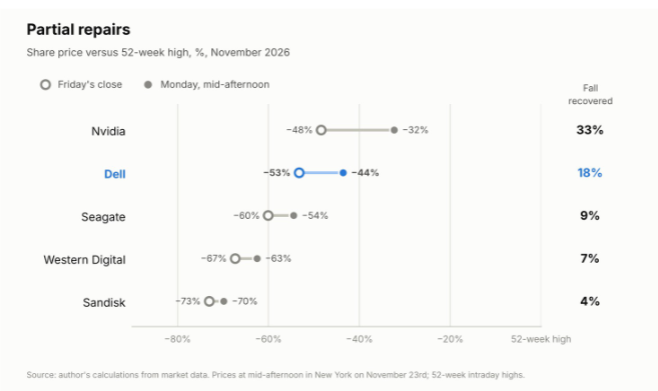
Nvidia, the source of the news, regained a third of its fall. Dell came second at 18%, about twice the recovery of any storage-maker. Dell opened more than 35% above Friday's close before settling near 20%. Seagate and Sandisk also faded from their opening highs, while Nvidia held almost all of its gain. Investors bought the original with conviction and the derivatives with hesitation.
Why, though, should a firm that assembles other people's chips trade like the company that designs them?
The Middleman's Margin
The answer lies in the bill of materials. Dell's AI business is one of integration. It buys accelerators, chiefly Nvidia's, wraps them in servers, networking and cooling, then ships and services the result. That makes Nvidia the price-setter for the scarcest input and Dell the claimant on what is left. Dell's gross margin last quarter was 21%; Nvidia's, in its latest quarter, was 74.9%. Anything that unsettles Nvidia unsettles the supply on which Dell's AI business rests.
The squeeze comes from below, too. Seagate's quarterly revenue rose by 61% and Western Digital's by 55%: component-makers are collecting the rents of scarcity, and Dell pays them. Its executives say memory is the tightest constraint, DRAM above all. An assembler survives such a squeeze by passing costs on, and Jeff Clarke, Dell's chief operating officer, told analysts last quarter that part of the growth in server revenue reflects price rises. Dell is thus a high-grade proxy: it shares Nvidia's fortunes, and now its governance risk, without owning any of its margin.
The Other Two-Thirds
It is not merely a proxy, however. Of $47bn in revenue last quarter, AI servers brought in $16.4bn, or 35%. The rest came from conventional servers and networking ($10.5bn, up 122%), storage ($4.9bn) and personal computers ($15bn).
Management says conventional-server growth comes mostly from customers replacing ageing machines. Pressed on whether price rises and pre-buying were flattering the figures, executives conceded that inflation is part of the story. Even so, roughly two-thirds of Dell's sales have little to do with who runs Nvidia. A share price that moves in lockstep with the AI trade is pricing only a third of the business.
What Tuesday Must Prove
The bar is high. Dell has guided to revenue of $49bn, $19bn of it from AI servers, and earnings of $6.50 a share; analysts expect about $6.60. Last quarter it guided to $44bn-45bn and $4.80, then delivered $47bn and $7.04. Options prices, according to Benzinga Pro, imply a move of about 13% in either direction.
Three numbers matter more than the headline. The first is margin. Earnings are guided below last quarter's although revenue is meant to rise, and the margin on PCs is expected to slip to about 6% from 7.6%. The second is conversion. A backlog of $95bn equals five to six quarters of AI revenue at the current pace, but it is worth only what component supply and customers' financing allow. The third is the full-year outlook of $192bn and $25.50 a share. A raise would signal that demand still outruns supply; a hold would invite doubt.
Whose Rally Is It?
Analysts were wary before Monday. On November 16th Morgan Stanley cut its price target for Dell to $403 from $511, and Citigroup to $550 from $600, though both kept their ratings. Dell itself bought back 9.5m shares last quarter at an average of $401, almost 20% above where the stock now trades.
Monday's gain is also fragile in ways Dell cannot control. Mr Huang has agreed to appear before House committees on December 1st, and the chairman of the Senate Banking Committee has asked him to testify in public on December 3rd. Questions about Nvidia's chips, national security and governance will arrive within days of Dell's results, and would reach Dell by the same route as Monday's cheer. Confidence borrowed from another firm is lent on that firm's terms.
The test is simple. If good numbers cannot hold Monday's gain, the market was pricing the AI trade, not Dell. If they can, Dell will have started to be valued on its own earnings: a harder standard, but a more durable one.