Meet the Gemini Agent: Google Cloud's Bid for the Enterprise Workday
Google Cloud has launched the Gemini agent, a single AI agent for knowledge work, media and code. We look at how it works, who is already using it and how it compares with rival agents from OpenAI and Meta.

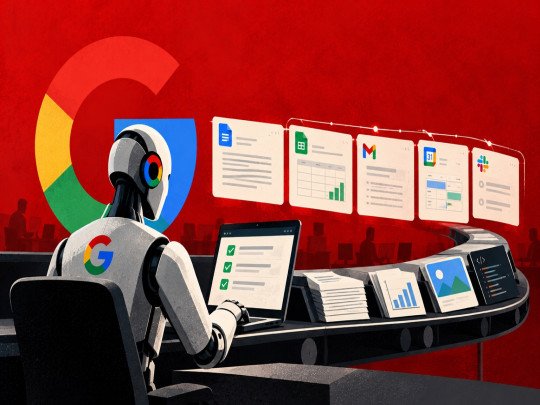
Key Highlights
- Google Cloud has launched the Gemini agent, a single system for knowledge work, media creation and code.
- The agent runs inside Workspace and can also be reached through Microsoft 365 and Slack.
- Identity controls, audit trails and spend caps anchor Google's pitch to corporate buyers.
- Banks, telecoms and retailers are already reporting efficiency gains from Gemini Enterprise.
- OpenAI and Meta have launched rival agents within weeks, sharpening competition for enterprise budgets.
Why This Launch Matters
Google Cloud has introduced the Gemini agent, an AI system built to do work, not just answer questions. Give it a goal, such as drafting a report or building a financial model, and it plans the steps, uses a company's own tools and hands back the finished result.
"Work now starts in the prompt window," said Thomas Kurian, chief executive of Google Cloud. He has numbers to back the claim: almost nine in ten Fortune 100 companies already use Gemini Enterprise.
The stakes are commercial. Software is sold per seat, but an agent that finishes tasks competes for labour budgets, which are far larger. That is why Alphabet (NASDAQ: GOOGL) and its rivals are racing to define the category.
What the Gemini Agent Does
The agent takes an objective, plans the steps, draws on a company's tools and returns a finished product. One interface covers questions, document work, image and media creation, and code. Users can assign work, schedule it or have the agent respond to events.
Four Design Choices That Matter
Persistence. The agent lives in the cloud, so a task begun on a phone can run overnight and be reviewed on a laptop.
Delegation. It can spawn short-lived helpers for parts of a job, or be set up as a standing team member with a defined role, its own mailbox and a restricted view of company data.
Placement. It sits inside Gmail, Docs, Sheets and Calendar, with access through Microsoft (NASDAQ: MSFT) 365 and Slack. Meeting staff in tools they already open each morning lowers the cost of adoption.
Model neutrality. Each task goes to a suitable model, drawing on Google's Gemini family and Anthropic's Claude for now, with more planned. Hosting a competitor's models suggests Google sees orchestration, not the model, as the lasting asset.
Governance and Cost: The Real Pitch
Where rivals advertise what their agents can do, Google dwells on what its agent cannot do. Kurian framed governance around four questions: who the agent is, what it may do, what it did, and what it must never touch. Each agent carries a verifiable identity, bounded permissions and an audit trail, and traffic passes through a gateway that enforces company policy in one place.
Cost control gets equal billing. Routing tools send simple jobs to cheaper models, and a hard cap pauses an agent when a project hits its spending limit. For finance chiefs who watched pilot budgets balloon, a feature that stops the meter may persuade more than a benchmark.
Customers in the Field
Banking and financial services. BNP Paribas is rolling Gemini Enterprise out to more than 65,000 employees for work such as credit memos. Bradesco says document review fell from one hour to five minutes, and Commerzbank reports cutting document quality checks from 20 hours to one. DBS Bank runs chains of 70 to 80 specialised agents on corporate credit memos with humans kept in the loop. Starling says its scam-detection tool quadrupled the rate at which customers cancel suspect payments.
Telecoms and industry. Verizon (NYSE: VZ) uses the technology to resolve customer contacts and predict network faults. Nokia reports resolution times cut by up to 80 percent, and Tata Steel says complaint turnaround halved after deploying more than 300 agents in nine months.
Retail and commerce. PayPal (NASDAQ: PYPL) says model deployment fell from weeks to minutes. Home Depot (NYSE: HD) reports four-fold faster phone resolution, and Wesfarmers cites half a million hours of administrative work saved at Bunnings.
The pattern is telling. Early value clusters in document-heavy, rules-bound work, where inputs and outputs are clear.
How the Rivals Compare
The launch lands in a crowded fortnight. OpenAI has introduced always-on agents called dots, built to pursue goals across applications with little supervision. Meta (NASDAQ: META) has released Muse, a personal agent that can shop, arrange travel, send emails and make payments.
The contrast is strategic. Muse targets individuals and relies on trust in an agent that handles money. Dots stress continuous autonomy. Google targets the organisation, where buyers value audit trails and liability protection over novelty. Consumer reach can migrate into offices, and enterprise incumbency can protect revenue against flashier rivals, so neither route is assured.
Finance and Legal Lead the Verticals
Specialist editions for financial services and legal work are in preview, with government, healthcare and retail to follow. The financial version draws on established data providers and regulatory filings, and exposes methodology, confidence levels and data lineage so compliance teams can trace conclusions to their inputs. CME Group (NASDAQ: CME) and Deutsche Bank are named users. These sectors pair high labour costs with strict reporting duties, which makes a traceable answer worth more than a fast one.
Risks Worth Weighing
Four uncertainties deserve attention. Efficiency figures supplied by sellers are unaudited. An agent acting across email, files and code magnifies the effect of one configuration error. Financial regulators may question whether automated reasoning chains meet record-keeping rules. And a multi-model design that lowers switching costs for buyers may compress margins for suppliers, Google included.
Outlook
The Gemini agent is less a technical leap than a positional move, an effort to make Workspace the default place where delegated work happens. Outcomes will probably turn on measurable returns for early adopters, the reliability of the control layer under pressure, and how quickly consumer-first rivals adapt to corporate demands. A prolonged contest looks more probable than a decisive win, and spending discipline may matter as much as model quality.
Related post