NVIDIA's $820 Billion CEO Square Dance
Jensen Huang resigned, was rejected, got 180,000 people to sign a petition, had a sitting president call the board, and was reinstated eleven days later. The leather jacket is back.

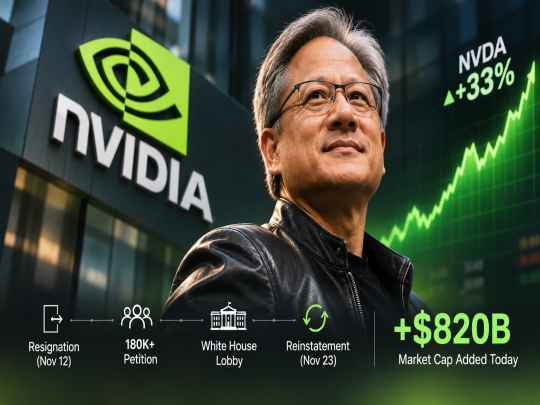

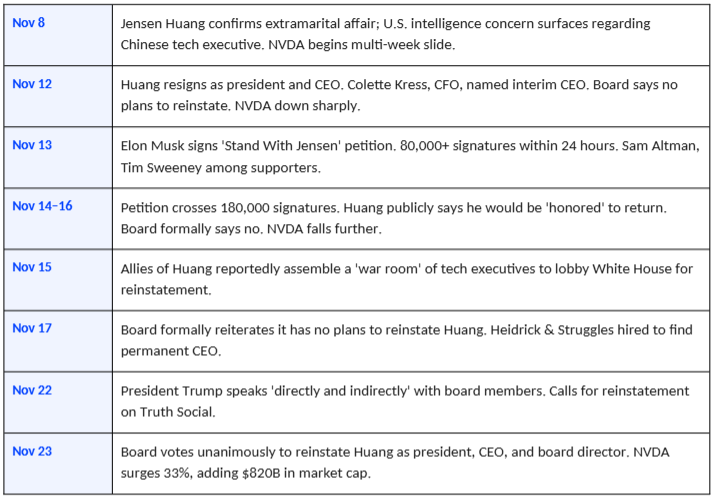
In the annals of corporate theater, few performances rival the eleven-day psychodrama that just played out at NVIDIA Corporation (NASDAQ: NVDA). There was a confession. A resignation. A stock wipeout measured in the hundreds of billions. A petition. A White House phone call. And, as of Monday morning, a reinstatement so complete (president, CEO, and board member, effective immediately) that you could be forgiven for wondering whether the whole thing was an elaborate stress test of the American financial system.
To recap, for anyone who spent the past fortnight mercifully offline: on November 8, Jensen Huang, the leather-jacket-clad co-founder who turned NVIDIA from a graphics card company into the defining infrastructure company of the artificial intelligence age, admitted to an extramarital affair. The relationship, with a Chinese technology executive whom U.S. intelligence reportedly believed to have ties to Beijing, was not, by any measure, a standard corporate-governance headache. Huang resigned on November 12. The world's most valuable chipmaker had just lost the person most responsible for making it the world's most valuable chipmaker.
“This will go down as the most costly mistake of the AI Revolution.”
Market commentary, November 12, on NVDA's initial decision to accept Huang's resignation
Wall Street, rarely given to understatement, did not understate. NVIDIA shares shed roughly 33% from the moment the affair became public, erasing what analysts described as the most consequential market-cap implosion tied to a single executive's personal conduct in a generation. One prominent market commentary widely followed across financial Twitter noted, on the very day of Huang's resignation, that the board had made a massive mistake and that there was no clear replacement for Jensen Huang. The same voice had estimated Huang's potential removal was approximately 80% priced into the stock, cold arithmetic suggesting the downside of keeping him was already baked in, while the upside of his return was essentially free.
Eleven Days That Rattled a Trillion-Dollar Company
The Reluctant Interim and the Willing Returnee
Through all of this, Colette Kress, NVIDIA's chief financial officer and a figure not usually associated with the kind of dramatic spotlight that tends to accompany global geopolitical soap operas, served as interim CEO. She reportedly confirmed to CNBC, shortly after Huang's exit, that the board had no plans to bring him back. It is fair to say that the board's plans changed. On Monday, the unanimous reinstatement announcement thanked Kress for her 'outstanding service as interim CEO.' She will continue, without ceremony and presumably with some relief, in her role as CFO.
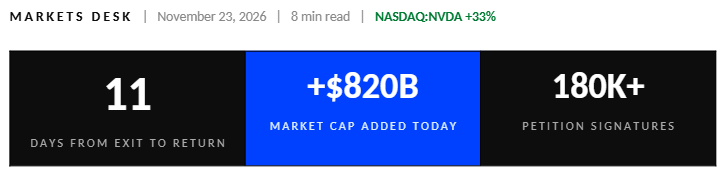
Huang's own path back had the structure of a comeback arc. He publicly stated he would return 'if the board allowed it.' A 'war room' of tech executives reportedly lobbied Washington. The petition (eventually carrying more than 180,000 names, including Elon Musk and Epic Games CEO Tim Sweeney) functioned as a kind of shareholder uprising conducted via the internet. And then President Donald Trump, who described Huang as a 'genius' and said the country 'needs Jensen's leadership at NVIDIA,' spoke directly with board members in the days preceding Monday's announcement. Beijing, Trump mused publicly, would have loved nothing more than to see Huang sidelined.
“We have to protect our geniuses.”
President Donald Trump, CNBC, November 23, 2026
The Market's Verdict Was Unambiguous
If you wanted a single data point to illustrate how thoroughly Jensen Huang's identity had become intertwined with NVIDIA's market value, Monday morning provided it. The moment the board's statement hit wires (that Huang was reinstated as president, CEO, and board director, effective immediately), NVDA shares surged more than 33%, adding approximately $820 billion in market capitalization in a single session. The stock had fallen roughly 40% from its peak since the scandal broke, suggesting that markets had spent two weeks pricing in a worst case. The worst case, it turned out, was not a permanent one.
To understand why NVIDIA without Jensen Huang was so terrifying to investors, consider what NVIDIA with him had become. The company had guided revenues of approximately $750 billion for fiscal year 2028. Its Blackwell GPU architecture had become the essential plumbing of the global AI buildout. No credible successor had been identified. The executive search firm Heidrick & Struggles, retained to find a permanent CEO, had barely had time to open their files. The gap between 'NVIDIA with Jensen Huang' and 'NVIDIA in search of Jensen Huang' was, in market terms, measured in the hundreds of billions of dollars.
The Investigation Continues. The Jacket Is Back.
It would be tidy to report that everything has been resolved. It has not. NVIDIA's internal investigation into the circumstances surrounding Huang's relationships is ongoing. A newly created compliance position is being established. Huang is expected to testify before congressional committees. The board, in its reinstatement statement, was careful to note that it had received 'input from senior levels of the United States government' regarding national security, and cited Huang's 'candor' in a series of meetings as the basis for restoring confidence in his leadership. The U.S. Attorney General weighed in to confirm Huang's return poses no security risk.
What NVIDIA's board has effectively concluded (unanimously, apparently after near-daily reversals) is that the company and Jensen Huang are, for the purposes of this industrial revolution in artificial intelligence, essentially the same entity. That is either a profound statement about irreplaceable leadership or a governance problem that will be studied in business schools for decades, depending entirely on how the next chapter unfolds.
“I am honored to return to NVIDIA and lead one of the most consequential technology companies in the world at the beginning of a new industrial revolution.”
Jensen Huang, reinstatement statement, November 23, 2026
Huang's own statement on his return was characteristically precise in its grandiosity. 'I take this responsibility with the greatest humility and renewed commitment,' he said, managing in a single sentence to invoke both contrition and destiny, a trick that, if nothing else, confirms that the man understands a press release.
The leather jacket, it appears, was never actually leaving. The question now is whether the board that just spent eleven days learning that lesson has any intention of remembering it. NVIDIA Corporation (NASDAQ: NVDA) added approximately $820 billion in market capitalization on Monday. The market's verdict, as usual, was blunt: on the question of whether NVIDIA is worth more with Jensen Huang than without him, the data were conclusive. The board, eventually, agreed.