Vera Rubin: The Chip Carrying Nvidia Through Its Messiest Quarter
Nvidia’s Vera Rubin platform added nearly $20 billion in quarterly revenue, drove $115.8 billion in sales and lifted guidance to $130 billion. Here is what the CPU-GPU system is, how it works, and the risks retail investors should weigh amid a CEO exit and new China curbs.

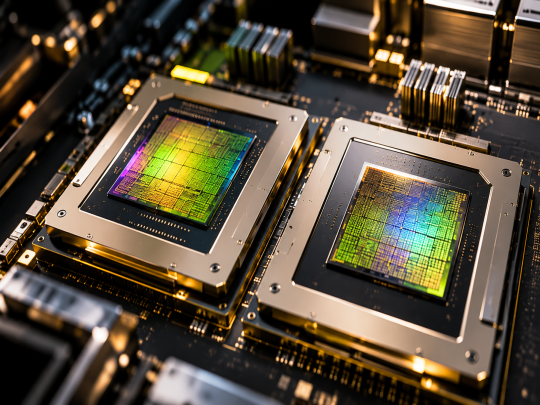
The AI accelerator behind Nvidia's blockbuster October quarter is a platform, not a product. Here is what retail investors actually need to know.
Nvidia (NASDAQ:NVDA) delivered the kind of quarter that would normally dominate headlines for a week. Revenue hit $115.8 billion for the three months to October, up 103% from a year earlier, with adjusted earnings of $2.68 a share, both comfortably ahead of Wall Street. Management guided the current quarter to roughly $130 billion, above the $125 billion analysts had pencilled in.
Yet the numbers arrived wrapped in noise: the abrupt exit of co-founder Jensen Huang as chief executive, finance chief Colette Kress stepping in as interim CEO, a stock down roughly a quarter on the month, and fresh U.S. restrictions on selling into China. Through all of it, one name kept surfacing on the earnings deck and the call: Vera Rubin. It is the product doing the heavy lifting, and the one investors are now trying to understand.
What Vera Rubin actually is
Vera Rubin is Nvidia's newest generation of data-center AI hardware, the successor to the Blackwell line that powered the past two years of growth. The confusing part for newcomers is that it is not a single chip. It is a platform, a tightly integrated system of silicon that Nvidia sells as one unit.
The name itself is a clue. "Vera" is Nvidia's custom Arm-based central processor (CPU); "Rubin" is the graphics processor (GPU) that does the AI math. Bolted together they form the Vera Rubin "superchip," the same way the prior generation paired a Grace CPU with a Blackwell GPU. The architecture is named after Vera Florence Cooper Rubin, the American astronomer whose work provided key evidence for dark matter.
The flagship configuration, the Vera Rubin NVL72, packs 72 Rubin GPUs and 36 Vera CPUs into a single liquid-cooled rack that behaves like one giant computer. Nvidia pitches it as the engine for "agentic AI," systems that don't just answer a prompt but run long, multi-step chains of reasoning, retrieval and tool use. The company says the platform delivers roughly 10 times the agent throughput of the previous Grace Blackwell generation.
Why it matters to the quarter
Three figures from the earnings deck tell the story.
First, Vera Rubin added nearly $20 billion in revenue quarter-on-quarter, a single product line contributing a sum larger than most semiconductor companies earn in a year.
Second, Nvidia called it the fastest product ramp in its history, with demand spread across both hyperscale cloud customers and a broader "AI clouds, industrial and enterprise" segment that grew to $47.5 billion.
Third, in its competitive debut on MLPerf, an industry-standard training benchmark, the Vera Rubin NVL72 delivered up to twice the performance per GPU of Blackwell Ultra, the chip it replaces. That is the kind of generational jump that keeps customers buying rather than waiting.
In plain terms: Vera Rubin is the reason the guidance is going up at a company this size, and the reason gross margins held near 75% even as spending climbed.
The specs, translated
The engineering details matter because they explain the economics. Each Rubin GPU carries 288GB of HBM4 memory, the fast, expensive memory stacked next to the processor, running at up to 22 terabytes per second, built from 336 billion transistors on TSMC's 3-nanometer process. (Note that Nvidia has quietly revised some of these headline numbers as production hardware shipped, a normal part of any ramp.)
For an investor, the takeaway is simpler than the acronyms. More on-chip memory and bandwidth means a single rack can serve larger AI models to more users at once, which lowers the cost per answer. Nvidia's pitch to cloud customers is that each generation roughly doubles to triples performance per dollar, which is precisely what lets those customers justify spending tens of billions on the next wave of chips.
Vera Rubin is already in full production and shipping, with early systems running at major clouds including Microsoft Azure, Google Cloud, Oracle, CoreWeave and others.
The roadmap behind it
Vera Rubin is one beat in a deliberately relentless cadence. Nvidia now ships a new data-center architecture roughly every year: Hopper, then Blackwell, then Blackwell Ultra, now Rubin. An enhanced Rubin Ultra is slated for the second half of 2027, followed by a generation named after physicist Richard Feynman around 2028. The strategy is to stay far enough ahead that no rival, or customer's in-house chip, catches up.
The risks retail investors shouldn't ignore
The Vera Rubin story is strong, but it sits on an unusually shaky backdrop. The leadership transition removes the founder most associated with Nvidia's vision just as execution matters most. Washington's move to curb Nvidia's China business puts a slice of future revenue in question. And the broader market debate, whether AI infrastructure spending is a durable build-out or a bubble, hangs over every forecast, however good this quarter's numbers look. A product ramp is only as valuable as the customers who keep funding it.
Bottom line
Strip away the drama and Vera Rubin is doing exactly what Nvidia needs: ramping faster than anything before it, carrying guidance higher, and defending the margins that make the company extraordinary. For retail investors, the chip is the bull case in physical form. The open question is no longer whether the technology sells, it plainly does, but whether a leaderless-at-the-top Nvidia, boxed out of China, can keep the machine running at this speed.
.png)