Wall Street Wrap: Pre-Market, October 19, 2026
U.S. stock futures point to a higher, tech-led open Monday as AI-linked chip and cloud stocks rebound from last week's selloff, led by a Goldman Sachs upgrade of CoreWeave and a JPMorgan upgrade of Intel. Disc Medicine soars on a pivotal trial win while Cleveland-Cliffs and Veradermics jump on earnings and trial data of their own. Anthropic pledges 5% of its shares to a new public benefit fund ahead of a planned IPO, French bond yields hit multi-decade highs amid violent protests, and Indonesian stocks plunge to a six-year low on an MSCI downgrade threat.


Disc Medicine soars on a pivotal trial win as chip and AI names rebound, while French bond yields hit multi-decade highs and Indonesian stocks plunge to a six-year low
Wall Street looks set for a tech-led higher open Monday as AI-linked chip and cloud names rebound from last week's selloff, even as French political turmoil rattles European bonds and a historic U.S. debt milestone keeps yields in focus.
Futures Snapshot

Futures rebounded broadly after last week's selloff, led by the Nasdaq, even as the VIX also rose.
What's Driving the Open
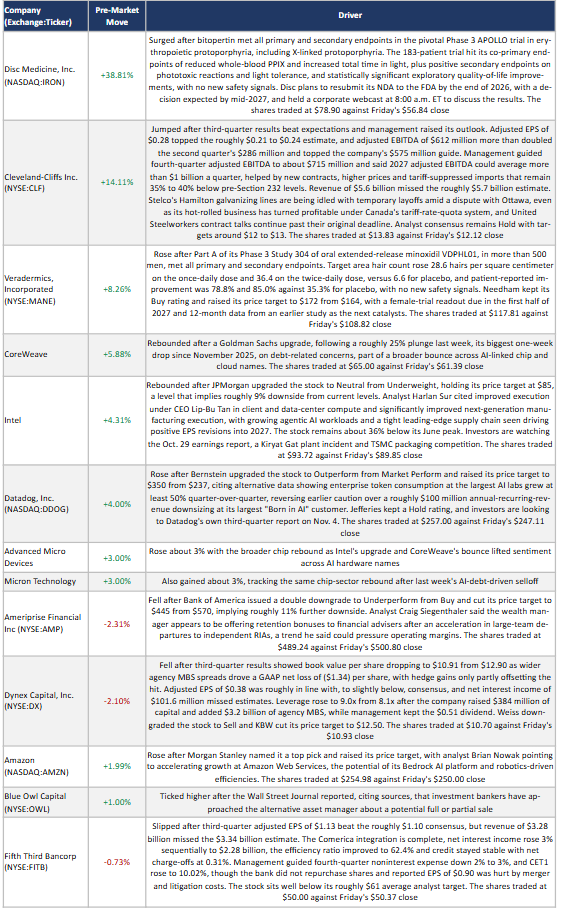
Nasdaq-100 futures led the rebound Monday, adding 1.23% after the Nasdaq Composite tumbled 4.5% last week, its worst week since June and an end to a four-week winning streak; the S&P 500 lost nearly 2% over the same span, its biggest weekly decline since late June. The bounce was led by chip and AI-linked names: Intel (NASDAQ:INTC) gained after a JPMorgan upgrade, CoreWeave (NASDAQ:CRWV) rose after a Goldman Sachs upgrade following last week's roughly 25% plunge, and Advanced Micro Devices (NASDAQ:AMD) and Micron Technology (NASDAQ:MU) each added about 3%.
Worries about AI financing persist beneath the rebound. Anthropic told investors its third-quarter revenue reached $16.8 billion, up from $11.6 billion in the second quarter, but some traders still question whether growth justifies recent gains in chipmakers. Goldman Sachs traders described AI credit spreads and hyperscalers as being at their widest levels of the year, with pessimism rising and options traders buying the second-highest volume of puts this year on Friday, behind only June. CoreWeave's bond yields remain near 15% even as its shares bounce Monday.
Treasury yields were little changed to modestly firmer to start the week, with the 10-year near 5.10%, as a JPMorgan strategist argued that stabilizing yields would support equities by easing pressure on AI funding and consumer finances. Oil held close to a four-week high but slipped Monday, with Brent near $108 and WTI near $101, as attacks on tankers in the Persian Gulf and Russia-Ukraine strikes on energy infrastructure kept a geopolitical premium in place. The CME FedWatch tool shows an above-85% probability the Fed holds rates at its Oct. 28 meeting.
What could change the picture: A fresh leg of AI-credit stress would revive the tech selloff, an escalation of Gulf tanker attacks could push Brent toward the $120 level Goldman Sachs has flagged, and a deeper rout in French bonds could spill into broader European risk appetite.
Overnight Markets
Asia closed mostly higher. South Korea's Kospi rose 1.76% to 5,768.01 and the Kosdaq added 1.78% to 808.89. Australia's S&P/ASX 200 gained 0.44% to 8,845.70. Japan's Nikkei 225 bucked the trend, closing 0.62% lower at 64,916.70, while the Topix was flat at 4,067.48. Mainland China's CSI 300 was little changed at 4,174.53, a session helped by data showing the economy grew 4.5% year-on-year in the third quarter, above the 4.4% expected, with retail sales up 1.1% in September from 0.4% in August. Bank of Japan Governor Kazuo Ueda said underlying inflation is quite close to the central bank's 2% target, signaling scope for further rate increases at its two-day policy meeting concluding Oct. 30. Indonesia's Jakarta Composite plunged more than 5% to its lowest level since early October 2020 after MSCI proposed reclassifying the country from emerging-market to standalone status, a move Goldman Sachs warned could trigger about $5.6 billion in passive fund outflows.
In Europe, the Stoxx 600 fell 0.82% and France's CAC 40 led losses, down 1.34%, as nationwide protests over living costs and political paralysis turned violent over the weekend and pushed French bond yields toward multi-decade highs. The U.K.'s FTSE 100 dipped 0.94% and Germany's DAX lost 1.1%.
Pre-Market Movers
Rates, FX & Crypto
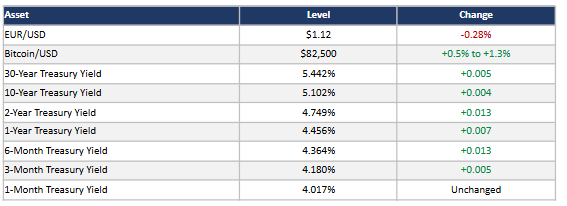
Treasury yield changes are in percentage points.
Treasury yields were little changed to modestly firmer across most of the curve to start the week, even as other commentary in today's batch described yields as pulling back; the 10-year sits near 5.10%, still below the roughly 5.3% peak hit earlier this month. The dollar index held near 101.85 after last week's 0.4% decline, with the euro slipping as French political and bond-market stress weighed on the single currency. Bitcoin rose roughly 0.5% to 1.3% to around $82,500, supported by China's stronger-than-expected GDP print and softer oil, though resistance near $82,875 and October ETF outflows of about $617 million point to a fragile move.
Commodities

Oil eased after last week's surge to a four-week high, with Gulf crude flows falling to about 8.5 million barrels a day from more than 20 million as tankers were attacked near Hormuz and Saudi Arabia. Goldman Sachs sees Brent reaching $120 if attacks escalate, while DBS expects a $100 to $110 range into the midterms. Trump's waiver of tariffs and sanctions on Russian energy, meant to support Ukraine peace talks, raised hopes of more Russian fuel reaching the market, though U.S. lawmakers have introduced legislation to block the purchases. Gold and gasoline slipped while silver and natural gas gained.
Key Levels & Catalysts Today
Economic data
- China's economy grew 4.5% year-on-year in the third quarter, beating the 4.4% expected, with retail sales up 1.1% in September from 0.4% in August.
- Housing starts and new building permits data for September are due Tuesday from the Census Bureau.
- The Fed's next rate decision is due Oct. 28, with the CME FedWatch tool showing an above-85% probability of no change.
Corporate
- Albertsons (NYSE:ACI) begins a two-week bench trial against Kroger (NYSE:KR) today in Delaware's Court of Chancery, seeking more than $8 billion in damages over their collapsed 2022 merger.
- JPMorgan Chase (NYSE:JPM) said it has invested $5 billion in equity in industries tied to U.S. economic and national security, and has financed about $230 billion under its Security and Resiliency Initiative over the past year.
- Netflix (NASDAQ:NFLX) and General Motors (NYSE:GM) report earnings Tuesday, followed by Tesla (NASDAQ:TSLA), Meta Platforms (NASDAQ:META) and IBM (NYSE:IBM) on Wednesday.
Top Stories
Anthropic pledges 5% of its shares to a new public benefit fund ahead of a planned IPO. The AI company said Sunday it will commit 5% of its shares to a public benefit fund, subject to shareholder approval, with its board able to add another 2% for every 50% increase in Anthropic's valuation above an undisclosed baseline. Anthropic said it has already committed $200 million to study AI's effects but that bolder approaches may be needed, and the fund could support large donations or direct distributions to populations affected by AI-driven job displacement; an August Pew survey found 71% of U.S. adults expect AI to reduce jobs over the next two years. The fund will be structured as an LLC rather than a tax-exempt nonprofit, with no lobbying or political giving. Anthropic told investors its third-quarter revenue reached $16.8 billion, up from $11.6 billion in the second quarter, ahead of a planned initial public offering reportedly slated for November that could value the company near $2 trillion. Tesla and SpaceX CEO Elon Musk said on social media he would rather see the shares given directly to the public.
French political and fiscal turmoil pushes bond yields to multi-decade highs. France's 10-year bond yield jumped more than 10 basis points to its highest level since 2002, with the 2-year up 6 basis points and the 30-year up 8 basis points, as violent weekend protests over living costs and political paralysis spread from Paris to Lyon and Marseille, prompting more than 2,000 arrests and an emergency cabinet meeting. The CAC 40 dropped 1.34% in a session led lower by banks, and the so-called OAT-Bund spread, the premium France pays over Germany, widened toward its highest level since the European sovereign debt crisis. Overseas investors now hold nearly 60% of French debt, up from about 48% in early 2022. "It looks like either the bond markets riot, or the people riot, or both," said Mike Bell of RBC BlueBay Asset Management, who called the situation a very real risk of a French sovereign debt crisis. Goldman Sachs strategists said taxes could rise for French businesses as the minority government of Prime Minister Sebastien Lecornu negotiates a 2027 budget, with far-right leader Marine Le Pen topping polls ahead of next year's presidential election.
Indonesia's stock market plunges to a six-year low on an MSCI downgrade threat. The Jakarta Composite Index tumbled more than 5% Monday to its lowest level since early October 2020 after MSCI proposed reclassifying Indonesia directly from emerging-market to standalone status, a move that could remove the country from major global equity benchmarks. MSCI is expected to make a final decision by June, contingent on whether Indonesian authorities show meaningful improvement in market governance and transparency. Goldman Sachs warned a full removal could trigger about $5.6 billion in passive fund outflows, equivalent to 18 days of average trading volume for constituents of the MSCI Indonesia Investable Market Index.
U.S. government debt hits $40 trillion, stoking a fiscal debate ahead of the midterms. U.S. government debt reached the milestone in August, and the Treasury reported a roughly $2 trillion deficit for the fiscal year ended Sept. 30, 12% larger than the prior year and the third-largest on record, with debt-service costs hitting a record $1.36 trillion. The debt-to-GDP ratio is near 100%, a level last seen financing World War Two, though analysts say world bond markets are not yet pricing a troubling rise in the premium investors demand to hold U.S. debt. Rising yields are pushing up consumer borrowing costs regardless: the average 30-year mortgage rate recently hit 7.40%, according to Freddie Mac, far above the ultra-low rates common in the 2010s. The debate is colliding with November's congressional elections, where polls show Republicans risk losing control of Congress.
Albertsons and Kroger head to trial over their collapsed $24.6 billion merger. Albertsons began making its case Monday in Delaware's Court of Chancery for more than $8 billion in damages against Kroger, arguing its larger rival failed to meet commitments to win regulatory approval for their 2022 merger by refusing to sell enough stores. Albertsons says it is owed the roughly $6.88 billion premium its shareholders would have received, plus a $600 million termination fee and more than $1 billion in tax adjustments. Kroger says it kept its obligations and blames the deal's collapse on regulators taking a narrow view of the grocery market. The bench trial is expected to run two weeks, with rulings often taking months.
Eyes turn to Tuesday's results from Netflix and General Motors, the Wednesday trio of Tesla, Meta and IBM, and whether France's bond-market stress deepens before the Fed's Oct. 28 decision.
Related post