Why Are BCE (TSX: BCE), Rogers and Telus Shares Falling?
Canada's telecoms were once the safest of safe harbours. Satellite rivals, heavy debts and doubts about dividends are testing that reputation.

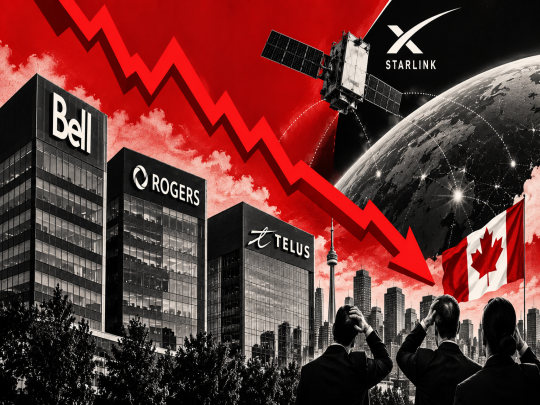
Canada's big three telecom stocks came under pressure while the broader market rose. Recent and same-day data show BCE Inc. (TSX: BCE) down around 5%, Rogers Communications (TSX: RCI.B) down about 3.7% and Telus Corp. (TSX: T) down about 3.5%. For income investors asking why Canadian telecom stocks are falling, several worries are combining: new competition, high debt, pricing pressure and doubts about dividends.
Competition from satellite internet
One concern is competition, including spectrum moves linked to SpaceX and its Starlink service. Spectrum is the radio airwave space that carries mobile signals. If a satellite company gains access to more of it, investors worry it could eventually offer mobile or home internet services that compete with traditional carriers.
Canadian telecoms have long enjoyed a market with few large players. Any threat to that structure can reduce the premium investors are willing to pay for their shares.
High debt and sensitivity to interest rates
Telecom companies spend heavily on networks, including 5G and fibre, and they carry large debt loads. When bond yields move, investors reassess how costly that debt is to carry and how safe the dividend looks. Reports describe the sector as sensitive to bond yields, which adds to caution even though yields eased on Tuesday.
Telecoms are traditionally seen as defensive stocks, meaning they hold up when the economy weakens. When high debt and competition worries appear, that defensive label loses some of its comfort.
Pricing pressure and dividend scrutiny
Recent wireless price increases by carriers have not fully reassured investors. Higher prices help revenue, but customers may switch providers if they feel they pay too much, and regulators and politicians can respond to consumer complaints. Investors are also looking more closely at balance sheets and whether dividends can be maintained while capital spending stays high.
Dividends matter because many retail investors buy telecom stocks mainly for income. A stock that offers a high yield can look cheap, but a high yield can also be a warning sign if the market doubts the payout.
Why it matters for the TSX
Telecom weakness limited gains on the S&P/TSX Composite Index and put the sector among the weaker groups on Tuesday. The index still rose about 1% because energy, mining, financials and retail more than offset the decline.
For investors, the lesson is that defensive does not mean risk free. Before buying a telecom stock for its dividend, review the payout ratio, debt levels, free cash flow and the pace of customer growth. Also watch regulatory decisions on spectrum and competition, which could change the industry outlook.
How to assess dividend safety in Canadian telecom stocks
Income seekers often search for the best Canadian dividend stocks and whether a high dividend yield is safe. To test dividend safety, review the payout ratio, free cash flow after capital spending, total debt relative to earnings, and the schedule for debt maturities. Compare BCE, Rogers and Telus with one another and with other defensive sectors such as utilities. If a falling share price pushes the yield higher, ask whether the market is signalling concern about future payouts. A reliable dividend is supported by steady cash flow, not just a high percentage on a screen.
This article is for information only and is not investment advice. Please check company filings and official data for the latest figures.