Anthropic Lists Tomorrow. Here's When It Lands in Your Index Fund, and How Much You'll Own
Anthropic lists on the Nasdaq tomorrow under ticker ANT, and index funds will be its biggest early buyers. This article sets out when VTI, QQQ and other ETFs add the stock, why the S&P 500 will wait, and how much of Anthropic most investors will actually own.

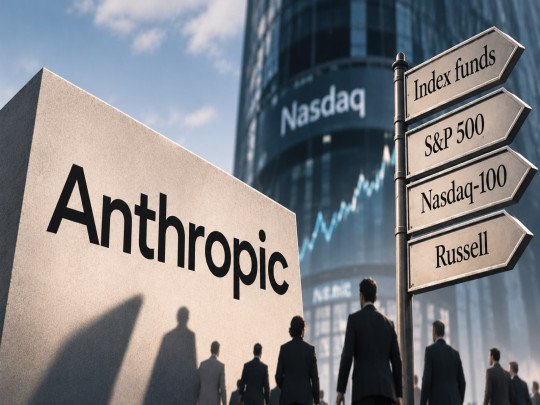
The year's most anticipated AI listing will reach millions of portfolios through the back door of index funds. When it arrives, how much you hold and what price your fund pays are all decided by rulebooks most investors never read.
Stockmarket debuts used to be a contest of conviction. Investors who believed in a company bought its shares, and those who did not stayed away. The listing of Anthropic (NASDAQ:ANT) on the Nasdaq tomorrow will work rather differently. Over the next five weeks, the most important buyers of the stock will be funds that hold no view on artificial intelligence at all.
The terms are vast. Anthropic is offering 825m shares at $70–78 each, a base deal worth up to $64.35bn. It is raising a further $26bn through a private placement at the IPO price with investors including Google (NASDAQ:GOOGL) and Nvidia (NASDAQ:NVDA). Demand was reported at several times the shares available. Yet only about 6% of the company's stock will trade freely at first. The rest remains with founders, employees and early backers.
For the millions of people who invest through index funds, that leaves three practical questions: when Anthropic will appear in their portfolio, how much of it they will own, and what their fund will pay for it.
In Brief
- Most broad US index funds should own Anthropic by Christmas. The S&P 500 will not, possibly for well over a year.
- For most investors the holding will be tiny, typically around 0.1% of a total-market fund.
- One little-known fund could hold roughly ten times that amount.
- For the first few weeks, forced buying by index funds, rather than views on the business, may drive the share price.
When It Arrives: A Countdown to Christmas
Until this year, a newly listed company could wait months, or even a year, to enter a major benchmark. In 2026 the big index providers rewrote their rules so that giant listings could join within weeks. Anthropic will be added in stages, and the timetable runs almost exactly up to Christmas.
Late November. The first to move should be the US Market Index run by Morningstar (NASDAQ:MORN), which admits large listings after a wait of about five trading days. With American markets closed for Thanksgiving on November 26, that points to the very end of the month for the Vanguard Total Stock Market ETF (NYSEARCA:VTI) and the Vanguard Extended Market ETF (NYSEARCA:VXF). MSCI (NYSE:MSCI) follows close behind. It has said Anthropic could join its Global Standard indexes at the close of November 30, provided the company passes its eligibility tests. That would bring the stock into funds tracking MSCI USA, MSCI World and MSCI ACWI, the global benchmarks used by many international investors.
Mid-December. FTSE Russell will add Anthropic at its December reconstitution. Funds tracking the Russell 3000 and Russell 1000, such as the iShares Russell 3000 ETF (NYSEARCA:IWV) and the Vanguard Russell 3000 ETF (NASDAQ:VTHR), will own it when markets open on December 14.
The Week Before Christmas. The Nasdaq-100, tracked by the Invesco QQQ Trust (NASDAQ:QQQ) and the Invesco Nasdaq 100 ETF (NASDAQ:QQQM), is expected to add Anthropic at its annual reshuffle, which takes effect when markets open on December 21. Under the fast-entry rule adopted by Nasdaq (NASDAQ:NDAQ) this year, the very largest listings can normally join after about 15 trading days. But Nasdaq's rules on timing mean an addition falling this close to the December review is folded into it.
Both the Russell and Nasdaq indexes will therefore take longer to add Anthropic than they took to add SpaceX (NASDAQ:SPCX) in June. That reflects holiday and review timing, not any concern about the company.
Apart from MSCI's and FTSE Russell's stated dates, these timings are estimates based on each provider's published rules.
The Index That Sits It Out
The S&P 500 is the exception. Funds such as the SPDR S&P 500 ETF Trust (NYSEARCA:SPY), the Vanguard S&P 500 ETF (NYSEARCA:VOO) and the iShares Core S&P 500 ETF (NYSEARCA:IVV) will not hold Anthropic for at least a year, and possibly much longer.
The S&P 500 is not simply a list of America's biggest companies. A newcomer must have traded for at least 12 months and must show positive earnings under standard accounting rules. The second test is the harder one for Anthropic: its filings show an operating loss of about $8bn in 2025, as spending on computing power soared. Size alone does not open the door. Tesla (NASDAQ:TSLA) listed in 2010 and grew into one of America's most valuable companies, yet joined the S&P 500 only in December 2020, after it had put together a run of profitable quarters.
The result is an odd split among funds that many investors treat as interchangeable. Someone who owns VOO will hold no Anthropic for the foreseeable future. Someone who owns VTI will hold some within days. Both believe they own "the market".
How Much You Will Own
The second surprise is how little most investors will hold. Index weights are based not on a company's total value but on its free float, the shares that can actually be traded. With only a sliver of Anthropic's equity in public hands, its weight will start small.
Vanguard has published estimates for its own funds, made before final pricing and assuming a public float of 5–7% of shares. In the Total Stock Market ETF (VTI), Anthropic is expected to start at between 0.05% and 0.15% of the portfolio. The Vanguard Total World Stock ETF (NYSEARCA:VT) and the Vanguard Large-Cap ETF (NYSEARCA:VV) land in a similar range of about 0.10% to 0.15%. The Vanguard Growth ETF (NYSEARCA:VUG), which tilts towards fast-growing companies, should hold a little more, at 0.15% to 0.30%.
The outlier is the Extended Market ETF (VXF). This fund is built to own every American stock outside the S&P 500. Because Anthropic cannot join the S&P 500 for now, it falls into VXF's universe as one of its largest holdings. Vanguard expects it to make up between 0.65% and 1.30% of the fund, as much as ten times its weight in VTI. On a $10,000 holding, a 0.1% weight means about $10 of Anthropic; in VXF, it could be as much as $130.
These weights will not stay fixed. As founders, employees and early backers sell shares over the coming months, the free float will widen. Index funds will then buy more, and Anthropic's weight will rise gradually rather than all at once.
Who Sets the Price: Buyers That Cannot Say No
The timetable matters for another reason: it shapes the price. An index fund's job is to copy its benchmark. When a company enters, the fund buys, usually at the closing auction on the day before the change takes effect. It does not weigh the valuation or wait for a better entry point.
Intropic, a London firm that analyses index rebalancing, estimates that passive funds will need about $19bn of Anthropic stock, roughly 28% of the shares on offer. Hedge funds know this, and many will buy in the first days of trading in the hope of selling to index funds later. Index-event specialists at Berenberg, a German bank, describe Anthropic as a mirror image of June's SpaceX listing, driven by the same forces over its first weeks of trading.
That precedent is encouraging for bulls. SpaceX priced at $135, opened at $150 and was 50% above its opening price by its third day, with index funds and retail investors absorbing nearly half the shares sold.
A repeat is far from assured. Anthropic's forced buying is spread over five weeks rather than packed into two. The company is also reported to be allowing employees, who hold about 15% of its equity, to sell some shares on the first day, which adds supply just as demand peaks. And index additions tend to follow a familiar pattern: prices rise in anticipation of the forced buying, then give back some of the gain once it is done.
Nor is there agreement on what the business is worth. Independent analysts' valuations range from about $500bn to $3trn. A spread that wide is a reminder that the index funds about to buy are not making a judgment at all. They are following a rule.
The Funds That Got There First
Some investors already own Anthropic, because their fund managers bought it privately. Capital Group is reported to hold shares worth at least $9bn across several of its mutual funds, and Fidelity is also among the largest mutual-fund holders.
Buying such funds now, in the hope of a listing-day windfall, is another matter. Fund disclosures show that managers holding Anthropic valued it very differently, with implied valuations about half a trillion dollars apart, and that most had already marked their stakes close to the expected IPO value. Investors buying in today are largely paying for a gain that has already been booked.
Thematic ETFs carry a different risk. The Tema Photonics & Optical ETF (NYSE:LAZR), a small fund launched only in June, recently had about 15% of its assets in Anthropic, while the Alger Concentrated Equity ETF (NYSEARCA:CNEQ) held more than 5%. These funds put a large bet on a single stock inside a fund wrapper, which is exactly the kind of concentration a diversified portfolio is meant to avoid.
What Investors Should Do
For most savers, the right response is undramatic.
- Know which index you own. That alone decides whether Anthropic arrives in days, by Christmas or not for a long while.
- Think in weights, not headlines. A trillion-dollar listing at 0.1% of your fund will not make or break your returns.
- Be wary of paying for access. Funds sold as a route into Anthropic have mostly priced in the gain already, and concentrated thematic funds add risk a diversified investor is trying to avoid.
- Let the rules do the work. A broad index fund will hold Anthropic in proportion to its place in the market, with no need to chase it.
Vanguard's guidance to its advisers sums it up: indexing exists to let markets, not hype, settle the outcomes.
For most investors, then, Anthropic will arrive this December like a stocking-filler: a pleasant surprise, a little exciting, and too small to change the year. That is not a letdown. It is exactly what owning the whole market is supposed to feel like.
.png)