ASX Post-Market Wrap: 11 September 2026
The ASX 200 fell for a fourth session running to a seven-week low as copper tumbled on tariff uncertainty and oil spiked past US$105 a barrel on escalating Middle East conflict, pushing bond yields to 15-year highs and lifting RBA hike odds toward 80%.

.png)
Welcome to ASX Post-Market Wrap, your quick end-of-session rundown of what moved the Australian market today, plus what's shaping global sentiment into tonight's Wall Street open.
Markets Today
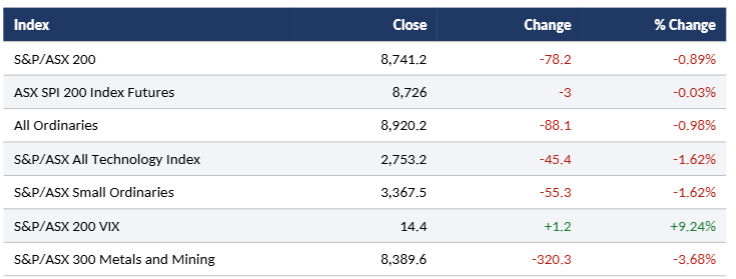
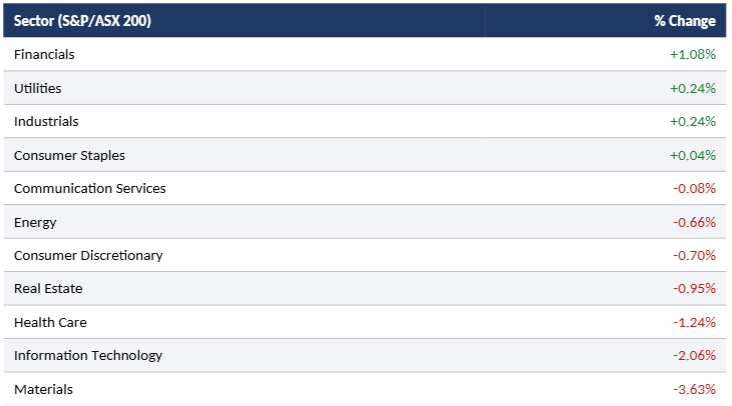
The ASX 200 fell for a fourth straight session on Friday, dropping 78.2 points, or 0.89%, to 8,741.2, its lowest close in seven weeks and a fresh 20-day low. It was a rough finish to a rough week: the index shed 2.94% over five sessions, its worst week in six months, though it did claw back from an intraday low, finishing 0.9% below its session high and just 0.5% above its low. Breadth told the real story: decliners crushed advancers 216 to 61 on the broader S&P/ASX 300, even as the late-session bounce made the closing numbers look tamer than the session actually felt. Financials was the lone standout among the eleven sectors, gaining 1.08% and rebounding from a recent slide, while Materials was hammered for 3.63% as a broad sell-off hit both base and precious metals.
Analytical View
Miners did the damage today. Copper tumbled more than 5% after reports emerged that the White House still hasn't decided on refined copper tariffs, weighing on affordability concerns even as buyers had spent months stockpiling ahead of expected duties. BHP fell 4.7%, Rio Tinto lost 4.2% and Fortescue dropped 2.5%, while pure-play copper names were hit even harder, with Sandfire Resources down 7% and Capstone Copper off 9.2%. South32, Northern Star Resources and Evolution Mining all lagged too, as gold slipped alongside base metals in a broad-based retreat across the sector. On the other side of the ledger, Financials was the session's best performer, up 1.08% and clawing back some of its recent losses, with the big four banks gaining between 0.6% and 2.5% as insurers Suncorp and Insurance Australia Group both rose on the broader strength long bond yields tend to bring to the sector. Uranium names were also under pressure, with Deep Yellow and Paladin Energy both down close to 10% tracking a sharp fall in the Sprott Uranium Miners ETF overnight, while GQG Partners dropped after reporting a fourth straight monthly decline in funds under management, down 4.6% to US$149.2 billion in August on outflows across all four strategies.
The bigger picture is a global bond and energy story. Brent crude spiked toward US$108-110 a barrel overnight, its highest level in nearly four months, as Iran and the US dug into a protracted conflict with US strikes on Iranian tankers, Iranian missile attacks on US bases in Jordan, and Houthi assaults on Saudi energy facilities all adding to the sense that a return to normal Middle East energy flows is a long way off. That fed straight into bond markets: the US 10-year Treasury yield surged to 4.97%, its highest since 2007, and Australia's 10-year followed it up to above 5.3%, the highest since May 2011, as traders pushed the implied odds of an RBA hike on 29 September toward 80%. In the US, diesel prices hit US$6 a gallon for the first time ever as war-driven refinery disruption in Russia and the Middle East squeezed supply, a cost that flows through to food, freight and energy prices well beyond the pump. Wall Street and Asia both carried the same negative tone into Friday: the Dow, Nasdaq and S&P 500 all fell to multi-week lows overnight, Japan's Nikkei dropped more than 2% in a sharp reversal of Thursday's gains, and Europe's major indices closed lower too. Tonight's US CPI print, due with consensus for a 0.4% monthly rise, is the next test of how much of this is already showing up in the numbers the Fed has to work with at next week's meeting.
What could change the picture: tonight's US CPI data ahead of the Fed's meeting next week, and the RBA's own decision on 29 September.
Sector Performance
Volume Outliers
Stocks trading furthest above their 90-day average volume:

Broker Moves

52-Week Highs & Lows
Highs:

Lows:

Near Highs

Commodities & Rates

Top Stories: Australia
GQG Partners posts fourth straight monthly FUM decline. GQG Partners reported ending funds under management down 4.6% to US$149.2 billion at the end of August, from US$156.4 billion a month earlier, with net outflows of US$4.3 billion spread across all four of its strategies and a further US$2.9 billion knocked off by negative investment performance. Year to date, FUM is down 9% to US$163.9 billion, with Emerging Markets and US strategies posting the sharpest declines at 16.4% and 18.8% respectively.
Alkane grows reserves at both operating gold mines despite depletion. Alkane's FY26 statements showed Tomingley's ore reserves rising 3.2% to 641,000 ounces of gold even after 95,000 ounces of depletion against record annual production of 80,000 ounces, while Sweden's Björkdal reserves grew 3.7% to 563,000 ounces on continued exploration success. The company flagged that San Antonio, Peak Hill, Boda and Kaiser weren't updated this cycle pending further drilling.
Tivan clears the way for tungsten drilling in the Northern Territory. Tivan secured its final regulatory approval and a Sacred Site Clearance Certificate from the Central Land Council to begin an 8,000-metre drilling program at its Molyhil tungsten project, aimed at generating the resource, metallurgical and geotechnical data needed for feasibility work. The project already carries a pre-tax NPV8 of $534.3 million from an April scoping study, with Sumitomo Corporation and ETFS Capital both signed on for up to $50 million in staged equity funding.
Copper tariff limbo drags down the resources sector. Copper prices fell more than 5% on reports the White House has yet to decide on a proposed tariff on refined copper imports, weighed down by affordability concerns even as buyers had built one of the world's largest US copper inventories anticipating the duties. The proposal on the table would start at 15% from January 2027, rising to 30% in 2028, and the uncertainty hit BHP, Rio Tinto and Fortescue alongside pure-play copper miners Sandfire Resources and Capstone Copper.
Bathla lenders begin selling off seized development sites. Lenders to collapsed Sydney property developer Bathla, which owes at least $3.4 billion, have started moving to recover losses, with 360 Capital's Mortgage REIT the first to put seized sites on the market to recoup a $31.7 million loan. Receivers have now been appointed across at least 17 Bathla projects, with other lenders including Wingate, Trilogy Funds and Centaur Property Funds Management also moving to take control of construction sites and land.
Management & RBA Speak
Joachim Nagel, President, Deutsche Bundesbank, on the case for the ECB to tighten further:
Nagel said he wouldn't rule out the ECB needing to move into "mild restrictive territory," though he stressed any further tightening would depend heavily on how energy prices and the broader inflation picture evolve over the coming month.
Donald Trump, US President, on the war with Iran:
Trump said he has no regrets about the US involvement in the conflict, arguing that letting Iran continue toward a nuclear weapon would have been the far greater risk given the threat he says it would pose to Israel and eventually US cities. He suggested a resolution is more likely to come after the November midterms, though he left open the possibility of an earlier settlement.
Corporate Actions & Reporting Calendar
Economic Calendar (Upcoming):

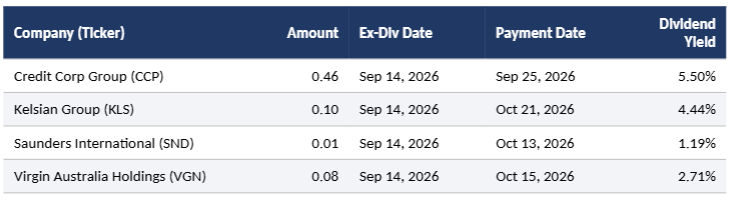
Ex-Dividend (Next Session — Monday, 14 September):
Closing Line
That's the wrap for today's session. Tonight's US CPI print is the next major test, the last inflation read before the Fed's meeting next week, with the RBA's own call now just under three weeks away on September 29.