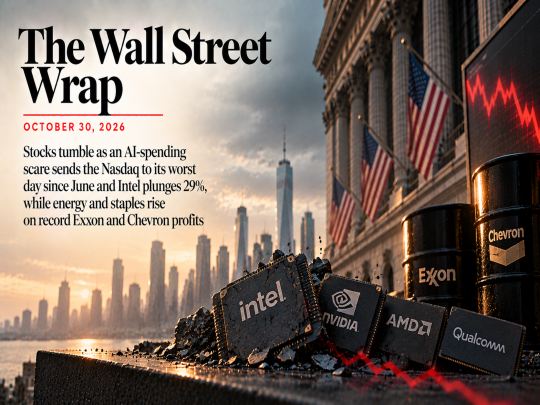
Nasdaq bloodbath: Intel's warning ends the AI trade's free pass
Intel’s profit warning, a memory-chip crunch and two cash-hungry hyperscalers produced the Nasdaq’s worst day since June. The market is moving from “hopes and dreams” to “show me” on AI spending.

A chipmaker's profit warning, two cash-hungry hyperscalers and a month of creeping doubt produce the worst day for technology shares since June
It has been a while since a company beat expectations and was punished quite so thoroughly for it. On October 30th Intel (NASDAQ:INTC) reported third-quarter results that topped forecasts, then guided to a fourth quarter that fell far short. Its shares dropped by 28.6%, erasing about $140bn of market value in the firm's worst day since 1974. By the close the Nasdaq Composite was down by 2.9%, its steepest one-day fall since early June, and America's technology firms had shed more than $1trn between them.
The damage was wide. The Nasdaq ended at 25,437, some 7.8% below its record close of October 6 and within sight of the 10% drop that marks a correction. The S&P 500 fell by 1.8% to 7,580, and the Dow Jones Industrial Average lost 1.1%, or 572 points, to close at 51,770. Information technology was the S&P's worst sector by some distance, down by more than 4%. For the month, the Nasdaq fell more than at any time since March 2025. Only the Dow, with its thin tech weighting, scraped a gain.
Memory loss
Intel's guidance was the trigger. It expects fourth-quarter revenue of $15bn to $16bn, against the $17.1bn analysts had pencilled in, and adjusted earnings of 25 cents a share, against a consensus of about 43 cents. The explanation offered by Lip-Bu Tan, the chief executive, was an "unprecedented memory crunch". Memory chips have grown dearer, and so have the personal computers that contain them. "Our customers began signaling a PC slowdown based on the memory prices and availability," he told analysts.
The numbers that follow are grim. Intel's client-computing revenue fell by 5% in the third quarter, and it expects PC-chip sales to drop by more than 20% from one quarter to the next in the current one. It now reckons the global PC market will shrink by about 12% in 2026 and by a further 10% in 2027, with weakness lasting at least until the middle of next year.
Bad luck piled on top of bad demand. An explosion at an Israeli fabrication plant earlier this month will cost roughly $300m in fourth-quarter revenue and about two percentage points of gross margin, according to David Zinsner, the chief financial officer. Intel's data-centre and AI business, which grew by 78% year on year, could not be served in full because of manufacturing constraints. The firm does not expect to generate positive free cash flow this year.
There is an irony here. The AI boom that is filling Intel's data-centre order book is also the reason memory is scarce and pricey, and so the reason its PC customers are retreating. One half of the business is feasting on the scarcity that is starving the other.
Intel's shares are nonetheless still up substantially this year, though they have lost more than half their value since a peak in June. The American government, which took a 10% stake under the previous administration, saw about $12bn of that holding disappear in a day.
Contagion
The rest of the chip industry followed Intel down. The Philadelphia Semiconductor Index (NASDAQ:SOX) fell by 7.2% and is now more than 15% lower for the month.
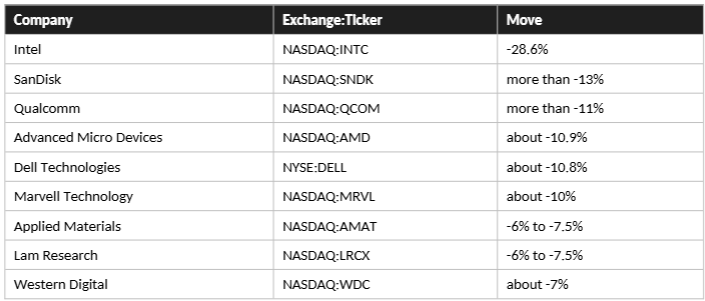
The rout reached the plumbing of the digital economy. Shares in Arista Networks (NYSE:ANET), Ciena (NYSE:CIEN) and NetApp (NASDAQ:NTAP) all sank.
From hopes and dreams to "show me"
It would be wrong to blame Intel alone. It lit the match, but the room was already full of gas. Investors have spent the week worrying about what the biggest spenders on artificial intelligence are getting for their money. On Thursday, Alphabet (NASDAQ:GOOGL) had its worst day on record, shedding about half a trillion dollars of value on fears of slower search-advertising growth and heavy spending. Amazon (NASDAQ:AMZN) then confirmed that its AI outlays are still rising, with capital spending expected to reach about $220bn in 2026. It also reported its slowest growth in core e-commerce for three years and free cash flow of minus $42.4bn over the past twelve months.
"We're moving out of the hopes and dreams phase of the AI trade and into the 'show me' phase," says Joe Tigay of Equity Armor Investments. The sums involved explain the change of mood. An estimated $750bn will be spent on AI-related investment this year, and the hyperscalers have accounted for more than a third of all capital spending by S&P 500 firms over the past year, a share that is expected to grow.
Think of a household that takes out a large mortgage on the strength of a secure salary. If the pay stops rising while the repayments keep climbing, even a fine house starts to feel like a burden. The advertising, retail and consumer businesses that pay for much of the AI build-out are showing signs of slowing, and the repayments are not.
Investors are drawing a sharp line between those who can afford the bill and those who cannot. Microsoft (NASDAQ:MSFT) and Oracle (NYSE:ORCL) won praise this season for funding their expansion with stronger free cash flow. Alphabet and others were punished for burning through cash. Spending paid for out of earnings is an investment. Spending paid for out of hope is a wager.
Rotation, not (yet) panic
Other worries added to the gloom. Reports that hackers had stolen some $6.3bn from Binance, a cryptocurrency exchange, hit crypto-linked shares and knocked about 3% off Bitcoin. Treasury yields fell as investors sought refuge in government bonds.
Not everything fell. Regeneron Pharmaceuticals (NASDAQ:REGN) jumped by more than 13%, and T-Mobile US (NASDAQ:TMUS) rose by more than 6%. Cboe Global Markets (CBOE:CBOE) and Global Payments (NYSE:GPN) also gained. Money, in short, is moving out of expensive technology and into steadier earners, rather than leaving equities altogether. The broad market remains only modestly below its all-time highs, and Intel's own data-centre sales show that demand for AI hardware has not vanished.
But analysts are adjusting. Morningstar and Goldman Sachs are among those trimming near-term estimates for firms exposed to PCs, and warning that memory-price inflation may suppress unit sales well into 2027.
The reckoning
The lesson of Friday is not that artificial intelligence has failed. It is that the market has changed what it asks of it. Valuations of many AI-exposed shares assumed something close to perfection, and perfection leaves little room for a missed quarter or a dearer memory chip. The next round of earnings will be judged on a simple test: can AI revenue grow faster than the cash needed to produce it? Firms that can show the arithmetic will be forgiven a great deal. Those that cannot may find that the era of uncritical enthusiasm ended with the month.