One Rate, Two Economies
A 4.3% GDP quarter, flat October spending, 3.3% core inflation and a Beige Book describing a tired consumer. The AI-led boom and a stretched household sector leave the Fed setting one rate for two economies.

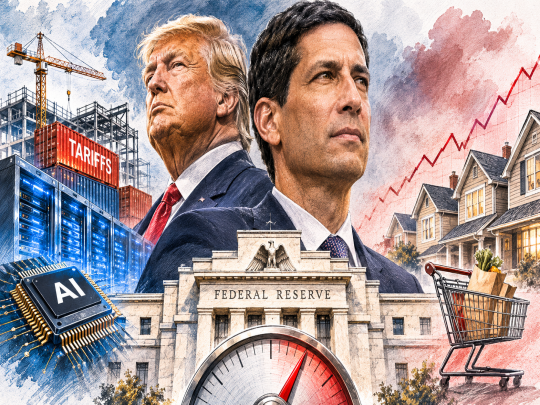
A blistering third quarter and a sullen consumer arrive on the same day. The Federal Reserve has to answer both with a single interest rate.
The Core Quant | US Macro | 26 November 2026
The American economy delivered two messages on Wednesday, and they do not sound like one voice.
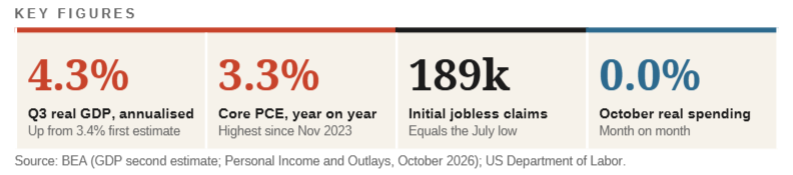
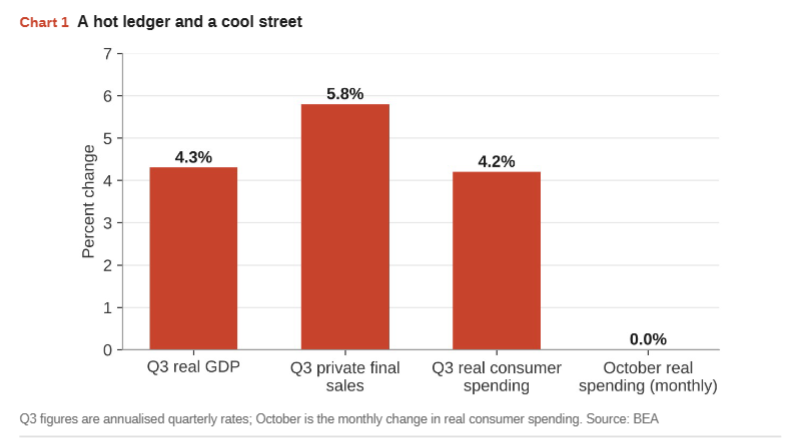
The first, from the Bureau of Economic Analysis, was that output grew at an annualised 4.3% in the third quarter, nearly a point faster than first reported and the quickest pace in three years. The second, from the same agency on the same morning, was that real consumer spending in October did not grow at all. Between those two numbers sits the most awkward decision the Federal Reserve has faced in years.
The Fed meets on December 8th and 9th, and a quarter-point rise is as good as priced. The question is what it believes it is tightening against: the economy of the national accounts, or the one described by the people it interviews.
The ledger runs hot
Start with the ledger. Real final sales to private domestic purchasers, the measure Fed officials watch for underlying demand, rose 5.8%. Gross domestic income, the income-side twin of output, grew 4.4%, so the strength is not a statistical illusion confined to one side of the books.

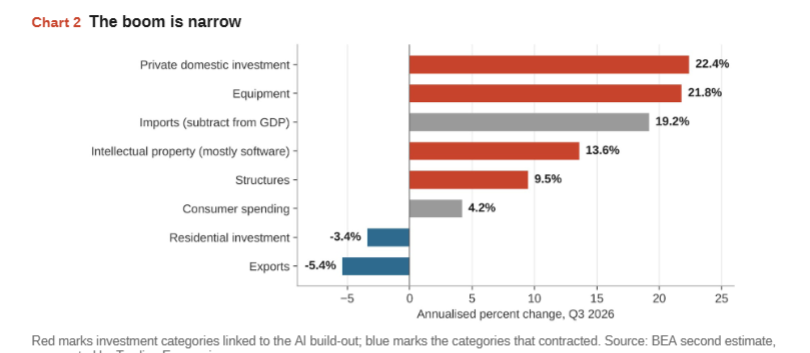
Business investment climbed by more than a fifth, with spending on equipment up 21.8% and on intellectual property, mostly software, up 13.6%. Imports jumped 19.2% as firms bought the machinery and components for data centres.
The artificial-intelligence build-out is pulling in chips, electrical gear, power generation and construction labour at a pace the rest of the economy cannot match. The Cleveland Fed, in the latest Beige Book, reports robust manufacturing demand led by data centres, power generation and defence, with supplies of microchips and electrical components stretched and lead times lengthening. In the Richmond district, a North Carolina builder says trades workers are travelling out of state for higher data-centre pay, which is pushing up his wage bill.
The headline deserves caveats. Inventories added about 1.6 percentage points to growth, and government spending was lifted in part by one-off sales of crude from the Strategic Petroleum Reserve. Part of the upward revision rested on a technical judgment: the BEA raised its software estimate mainly because of revised producer-price data. Even so, trimmed of every quibble, the quarter was strong.
The street runs cool
Now step outside the ledger. The Beige Book, which collects reports from businesses and community groups up to mid-November, describes an economy that is tired. Eight of the twelve Fed districts reported slight to moderate growth; four reported none. Consumer spending was little changed, and households were choosier about discretionary purchases. Auto sales softened, which contacts blamed on dear fuel and higher borrowing costs. Residential property weakened, and construction fell back.
October's spending data agree. Nominal outlays rose 0.3%, but prices rose by the same amount, so real spending was flat. Income looked healthier, rising 0.7%, though part of that was a one-off Medicare premium rebate. The saving rate edged up to 4.1%.
The Atlanta district's report states the divide plainly. Lower- and middle-income shoppers are hunting for promotions and trading down; higher-income households keep buying premium goods and travel. Cleveland found auto dealers lifting incentives by 17.5% in a month to move cars, while one of its manufacturers was preparing to raise contract prices by 19% in January.

Housing makes the point from another angle. Building permits fell to an annual rate of 1.297m in October, the lowest since May 2020, and mortgage rates remain above 7%. Yet new-home sales leapt 14.2% in the same month, thanks to the South, where they rose 36.2%; every other region fell. Lower prices, not cheaper credit, did the work.
A labour market that has stopped moving
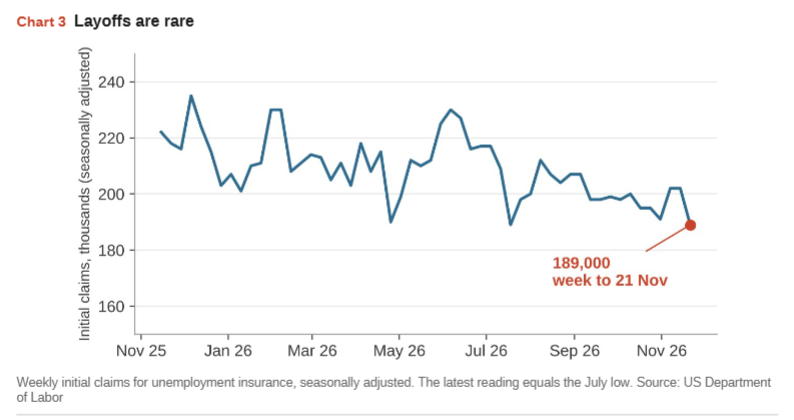
Employment tells a similar story in a different key. Initial claims for unemployment insurance dropped to 189,000 in the week ending November 21st, equalling the lowest level in some six decades and well below the 200,000 that forecasters expected. Continuing claims slid to 1.7m. Layoffs, evidently, are rare.

But rare layoffs are not the same as strong hiring. The Beige Book finds that many firms are keeping head counts steady and hiring mainly to replace leavers, and that some are using AI to avoid adding staff at all. Wages are rising a little faster, mostly for scarce skilled workers and to offset the cost of living.
Why prices will not wait
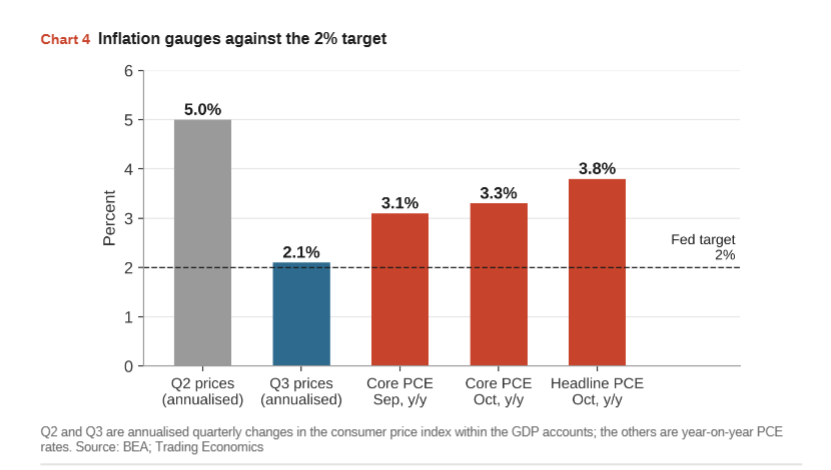
Prices are what turn this puzzle into a policy problem. Core PCE inflation, the Fed's favoured gauge, rose to 3.3% in the year to October, from 3.1% in September and above forecasts of 3.2%. It is the highest since November 2023. Monthly core inflation has now printed 0.3% for three months running, a pace that compounds to about 3.7% a year. Headline inflation stands at 3.8%.
The GDP report supplies a curious counterpoint. The consumption price index within the quarterly accounts rose at an annualised 2.1% in the third quarter, down sharply from the energy-driven roughly 5% of the second.

As the energy shock fades, a broader, stickier inflation takes its place. The Fed's minutes suggest officials fear exactly that: a large majority worried that inflation could persist even after petrol prices ease and the effects of tariffs and AI spending fade.
The Beige Book shows how the pressure moves. Input costs generally outpaced selling prices, with firms citing fuel, freight, tariffs and insurance, and one Cleveland banker describing double-digit rises in health premiums. Competition and price-sensitive customers limit how much can be passed on, but contacts expect costs to keep rising. The tariff picture is about to get more crowded. On Wednesday the US Trade Representative proposed new Section 301 duties of up to 20% on 14 economies, among them China, the European Union, Japan, South Korea and India, after an eight-month inquiry into industrial overcapacity. They are proposals open to public comment, and reports suggest they could start in January; the Beige Book, gathered before 16 November, does not reflect them.
The Fed's problem
Here the two economies collide. Officials broadly agree that the AI build-out is itself an inflation risk, since demand for its products outruns supply and lifts the price of technology goods. At the October meeting, many policymakers called it a material source of price risk, and most wanted better information on how durable the spending is. Wednesday's tariff proposals, if enacted, would add a supply-side push on top of the demand pull from AI that officials already fear.
The central bank held rates at 3.75-4% by ten votes to two, with Governor Lisa Cook and Cleveland's Beth Hammack preferring a hike. Nearly everyone now expects a rise in December. Governor Christopher Waller wants a half-point, and thinks several increases may be needed beyond the two that economists pencil in; New York's John Williams has argued that the moment does not call for dramatic action.
The trouble lies in who bears the cost of tightening. A higher policy rate acts on the interest-sensitive parts of the economy: mortgages, car loans, small-business credit, consumer demand. Those are the cool parts, the same households and builders the Beige Book describes as stretched. The hot part, the data-centre boom, is driven by corporate capital budgets and the expected returns on AI, and it is far less responsive to a quarter-point change.

There is a case against this worry. Inflation has been above target for roughly five and a half years. Waller notes that core prices have run at about a 3.5% annual rate for three months, and that businesses expect customers to accept rises near 3%. If firms and workers come to expect that, the damage lasts. A central bank that waits for the street to heat up before acting may wait for ever while expectations harden.
Markets have taken a middle road. After Wednesday's data, traders still priced two more rises in 2027, but cut the odds of a third to about one in three from roughly even. Treasury yields fell, which suggests the weaker spending figure carried more weight than the strong GDP one.
What to watch
Three things will settle which economy is the truer guide.
- Data-centre spending. The Beige Book already records unease in Virginia, where uncertainty over projects is spilling into the industrial property planned around them, and the Fed's own minutes note that much AI-related debt has grown through opaque financing. A stumble there would knock the engine of growth just as higher rates bite elsewhere.
- Consumer spending. October's flat reading may be noise; the November figures and the third GDP estimate, both due on December 23rd, will say more.
- Inflation's breadth. If core inflation spreads further beyond energy and tariff-exposed goods, the case for tightening strengthens, whatever the street thinks.
For now the central bank must choose between the confident ledger and the cautious street. Hiking into a flat consumer risks pushing the cool economy colder. Waiting while core inflation climbs risks teaching everyone that 3% is normal. Wednesday's data made neither option comfortable, which is the most honest reading of an economy that has stopped speaking with one voice.
Related post