Six Takeaways From Wednesday's Bank Stock Selloff: 3.7% CPI, 5.2% Yields and What to Watch Next
Hot 3.7% CPI and 10-year yields above 5.2% pulled bank stocks lower on Wednesday. BofA fell 4.76%, State Street 4.14% and Carlyle 3.95%, while Morgan Stanley held flat after a beat. Six takeaways, plus what to watch next.


Key Highlights
- Headline CPI of 3.7%, against 3.6% expected, pushed 10-year Treasury yields above 5.2% and lifted the odds of an October Fed rate rise to roughly one in three.
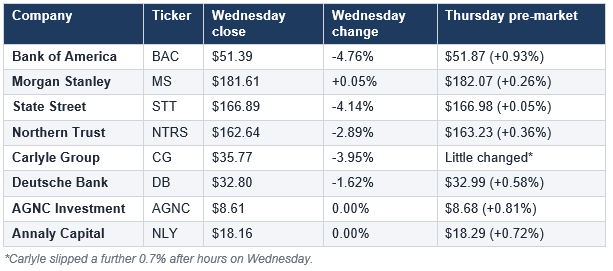
- Bank of America fell 4.76% to $51.39; State Street fell 4.14% to $166.89; Carlyle fell 3.95% to a fresh 52-week low of $35.77.
- Morgan Stanley beat estimates and still ended flat at $181.61, up 0.05%.
- AGNC and Annaly closed unchanged near their 52-week lows, with dividend yields of about 16% to 17%.
- Thursday's pre-market indications are mostly modestly higher, with producer-price data due later today.
Rates Overrule Results
On Wednesday, a bank's own quarter mattered less than the bond market. Morgan Stanley and State Street both beat profit forecasts, yet one went nowhere and the other lost more than 4%. Bank of America, which missed, fell almost 5%. One number explains most of the pattern, and it was not in any earnings release.
Wednesday's Closing Scorecard
3.7%: The Number That Moved Everything
Headline consumer prices rose 3.7% from a year earlier in September, a tenth of a point above the 3.6% economists expected. It was a small miss, but it landed in a market already anxious about the Federal Reserve.
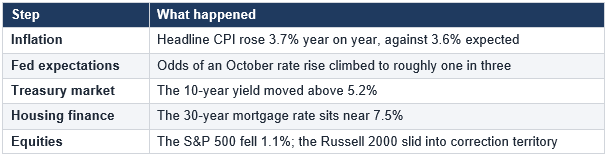
One market summary called it the worst broad-market day since July. AI-linked technology shares fell alongside the banks, and Asian markets had already tumbled overnight.
Banks felt the shock in a particular way. Higher yields can lift net interest income, but they also weigh on fixed-income trading, the market value of bond portfolios, mortgage origination and loan demand. On Wednesday investors weighed the costs more heavily than the benefits. The six takeaways below all trace back to that one print.
Takeaway 1: Rates Now Outweigh Results
The evidence: Morgan Stanley's earnings of $3.03 a share and revenue of $20.34 billion topped estimates, and its equities-trading revenue jumped 41% to $5.8 billion. The stock closed up just 0.05% at $181.61. State Street's adjusted earnings of $3.69 a share also beat, yet it fell 4.14%. Bank of America, which missed on earnings, fell 4.76% to $51.39.
What it means: Good news and bad news produced similar reactions. Until yields settle, the direction of the bond market is likely to matter more to bank shares than the details of any single report.
Takeaway 2: A High Bar Punishes Even Good Quarters
The evidence: State Street reported record assets under custody and administration of $59.2 trillion and assets under management of $6.3 trillion, and it raised 2026 guidance to fee-revenue growth of 13% to 14% and net-interest-income growth of 15% to 16%. But revenue of $4.00 billion fell short of a consensus near $4.04 billion, with fee revenue and foreign-exchange trading both softer. Truist noted that the bar had been set very high after a strong run in the stock, which is still far above its 52-week low of $104.64. A law-firm investigation notice added to the pressure.
What it means: After a big rally, a small revenue miss can outweigh record operating metrics.
Takeaway 3: Trading and Deal Revenue Are the Soft Spot
The evidence: At Bank of America, fixed-income trading revenue fell 17% and investment-banking fees dropped 11%, offsetting an 8% rise in net interest income. At Morgan Stanley, investors focused on softer fixed-income and investment-banking results, along with a reversal of carried interest in investment management, despite the strong equities quarter. The shares remain about 22% below their 52-week high of $232.25, and analysts are split: Keefe, Bruyette & Woods cut its target to $230 and called a pullback of more than 20% an attractive entry point, while BNP Paribas lowered its own to $185 from $250.
What it means: Rising yields can hurt the market-sensitive parts of a bank's revenue even when other lines are strong. The gap between analyst targets shows how unsettled views are.
Takeaway 4: One-Off Charges Get No Benefit of the Doubt
The evidence: Bank of America's adjusted earnings of $1.08 a share missed the roughly $1.10 expected, and revenue of about $30.0 billion fell short of a consensus near $30.6 billion. A $1.2 billion penalty from the Treasury, the OCC and FinCEN over anti-money-laundering failures cost $0.17 a share. The chief financial officer said the remediation costs are largely in the expense base and that the consent order carries no restriction on growth. Wells Fargo still trimmed its price target to $64 from $69. Volume was roughly 118 million shares, about three times normal.
What it means: In a nervous tape, a charge that management calls contained still drew heavy selling.
Takeaway 5: Weakness Spreads Across Peer Groups
The evidence: Northern Trust fell 2.89% to $162.64, its second straight decline, after State Street's results. Its own position looks sound: it beat in the second quarter, raised its dividend by 10% and lifted 2026 guidance. Carlyle closed down 3.95% at a fresh 52-week low of $35.77 and is down roughly 36% over the past year. TD Cowen, RBC and UBS all cut targets, and KKR, Apollo, Blackstone, Ares and Blue Owl were also lower earlier in the week. Carlyle's own research chief has warned about private credit's heavy exposure to AI-related borrowers. Deutsche Bank fell a milder 1.62% to $32.80, helped by a Boston Consulting Group forecast of record global investment-banking revenue of $1.1 trillion in 2026.
What it means: Selling moved by sector as much as by company. The exceptions, such as Deutsche Bank's smaller decline, were the ones with some independent support.
Takeaway 6: High-Yield Income Stocks Are Sending a Warning
The evidence: AGNC closed unchanged at $8.61 and Annaly at $18.16, but both sit near their 52-week lows of $8.41 and $17.76. Dividend yields are about 16.7% and 16.0%. Piper Sandler lowered its AGNC target to $10 from $12 and KBW cut to $9 from $11. Piper also trimmed its Annaly target to $21.50, though consensus on Annaly remains Moderate Buy.
What it means: Yields above 5.2% and mortgage rates near 7.5% can widen spreads on agency mortgage securities and erode book value. A very high dividend yield also reflects how much risk the market sees in leveraged mortgage portfolios.
What to Watch Next
- Today: Producer-price data is due, and retail sales are also awaited. Both could move expectations for the Fed.
- October 19: AGNC reports after the close.
- October 20: Annaly reports after the close, with consensus near $0.78 a share.
- October 21: Northern Trust reports, with consensus near $2.87 a share on about $2.26 billion in revenue.
- November 4: Carlyle reports.
The Bottom Line: Read the Bond Market Alongside the Balance Sheet
Wednesday’s selloff was less a verdict on any one bank than a repricing of interest rates. The results on the screen ranged from record assets at State Street and a 41% jump in equities trading at Morgan Stanley to a miss at Bank of America, and yet the shares mostly moved the same way. When quarterly numbers this different produce reactions this similar, something larger is setting the price.
That larger force can change direction quickly, and two things would matter most. A softer inflation signal, starting with today’s producer-price data, could ease pressure on the Fed and let yields retreat from 5.2%. Another hot reading would keep the roughly one-in-three odds of an October rate rise alive and keep the strain on trading-heavy lenders, custody banks and mortgage REITs. Thursday’s modestly higher pre-market quotes look more like a pause than a verdict.
The earnings run that follows, from AGNC on October 19 to Carlyle on November 4, will test whether company results can break through the rate narrative. Until they do, investors reading these stocks need to follow the yield curve as closely as the income statement.
Wall Street Wrap: Pre-Market, October 15, 2026
Related post


 (1).png)