Wall Street Wrap: Pre-Market, October 15, 2026
U.S. stock futures are split on Thursday as a global tech rout over AI borrowing sends South Korea's Kospi down 7.6% and hits chip stocks, while the Dow holds up on a Treasury rally. Penske Automotive jumps on a take-private deal, OPKO Health surges on a Labcorp sale, and CoreWeave and Rocket Lab fall. Hot producer prices fail to stop yields from falling.


Tech rout deepens as the Kospi plunges 7.6% and AI debt fears hit chip stocks, while Penske Automotive and OPKO Health soar on deals
Wall Street looks set for a divided open on Thursday as a global tech rout over AI borrowing weighs on the Nasdaq, while a rally in Treasuries and defensive stocks supports the Dow despite hot producer prices.
Futures Snapshot
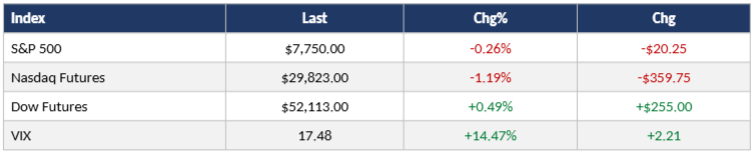
Futures were split early Thursday, with the Dow higher while the Nasdaq led losses on AI-debt worries and a global chip rout.
What's Driving the Open
Wall Street is coming off a losing session. The Nasdaq Composite posted its biggest one-day decline since July 23 on Wednesday, and the Dow and S&P 500 also ended lower. The selling is spreading around the world. South Korea's Kospi plunged 7.57% overnight to 5,554.22, dragged by its two biggest chipmakers, which fell more than 11% and nearly 10%, and Japan's Nikkei 225 lost 4.9%. Over five days, memory stocks have lost between a fifth and a quarter of their value. Investors are fretting about the huge borrowing underpinning AI infrastructure, with bond yields at one cloud-computing provider hitting about 15%, and Nasdaq-100 futures point to a sixth decline in seven sessions. Adding to the unease, Anthropic told prospective investors that third-quarter revenue rose to $16.8 billion from $11.6 billion in the second quarter and that it was profitable on an adjusted basis, though some traders fear the pace is too slow to justify the gains in chipmakers.
Fresh data did little to help. Producer prices jumped 1.3% in September, the biggest monthly rise since March 2022, and 6.3% on the year, the largest since December 2022, against 5.5% expected. Core producer prices, which exclude food and energy, rose 0.7% against 0.3% expected. Retail sales rose 0.8% against 0.3% expected, helped by higher gasoline prices, and initial jobless claims came in at 199,000. Yet Treasuries are rallying as investors sell tech shares and seek safety, with the 10-year yield down 0.117 percentage points at 5.073%. Traders now see roughly a 30% chance of a rate hike at the next meeting, according to CME FedWatch, after odds briefly peaked at 58% following Wednesday's consumer price report, Deutsche Bank analysts said. San Francisco Fed President Mary Daly said further rate increases would probably be needed but signaled no need to act in October.
What could change the picture: Further stress in AI-linked credit would deepen the tech rout, another leg of selling in Asian chipmakers would weigh on the open, and a rebound in yields after the hot producer prices would revive rate-hike bets.
Overnight Markets
In Asia, South Korea's Kospi plunged 7.57% to 5,554.22 and the small-cap Kosdaq lost 7.65% to 760.82, as the country's two biggest chipmakers fell more than 11% and nearly 10%. Japan's Nikkei 225 lost 4.9% to 64,425.95, while the Topix fell 2.38% to 3,999.34. Japan's Softbank, a heavy investor in the industry, sank by a similar amount to the chipmakers. China's CSI 300 fell 1.23% to 4,166.01, Hong Kong's Hang Seng was down more than 1% in its last hour of trading, and Australia's S&P/ASX 200 ended flat at 8,719.7.
In Europe, tech shares also fell, though less dramatically than in Asia.
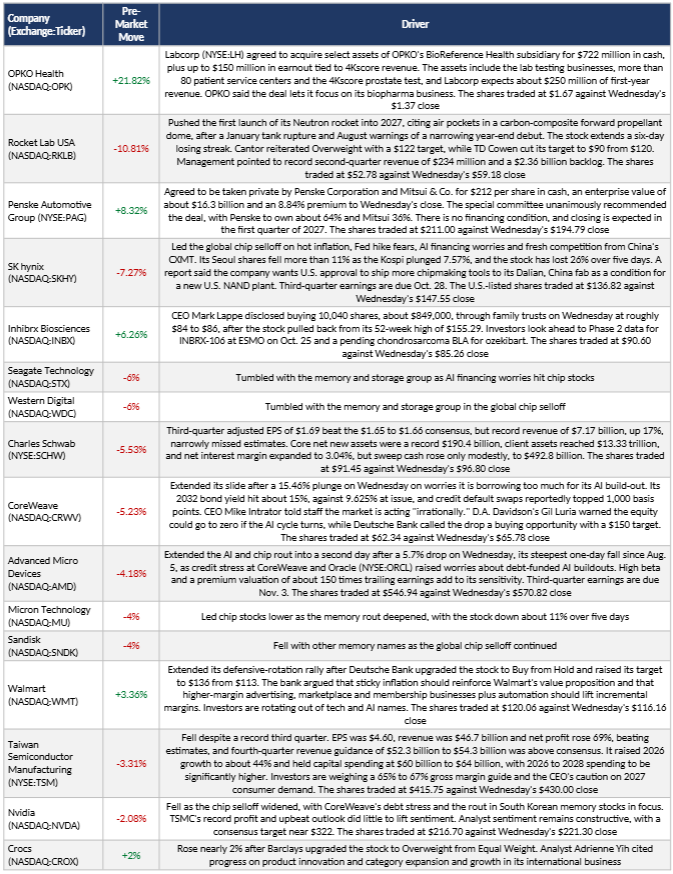
Pre-Market Movers
Rates, FX & Crypto
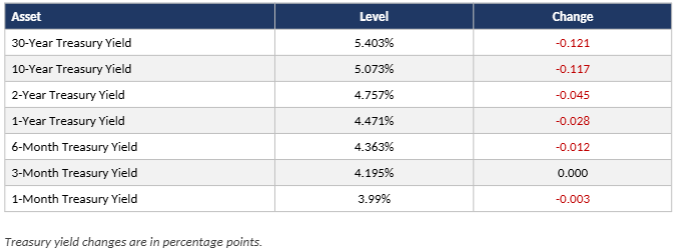
Yields fell as investors cashed in tech shares and fled to the safety of bonds, even after producer prices ran hot. The 10-year yield dropped to a three-week low, and the 30-year fell the most, by 0.121 percentage points. Shorter maturities barely moved, with the 3-month unchanged. The dollar slipped 0.5%. Traders now price roughly a 30% chance of a hike at the next Fed meeting, down from the intraday peak of 58% after Wednesday's consumer price report, and still see a 25 basis point rise in December.
Commodities
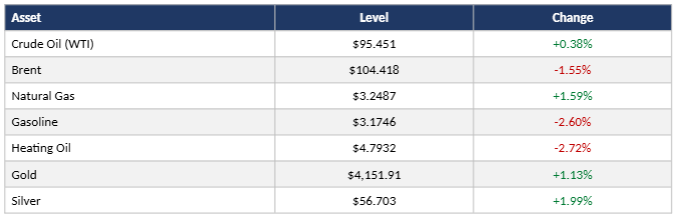
Gold is recovering from its post-inflation selloff as the dollar slips and Treasury yields fall, with silver following higher. Oil is mixed, with WTI edging up while Brent falls, and gasoline and heating oil are both down more than 2.5%. Gasoline stations posted a 6.4% jump in September sales, reflecting higher prices at the pump.
Key Levels & Catalysts Today
Economic data
- Producer prices rose 1.3% in September and 6.3% from a year earlier, with energy costs for producers up 10.8% on the month.
- Retail sales rose 0.8% against 0.3% expected, and August was revised up to 1.3%. Excluding autos, gasoline, building materials and food services, sales edged up only 0.1% after a 1.2% jump in August.
- Initial jobless claims rose by 1,000 to 199,000, below the 200,000 expected, and continuing claims fell by 4,000 to 1,710,000.
- The New York Empire State manufacturing index climbed to 25.5 in October from 7.6 in September, against 10.3 expected, its strongest reading in nearly five years.
- The Fed's next interest rate decision is about two weeks away.
Corporate
- Cboe extends trading hours for options on 24 stocks and five ETFs on Monday, with sessions from 7:30 a.m. to 9:25 a.m. ET and 4:00 p.m. to 4:15 p.m. ET.
- Anthropic is expected to launch its initial public offering in November, seeking a valuation of more than $2 trillion.
Top Stories
Anthropic tells prospective investors third-quarter revenue reached $16.8 billion. At an investor day in San Francisco ahead of its expected initial public offering, the company said revenue rose from $11.6 billion in the second quarter and $4.7 billion in the first, and that it was profitable on an adjusted basis. Analysts who met executives estimate its annual revenue run rate could reach $110 billion by the end of the year. Anthropic has committed at least $518 billion over a decade for cloud services, computing and infrastructure, and some traders worry that its growth is not fast enough to justify the gains in chipmakers.
Memory stocks extend their rout as investors weigh China and oversupply. Over five days, SK hynix has plunged 26%, Samsung 22% and Micron around 11%. The jitters began when China's CXMT announced plans for a server memory product on a new architecture that would allow higher storage density, raising fears it could take share from incumbents. Analysts are skeptical it can scale production. "We don't think this is going to swing the supply-demand equation at all," said Kevin Cassidy of Rosenblatt Securities. Traders are also discussing a South Korean newspaper column citing experts who expect a "flood of new supply" by 2029, to which Elon Musk replied that China "will be making a LOT of RAM in 2028." Counterpoint Research sees DRAM prices falling about 23% in 2028 from 2027, though still up about 230% from 2025.
Retail sales beat forecasts, but spending outside gasoline is moderate. Rising gasoline prices accounted for most of September's increase, and inflation-adjusted wages fell again. The Federal Reserve's Beige Book said most districts reported little or no change in overall consumer spending between late August and early October, with higher-income households doing the heavy lifting in what economists call a K-shaped economy. A bank research institute reported rising use of buy now, pay later, though it said the pace was not overly concerning.
Eight states sue OpenAI over harm to children. The lawsuits argue that the company has not created sufficient safeguards to stop its technology from encouraging users to kill themselves, self-harm or inflict other forms of violence. The states are mostly Republican-led, with the exception of Arizona. OpenAI said it had "age-appropriate" protections in place and would work with states on safety policies.
Eyes on the Nasdaq's reaction to the AI-debt worries, on Asian chipmakers for signs of a floor, and on Treasury yields as traders reassess how much further the Fed will go.
Related post


 (1).png)