SpaceX's (NASDAQ:SPCX) Spectrum Grab Sends America's Big Three Wireless Stocks Tumbling
T-Mobile, Verizon and AT&T post some of their steepest one-day drops in years as investors price in a long-term threat from Starlink Mobile

- Oct 11, 2026
- 5 min read
Share this article
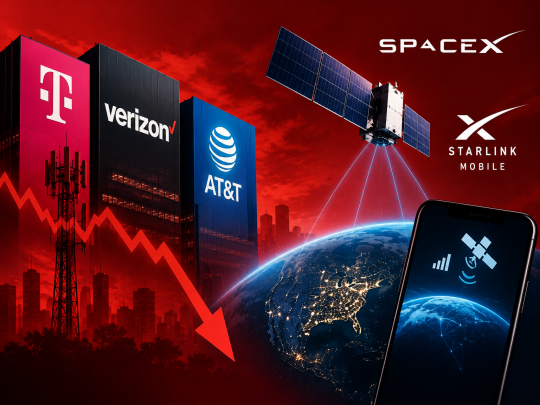
T-Mobile US Inc., Verizon Communications Inc. and AT&T Inc. shares fell sharply on Friday after SpaceX said it would buy a nationwide slice of radio spectrum, handing Elon Musk's company a potential new weapon in its push to compete directly with the largest names in American wireless.
T-Mobile (NASDAQ: TMUS) dropped about 13.3% to close near $148.58, the biggest decline of the three, and traded close to its 52-week low during the session. AT&T (NYSE: T) fell about 9.8% to around $22.18. Verizon (NYSE: VZ) slid about 8.75% to around $41.65, one of its worst single-day drops in years. All three ranked among the biggest losers in the S&P 500. European telecom stocks also weakened in sympathy.
The message from the market was blunt: a business long viewed as a stable, dividend-paying oligopoly now has a credible, deep-pocketed challenger. Whether that challenge turns out to be real is a question that will take years to answer. Investors, however, chose to price the risk in a single day.
What SpaceX Is Buying
On Thursday, October 8, SpaceX announced a definitive agreement to acquire 100% of Grain Management's nationwide portfolio of low-band spectrum in the 800 MHz range. The package covers up to about 14 MHz of paired spectrum across essentially the entire United States. The reported price is roughly $8 billion in cash, though the parties have not officially confirmed the terms. The deal still needs approval from the Federal Communications Commission and must satisfy other closing conditions.
For readers who don't follow the telecom industry closely, a quick explanation: spectrum is the range of radio frequencies that carries wireless signals, including your phone calls, texts and data. It is a limited public resource, and in the U.S. the FCC decides who gets to use which pieces of it. Companies that hold licenses get exclusive rights to broadcast on a given frequency in a given area, which is why they are willing to pay enormous sums for them.
Not all spectrum is equal. Think of it as a choice among different kinds of roads:
- Low-band spectrum (roughly 600 to 900 MHz) travels long distances and pushes through walls and trees. It is excellent for rural coverage and for getting a signal indoors, but it can't carry as much data at once.
- Mid-band spectrum (roughly 1 to 6 GHz) balances range and capacity, and it is the workhorse of modern 5G.
- High-band or millimeter-wave spectrum moves huge amounts of data very fast, but over short distances and with poor penetration through buildings.
The 800 MHz block SpaceX is buying falls squarely in the first category, and that is exactly why it matters.
The Missing Piece in Starlink's Puzzle
SpaceX has spent the past several years building what the industry calls direct-to-device service, which lets ordinary smartphones connect to satellites without special hardware. It has partnered with carriers, including T-Mobile, in some markets. It has also acquired other spectrum, notably large blocks from EchoStar in deals totaling roughly $19 billion to $20 billion, and has launched hundreds of satellites capable of talking directly to phones.
The regulatory runway has been widening too. Around October 6 to 7, the FCC approved SpaceX to deploy up to 15,000 next-generation direct-to-device satellites, a big step up from the roughly 650 currently in orbit with higher capacity per satellite.
Still, there was a technical gap. SpaceX's existing mid-band spectrum, around 2 GHz, provides capacity. But signals at those frequencies struggle to penetrate buildings. A phone sitting inside a house, an office or a parking garage has a hard time hearing a satellite hundreds of miles overhead. Low-band spectrum helps solve that problem because it travels farther and passes through obstacles more easily. It also works with most phones already in people's pockets, which lowers the hurdle of getting customers onto a new network.
SpaceX said the 800 MHz holdings would help Starlink Mobile become a more competitive U.S. mobile carrier by combining its satellite constellation with terrestrial capabilities. In plain terms, the company is describing a hybrid network, with satellites covering vast areas and some ground-based infrastructure filling in where signals need extra help. Musk and the company framed the purchase as a significant step that could target existing wireless customers, a point that did not go unnoticed on Wall Street.
A Very Quick Flip
The origin of this spectrum makes the story more interesting. The 800 MHz block dates back to older networks in the Nextel and Sprint lineage. T-Mobile inherited it through its merger with Sprint but treated it as underused, especially compared with its preferred 600 MHz low-band holdings, which it has built out more extensively for 5G.
In March 2025, T-Mobile reached an agreement in principle to sell its nationwide 800 MHz portfolio to Grain Management, a private equity firm focused on digital infrastructure. In exchange, T-Mobile was to receive cash plus Grain's 600 MHz licenses. The FCC approved the transfer on July 1, 2026, and the deal closed on August 11, 2026. T-Mobile received about $2.9 billion in cash along with the additional 600 MHz spectrum, which strengthens its existing low-band coverage.
Less than two months later, Grain had a buyer willing to pay a reported $8 billion for the same portfolio. That is a substantial gain in a short period, and it says something about how SpaceX values the asset compared with how a traditional carrier did.
The gap is worth pausing on. T-Mobile did not lose a crown jewel here. It sold what it considered an underused asset, took cash and got spectrum it prefers. The value SpaceX sees in the 800 MHz block comes from what the company plans to do with it, not from how the block was being used before.
Why Investors Hit the Sell Button
The selloff began in after-hours and premarket trading following the announcement and accelerated through Friday's session. Several things were happening at once.
First, the competitive threat looks more credible. For years, investors have asked whether satellite-to-phone services could ever become more than an emergency backup or a rural add-on. SpaceX now has deep capital, a growing constellation, mid-band spectrum and, if regulators approve, low-band spectrum that fills a technical weakness. That combination moves the company closer to offering a mobile service that doesn't depend entirely on partnering with a terrestrial carrier.
Second, the market structure matters. The U.S. wireless industry is effectively dominated by three companies. That structure has supported relatively stable pricing and predictable cash flows, which is why these stocks are popular with income-focused investors. A new competitor with a different cost structure, and one that isn't bound by the need to build a tower on every hill, threatens the assumptions behind those valuations. Even a modest increase in pricing pressure or customer churn can matter when a company's value rests on steady, long-lived profits.
Third, analysts flagged the disruption risk. Scotiabank cut its price targets on all three carriers while, in some cases, leaving its ratings unchanged. Other research notes pointed to the deal as a clear sign of SpaceX becoming a more aggressive spectrum buyer. The takeaway from the sell side was not that the carriers will lose customers tomorrow, but that the range of possible outcomes five or ten years out has widened, and the downside tail is now fatter.
Fourth, the reaction was sector-wide. The selling was not about any single company's earnings or management. Tower owners and other infrastructure plays did not drop in the same way, which suggests investors were repricing carrier competition specifically rather than the entire telecom ecosystem.
Other Forces at Work
SpaceX was the dominant explanation for Friday's moves, but it wasn't the only one. Dividend-oriented and telecom stocks have also felt pressure from rising Treasury yields. When government bonds pay more, high-yielding stocks look less attractive by comparison, and investors sometimes rotate out of them.
There was also a technical factor. AT&T and Verizon both traded ex-dividend on Friday, meaning new buyers no longer qualified for the next payout and the share prices adjusted lower by roughly the amount of the dividend. That mechanical effect was small relative to the size of the declines, but it added to the day's red ink.
Neither of these factors explains a drop of nearly 9% to 13%. They help explain why the selling felt so broad and so heavy.
Not All Three Are Equally Exposed
It's tempting to lump the carriers together, but their situations differ.
T-Mobile suffered the largest decline, which may reflect a few things. It has been the growth story among the three in recent years, so its shares may have carried higher expectations. It is also the carrier that has partnered with SpaceX in some markets, which adds an awkward layer: a collaborator could become a rival. At the same time, T-Mobile already monetized this specific spectrum and picked up useful 600 MHz holdings in return. The impact on T-Mobile is therefore more about future rivalry than about lost assets.
Verizon and AT&T have large customer bases and heavy investment in their own networks. Their stocks are widely held for dividends, and a shock to the perceived safety of that income stream can drive sharp reactions. Verizon's decline, in particular, ranks among its worst single-day drops in years.
One point to keep in mind: the stocks fell in lockstep, but the fundamentals of each business did not change overnight. Subscribers didn't switch carriers on Friday. Network performance didn't deteriorate. What changed was the market's estimate of what these businesses could be worth in a world with a better-funded competitor.
The Threat Is Real, but It Isn't Immediate
It is important to separate headlines from timelines. Several steps stand between Friday's announcement and a SpaceX that seriously competes for the average American's phone plan.
- Regulatory approval. The Grain acquisition needs FCC clearance. The agency's chairman, Brendan Carr, publicly welcomed the competitive angle, which could be read as a favorable sign, but approval is not guaranteed and conditions may apply.
- Satellite deployment. The newly approved constellation of up to 15,000 direct-to-device satellites has to be built, launched and brought into service.
- Terrestrial build-out. A hybrid network implies ground infrastructure, and that takes time and money.
- Devices and ecosystem. Even though low-band spectrum is already supported by most phones, the full set of device support, software and customer-service operations has to come together.
- Capacity limits. Analysts have noted that limited spectrum depth still constrains pure satellite performance in dense urban areas without ground infrastructure. A satellite can only serve so many people in a crowded city at once.
In other words, this is a multi-year story. Nothing about the deal suggests that Verizon, AT&T or T-Mobile will lose a meaningful share of their customers in the next quarter or two. But markets are forward-looking, and they tend to react to the direction of travel, not just the current location.
What It Means for Everyday Investors
For retail investors who own these stocks, often as core income holdings, Friday raises a few practical questions. None of what follows is a recommendation, but it may help frame your thinking.
Understand why you own it. If you hold a carrier for its dividend and steady cash flow, ask whether the long-term durability of those profits has changed. The near-term numbers haven't, but the risk profile arguably has.
Separate noise from signal. A one-day drop of 9% to 13% in large, mature companies is unusual, and part of it reflects how crowded the trade in telecom dividend stocks had become. Sharp, headline-driven selloffs can overshoot, and they can also be the start of a longer repricing. It is hard to know in real time which is which.
Watch the regulatory process. The FCC's review will be a key signal. Conditions attached to approval, or delays, could change the competitive picture.
Watch SpaceX's actual rollout. Announcements are cheap. Subscriber numbers, pricing, coverage maps and customer reviews will tell investors far more about how serious the challenge is.
Mind concentration. If a large part of your portfolio sits in a handful of telecom or high-dividend stocks, Friday was a reminder of how correlated they can be when sentiment shifts.
Who Wins, Who Loses
SpaceX is the clear near-term winner. It gains scarce spectrum that most existing phones can already use, and it moves closer to operating as a more independent mobile provider, especially for rural and indoor coverage.
Grain Management is the financial winner. It acquired an underused portfolio in a deal valued at roughly $2.9 billion in cash and spectrum and, per reports, is selling it for about $8 billion within about two months.
The traditional carriers are the losers in perception, if not yet in fact. Their stock prices reflect an expectation of tougher competition rather than any immediate loss of customers or assets.
Consumers could be long-term winners. More competition can lower prices, improve coverage in rural areas and dead zones and spur innovation. That outcome depends on SpaceX's ability to deliver reliable, high-capacity service at scale, and on regulators making sure the market stays competitive.
The Bottom Line
Friday's selloff was a story about expectations, not earnings. SpaceX bought a piece of the airwaves that fills a gap in its Starlink Mobile ambitions, and the market immediately asked what that means for the three companies that have shared the American wireless market for years. The answer, at least for one trading session, was that the risk is higher than previously assumed.
The path from spectrum purchase to real competition is long, with regulatory, technical and commercial hurdles along the way. But investors have seen how quickly well-funded newcomers can disrupt established industries, and they weren't willing to wait for proof. For anyone holding the carriers, the coming months will be about watching whether the threat shrinks into a footnote or grows into the defining issue for the sector.
This article is for informational purposes only and does not constitute investment advice. Share prices and percentage moves are approximate. Deal terms, including the reported $8 billion price, have not been officially confirmed by the parties.
Related post