Why Telecom Stocks NASDAQ:TMUS, NYSE:VZ and NYSE:T Fell Up to 13%, and How Big the SpaceX Risk Is
T-Mobile, Verizon and AT&T lost up to 13% in a day. The direction of the risk looks real. The size and speed of the repricing is harder to defend.

- Oct 11, 2026
- 5 min read
Share this article
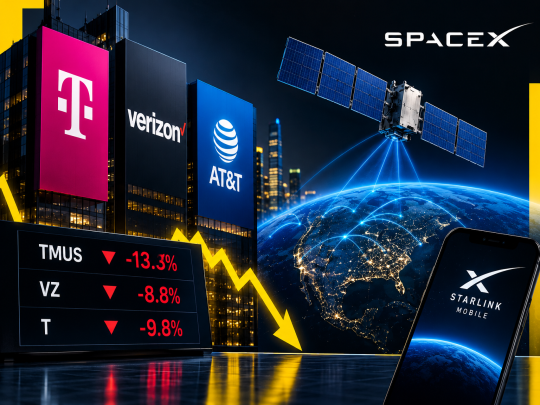
When shares of three of America's largest companies fall 9% to 13% in a single session, investors tend to assume something broke. On Friday, October 9, T-Mobile (NASDAQ: TMUS) dropped about 13.3%, AT&T (NYSE: T) fell about 9.8% and Verizon (NYSE: VZ) slid about 8.75%, after SpaceX announced a deal to buy nationwide low-band spectrum.
But nothing broke. No customers left. No network went down. No earnings were missed. What changed was a story about the future. So the question for anyone holding these stocks is simple: is the market correctly spotting a real long-term threat, or is it panicking over a headline?
The honest answer is a bit of both. Here is the case for each side.
The Case That the Threat Is Real
SpaceX is not a typical newcomer. Plenty of companies have promised to disrupt wireless and failed, largely because building a national network costs a fortune. SpaceX has already cleared that hurdle in a different way. It has deep capital, a satellite constellation and a track record of doing things incumbents said were too hard.
It has been quietly collecting the pieces. SpaceX previously acquired large spectrum blocks from EchoStar in deals totaling roughly $19 billion to $20 billion. This week the FCC approved up to 15,000 next-generation direct-to-device satellites, a large jump from the roughly 650 currently in service. Now it is buying Grain Management's nationwide 800 MHz portfolio, up to about 14 MHz of paired spectrum, for a reported $8 billion. That is a pattern, not a one-off.
The deal fixes SpaceX's biggest technical weakness. Its existing mid-band spectrum, around 2 GHz, offers capacity but struggles to reach phones inside buildings. Low-band spectrum travels farther and passes through walls more easily, and most phones already support it. In other words, it targets exactly the gap that separated satellite-to-phone service from a true mobile carrier.
The company is saying the quiet part out loud. SpaceX described a hybrid network of satellites plus terrestrial capabilities and said it wants Starlink Mobile to be a more competitive U.S. carrier. Elon Musk and the company framed the deal as a step that could target existing wireless customers. This isn't a partnership posture. It is a competitor's posture.
The industry structure makes it matter. U.S. wireless is effectively a three-player market, which supports steady pricing and predictable cash flows. Those qualities are why these stocks are favorites for income investors. A fourth player with a different cost structure does not need to win a large share to pressure prices. Even modest competition can change the math for businesses valued on stable profits.
Smart money is paying attention. Scotiabank cut price targets on all three carriers and flagged higher disruption potential from hybrid satellite-terrestrial networks. Analysts also described the deal as a clear sign of SpaceX becoming a more aggressive spectrum buyer.
The Case That It Is Panic
The timeline is long. The deal still needs FCC approval. Satellites have to be built and launched. Ground infrastructure has to be deployed. Devices, software, billing and customer support all have to work at scale. Competing for the average American's phone plan is a multi-year project, and the stocks priced in a lot of that future in one day.
Fourteen megahertz is helpful, not unlimited. The spectrum is valuable for coverage, but coverage is not the same as capacity. Analysts have noted that limited spectrum depth still constrains pure satellite performance in dense urban areas without ground infrastructure. A satellite can only serve so many people in a crowded city at once. The big carriers have large, dense networks built for exactly those places, where most of their customers live and most of the data is used.
Not every loss is a loss of assets. T-Mobile already sold this spectrum to Grain, in a deal that closed in August, for about $2.9 billion in cash plus Grain's 600 MHz licenses. T-Mobile considered the 800 MHz block underused and kept the low-band holdings it prefers. So the damage to T-Mobile is about future rivalry, not about something it lost. A 13% drop for a company that didn't lose a single asset is a big reaction.
Other forces piled on. Rising Treasury yields have been pressuring dividend-oriented stocks, since higher bond payouts make high-yield shares less attractive. AT&T and Verizon also traded ex-dividend on Friday, which mechanically lowers the share price. Neither explains the full drop, but both can make a selloff feel more severe and more broad than the news alone justifies.
The selling was sector-wide, which is a clue. The reaction wasn't tied to any company's earnings or management. Tower and other infrastructure stocks did not fall the same way. When everything in a group drops together on a single headline, some of the move is usually positioning, with investors who were already worried using the news as a reason to exit.
Regulation cuts both ways. FCC Chair Brendan Carr welcomed the competitive angle, which may help the deal. But regulators also decide timing and conditions, and the process can be slow or messy. Any delay or restriction changes how fast the threat arrives.
So Which Is It?
The most defensible reading is that the direction of the risk is real and the size of the move is debatable.
The direction is real because SpaceX has assembled capital, satellites, spectrum and regulatory support at the same time. A year ago, a hybrid satellite-and-ground carrier seemed like a long shot. After this week, it looks like a plausible competitor, and markets are right to assign it a higher probability than before.
The size is debatable because Friday's drop assumes the threat arrives quickly and bites hard. That requires several things to go right for SpaceX: approval, execution, capacity in cities, customer adoption and pricing that lures people away from carriers they already know. The more of those that slip, the more the selloff looks like an overreaction.
A useful way to think about it: the market didn't say the carriers are broken. It said their future profits are less certain than yesterday, and it lowered the price it was willing to pay for that uncertainty. The question is whether it lowered the price by the right amount.
What to Watch
Rather than guessing, retail investors can track a few signals that will show which side is winning.
- FCC review. Approval, delays or conditions on the Grain transaction.
- Satellite deployment. How quickly the newly approved constellation actually goes up.
- Commercial launch details. Pricing, plans, coverage maps and who the service is aimed at. Rural and indoor coverage is one thing. Winning city customers is another.
- Carrier responses. Whether the big three cut prices, bundle more aggressively or cooperate with SpaceX. T-Mobile already partners with the company in some markets.
- Customer data. Subscriber additions and churn in upcoming earnings reports. Real competition shows up in the numbers before it shows up in slogans.
- Interest rates. Part of the pressure on these stocks has little to do with SpaceX, so bond yields matter too.
What It Means for Investors
If you own these stocks, Friday is a prompt to check your reasons. Those who hold for dividends and stability should consider whether that stability is as secure as it seemed. Those who see an overreaction should remember that sharp selloffs can overshoot, but can also be the start of a longer repricing. It is hard to tell the difference in real time.
It also helps to remember how concentrated these positions can be. Many income-focused portfolios hold several telecom and high-dividend names at once, and Friday showed how closely they can move together when sentiment shifts.
The Bottom Line
This was not a pure panic, and it wasn't a verdict that the old carriers are doomed. It was a repricing of risk, probably a little too fast and a little too large, in response to a threat that is real but still years from proving itself. The coming months of regulatory decisions, satellite launches and customer numbers will show whether Friday looks like a warning that was ignored or an overreaction that was bought.
This article is for informational purposes only and is not investment advice. Prices and percentage moves are approximate. The reported $8 billion price has not been officially confirmed by the parties, and the deal remains subject to FCC approval.
Related post