The Jensen Huang Story: From a Denny’s Booth to the Boardroom Exit
Jensen Huang took Nvidia from a Denny’s booth to the centre of the AI boom. His sudden exit shows how much of that rise depended on one man.

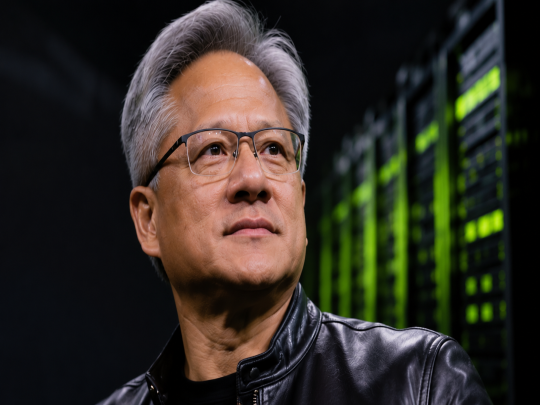
How a boy sent to a Kentucky reform school built the company at the heart of the AI boom, and lost it in a week
The booth at the Denny's on Berryessa Road in East San Jose is unremarkable. Late in 1992 three engineers sat there for hours, nursing what one of them later called "one bottomless cup of coffee", and sketched a company. Thirty-three years later, on November 12th 2026, that company issued a short statement. Jensen Huang, its co-founder and only chief executive, had resigned, effective immediately. The board thanked him for his "immeasurable contributions". Mr Huang himself said nothing.
Between those two moments lies one of the great stories in American business, and a warning. The qualities that made Nvidia (NASDAQ:NVDA) were the same ones that made it fragile. These were a single man's conviction, his personal web of relationships and his willingness to bet the company again and again. A firm built so completely around one person could rise further than almost any before it. When that person fell, it had no one ready to take his place.
The Outsider
Huang Jen-Hsun was born in Taipei in 1963 and spent part of his early childhood in Thailand, where his father worked at an oil refinery. When he was nine, unrest there led his parents to send him and his older brother to relatives in Washington state. The relatives in turn sent the boys to a boarding school in Kentucky. It turned out not to be the school they thought. The Oneida Baptist Institute was a religious academy for troubled youths, and the uncle had mistaken it for a prestigious school.
The boy cleaned toilets every day, was bullied and learned to look after himself. He never treated it as a grievance. Decades later he would tell Stanford students he had cleaned more toilets than all of them combined, and in 2019 he gave the school $2m for a building that bears his name. Out of Kentucky came the creed he preached for the rest of his career. Greatness, he argued, comes from character, and character comes from suffering. To one Stanford audience he wished "ample doses of pain and suffering".
His parents eventually joined their sons in Oregon. As a teenager he waited tables at a Denny's. He studied electrical engineering at Oregon State and went on to design microprocessors at AMD from 1983 to 1985, before joining LSI Logic, a chipmaker, where he rose to run its CoreWare division. He earned a master's degree from Stanford at night along the way. At LSI he was assigned to a demanding client, Sun Microsystems, and to two of its engineers, Chris Malachowsky and Curtis Priem. The three became friends. When Sun's graphics plans shifted, the two Sun engineers wanted out, and they asked Mr Huang to join them.
The Bet on a Booth
Nobody wanted to jump first. Mr Huang's wife, Lori, did not want him to quit LSI unless Mr Malachowsky left Sun at the same time, and Mr Malachowsky's wife felt the same way about Mr Huang. Mr Priem broke the deadlock by resigning first. The company was incorporated in April 1993 with $40,000 in the bank, and soon raised $20m of venture capital from Sequoia Capital and Sutter Hill Ventures. The name came from invidia, the Latin for envy.
The idea was a chip to make video-game graphics faster and more realistic. It was an idea shared by dozens of other start-ups, and Nvidia's first attempt nearly killed it. Its debut chip, the NV1, rendered images in a way the rest of the industry did not adopt. A contract to design graphics for Sega's next console went badly. By 1996 Nvidia was close to running out of money.
What Mr Huang did next became company legend. He flew to Japan, told Sega the truth and asked its president to turn the money still owed into a $5m equity investment. Sega agreed. Nvidia laid off half of its 100 staff and bet everything on a single new chip. When the RIVA 128 launched in August 1997, the company had one month's payroll left. It sold a million units in four months.
From that ordeal came the company's unofficial motto: "Our company is thirty days from going out of business." Nvidia went public in 1999 and the same year launched the GeForce 256, which it marketed as the world's first graphics processing unit, or GPU.
The Long, Lonely Bet
For the next decade Nvidia was a good business that few outsiders found interesting: a maker of graphics cards for gamers. Then Mr Huang made the decision that defined his career. In 2006 the company introduced CUDA, a platform that let programmers use the GPU's many small processors for general computing rather than just graphics. It added cost to every chip and had no obvious market. Shareholders were sceptical, and for years the bet looked expensive and unrewarded.
The payoff came from a bedroom in Toronto. In 2012 a team of researchers trained a neural network called AlexNet on two Nvidia gaming cards. It won the ImageNet image-recognition contest with an error rate of about 15%, against 26% for the runner-up, an enormous margin in a field that usually moved by fractions of a point. Deep learning had arrived, and it ran on Nvidia's chips and software.
Mr Huang moved quickly. In 2016 Nvidia launched the DGX-1, a machine built for AI, and he personally delivered the first one to a small non-profit lab in San Francisco called OpenAI. On its casing he wrote a dedication "to the future of computing and humanity". Six years later that lab released ChatGPT.
The World's Most Valuable Company
Before ChatGPT appeared in late 2022, Nvidia was worth about $400bn. What followed had no precedent. The race to build large language models made Nvidia's data-centre chips the most sought-after product in technology, and its H100 processors were rationed like a scarce commodity. Nvidia crossed $1trn in market value in 2023, $2trn in February 2024 and $3trn that June. In July 2025 it became the first company ever worth $4trn, and three months later the first worth $5trn.
The products kept coming. Its next generation, Blackwell, was sold out well into 2026, and Vera Rubin, its successor, was due in the second half of the year. Revenue, $4.1bn in fiscal 2014, reached $216bn in fiscal 2026. In October 2026 the shares hit a record close, valuing Nvidia at about $5.76trn and putting $6trn within sight.
Mr Huang became the industry's star turn. In his black leather jacket he filled arenas for product launches, and in Taiwan his visits set off a frenzy known as "Jensanity". He ran the company in a way no management textbook recommends: around 60 people reported directly to him, with no one-on-one meetings and no obvious second-in-command. Admirers saw speed and transparency. Others saw a company that depended, to an unusual degree, on one man.
The Central Bank of AI
As the boom grew, Nvidia began spending its fortune to make sure the boom continued. It took stakes in its own customers. It held about 7% of CoreWeave, a "neocloud" that rents out Nvidia-powered computing, and agreed to buy up to $6.3bn of capacity that CoreWeave (NASDAQ:CRWV) could not sell to others. It invested in xAI, Elon Musk's AI venture, and in Intel (NASDAQ:INTC). In September 2025 it signed a letter of intent to invest up to $100bn in OpenAI to help fund new data centres. That pledge later stalled, but Nvidia has still put at least $30bn into the company.
The logic was simple. Nvidia's money helped customers buy Nvidia's chips, and its backing let young firms borrow at rates far closer to those paid by tech giants. Critics called it circular financing and recalled the telecoms-equipment makers that lent to their customers before the dotcom bust. By late 2026 Nvidia's obligations to other firms were estimated at about $400bn, and investors had taken to calling it "the central bank of AI". As one headhunter put it, Mr Huang was "connected financially to everybody".
Washington's Favourite
Mr Huang also became a statesman of sorts. He lobbied to keep selling chips to China despite American export controls, first the H20, designed to comply with them, and later the more powerful H200. He cultivated President Donald Trump, who called him a friend, and joined him on a trip to China in May 2026. In August, on stage at a conference, he took a call from the president and put it on speakerphone. "I'm with you all the way," Mr Trump told the room.
That closeness gave Nvidia a great deal of influence. It also made the company vulnerable. Mid-term elections in early November handed Democrats both chambers of Congress, and they promised scrutiny of Nvidia. Its shares fell by 9% in the week of the results.
One Week in November
The end came quickly. In late October and early November the New York Times reported that Mr Huang had developed a close relationship with Alice Huang (no relation), a former executive of Megaspeed, a Singapore-based data-centre firm and Nvidia customer. Megaspeed had faced scrutiny over whether it was steering Nvidia chips into China. American officials reportedly believed she was gathering intelligence for Beijing. China called the claim a smear. Nvidia at first said that its boss's dealings with her were not unusual.
On Sunday November 8th Mr Huang sent a letter to staff. It began: "I owe my family and all of you an apology." He admitted being unfaithful to his wife, took full responsibility and denied compromising national security or company secrets. The board said Mr Huang had been the target of a "foreign intelligence effort" and appointed a committee of independent directors to investigate. By Tuesday it had hired Wachtell Lipton, a law firm. On Wednesday the Times reported a second affair, this time with a senior Nvidia executive, and that the board had met to discuss the company's future. On Thursday Mr Huang resigned.
The shares fell by as much as 14% that day, and Nvidia's market value dropped below $4trn, more than $1.7trn below its October peak. Colette Kress, the finance chief for 13 years, became interim chief executive. Harvey Jones, a director since 1993, became the board's first-ever chairman. Lawmakers in both parties made clear that his departure would not end their inquiries. Mr Trump suggested Tim Cook of Apple as his successor.
One rival stood to gain. AMD (NASDAQ:AMD), now led by Lisa Su, saw its shares rise sharply that week. Ms Su is Mr Huang's first cousin once removed, though she has said they never met at family gatherings: "No family dinners."
What He Leaves Behind
Judged by what he built, Mr Huang belongs among the great founders of his era. He spotted parallel computing's potential years before anyone else, held his nerve when Nvidia was weeks from collapse, and bet billions on CUDA when shareholders wanted profits. Without him, the AI boom would have arrived later and looked very different.
But the same qualities made Nvidia fragile. A company organised around one man's judgement had no obvious successor. An industry partly financed by one company's balance sheet depended on that company's credibility. And a founder who had become a diplomat, lobbyist and celebrity faced risks that a chip designer never did.
Nvidia's technology, customers and cash will outlast him. Whether it can still dominate without him is a harder question.
Mr Huang spent three decades telling his staff that their company was always 30 days from going out of business. He meant it as a spur against complacency. In the end, it was not the company that ran out of time. It was the man who built it.