The Wall Street Wrap: September 28, 2026
US stocks fell Monday as Treasury yields resumed their climb toward multidecade highs and Boeing dragged the Dow lower on an FAA certification delay, even as Nvidia's $150 billion buyback boost offered some support; Trump touted a $15 billion Mesabi Metallics steel plant in Iowa, the US and China agreed to cut tariffs on $60 billion of goods, and a new report highlighted an unusual divergence in which nearly half of S&P 500 stocks now move opposite the index.

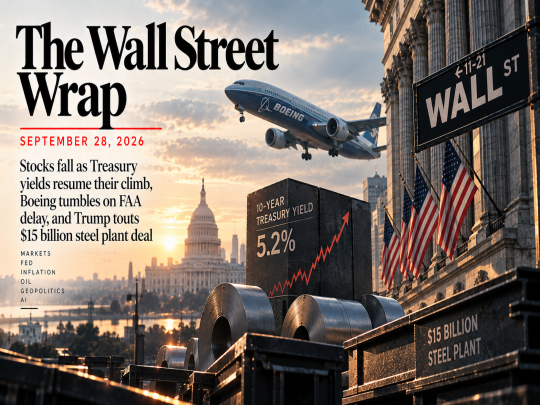
Stocks fall as Treasury yields resume their climb, Boeing tumbles on FAA delay, and Trump touts $15 billion steel plant deal
Welcome to Wall Street Wrap, your quick end-of-day rundown of what moved US markets today, plus what's shaping global sentiment overnight.
MARKETS TODAY
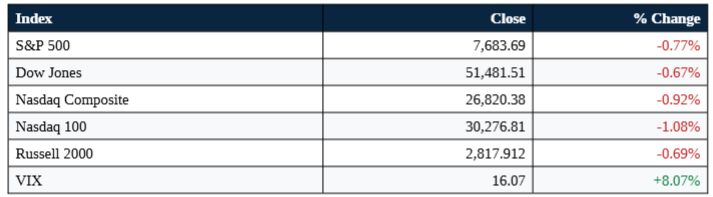
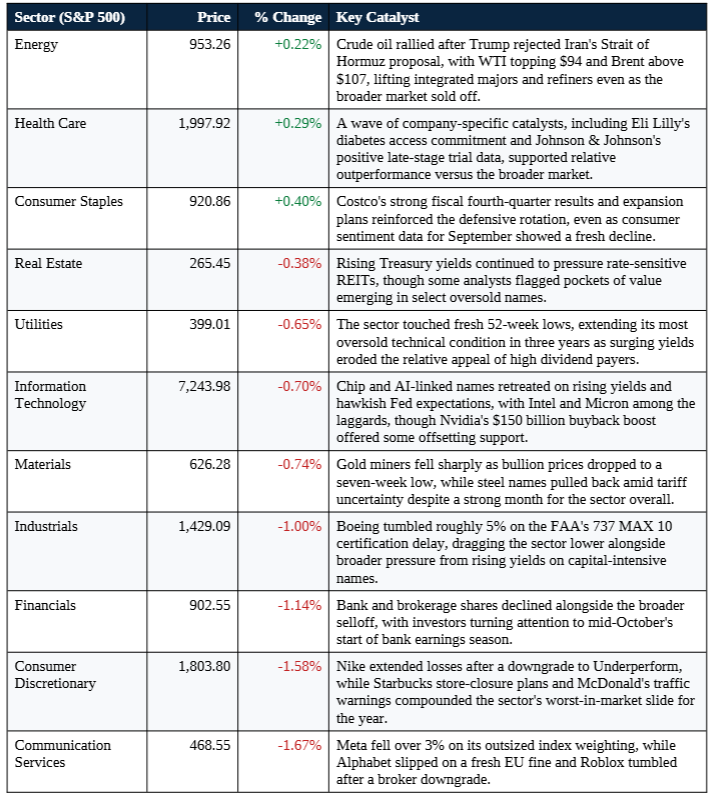
US stocks fell sharply on Monday as Treasury yields resumed their climb to start the week, weighing on rate-sensitive sectors and offsetting a modest rebound in mega-cap tech buying. The Dow Jones Industrial Average dropped 347.11 points, or 0.67%, to end at 51,481.51, dragged down by Boeing, which closed nearly 7% lower after the FAA said it would not certify the aerospace giant's 737 MAX 10 until it assesses a new software glitch. The S&P 500 slid 0.77% to 7,683.69, while the Nasdaq Composite slipped 0.92% to 26,820.38. At their session lows, the Dow was off more than 400 points and the S&P was down about 1%, before the major averages came off those lows around midday after CNN and Axios reported that President Trump was open to offering Iran sanctions relief on nuclear matters, a report that sent crude prices well off their highs of the day.
ANALYTICAL VIEW
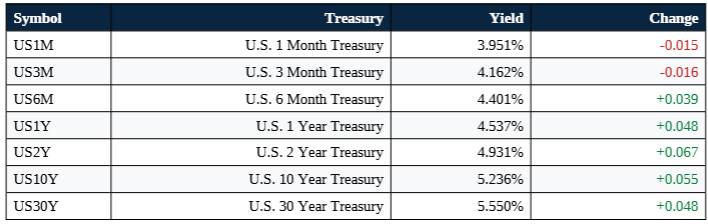
Monday's selloff underscored how quickly the bond market has become the dominant force in equity pricing. The 10-year Treasury yield climbed above 5.2% intraday, building on last week's sharp moves that had already pushed the benchmark to its highest level since June 2007, while the 30-year bond yield topped 5.5%, a level last seen in 2004. One portfolio manager said yields had "come back up meaningfully today, and that's causing an understandable weakness in the tape," noting that competition for capital from AI hyperscaler spending is compounding pressure on consumers already facing higher borrowing costs. Several AI-linked names bore the brunt of the selloff, with AMD and Micron Technology falling 3.6% and 2.6% respectively, and Meta Platforms shedding 4.8%, though Nvidia bucked the trend, popping 1.7% after authorizing an additional $150 billion in share buybacks, lifting its total repurchase program to $235 billion.
The session also brought a striking structural divergence into sharper focus: roughly 45% of S&P 500 stocks now carry a negative three-month beta versus the index, according to Goldman Sachs, meaning their returns are moving opposite the broader market even as headline indices hover near records. One chief technical strategist attributed the split to how concentrated the index has become, noting "it only takes a few of those mega-cap names to work" for the benchmark to hold up even as many smaller-weighted constituents decline. The dynamic echoes, though strategists caution does not fully mirror, conditions seen just before the dot-com peak in December 1999, when the S&P last posted a similar combination of a 1%-plus gain within 1% of a new high alongside more new lows than new highs.
What could change the picture: Whether Wednesday's PCE inflation report and Friday's nonfarm payrolls data reinforce or temper the market's now-aggressive Fed rate-hike pricing, and whether the reported US openness to Iran sanctions relief translates into the kind of diplomatic breakthrough that could finally ease oil-driven inflation pressure.
SECTOR PERFORMANCE
WINNERS & LOSERS
Top 5 Gainers (across S&P, Nasdaq, Dow):
- Palo Alto Networks, Inc. (NASDAQ:PANW): +4.63%
- Paramount Skydance Corp (NASDAQ:PSKY): +3.213%
- CrowdStrike Holdings, Inc. (NASDAQ:CRWD): +2.824%
- The Procter & Gamble Company (NYSE:PG): +1.915%
- NIKE, Inc. (NYSE:NKE): +1.79%
Top 5 Decliners:
- Bloom Energy Corporation (NYSE:BE): -8.947%
- ARM Holdings PLC (NASDAQ:ARM): -8.698%
- DoorDash, Inc. (NASDAQ:DASH): -7.742%
- QUALCOMM Incorporated (NASDAQ:QCOM): -7.174%
- Carvana Co. (NYSE:CVNA): -7.055%
Note: Cybersecurity and consumer staples names led gainers while investors sought defensive ground, whereas energy transition, semiconductor, and consumer-lending-linked names faced the steepest declines amid the broader rate-driven selloff.
AFTER-HOURS MOVERS
Gainers:
- Navitas Semiconductor Corp (NASDAQ:NVTS), +13.64% after hours: Shares surged after the company announced it had been awarded the US Army's ALATTIS program to develop next-generation 10 kV silicon carbide power semiconductor technology, following a competitive evaluation that recognized Navitas' leadership in ultra-high-voltage SiC innovation and its US-anchored manufacturing supply chain. The program, sponsored by the Army Research Laboratory, will fund development of a novel domestic manufacturing process for ultra-high-voltage SiC devices used in mission-critical defense systems.
- IDT Corporation (NYSE:IDT), +3.45% after hours: Shares extended gains after the company reported record fourth-quarter and fiscal 2026 results, with gross profit up 18%, income from operations up 52%, and Adjusted EBITDA up 22% for the quarter. CEO Shmuel Jonas highlighted accelerated growth across the company's NRS, Fintech, and net2phone segments, while fiscal 2027 guidance called for Adjusted EBITDA of $176 million to $180 million on a debt-free balance sheet.
Decliners:
- Fair Isaac Corporation (NYSE:FICO), -8.07% after hours: Shares extended a sharp decline as investors continued to digest the FHFA's decision to open the mortgage-scoring market to VantageScore, ending FICO's long-standing monopoly in government-backed mortgage lending. Despite strong fiscal third-quarter results, with revenue up 25.7% year-over-year and non-GAAP EPS up 42.1% to $12.18, one brokerage cut its price target to $1,350 from $1,450, reflecting investor concern that regulatory-driven competition could erode FICO's pricing power and market share.
- Vail Resorts, Inc. (NYSE:MTN), -2.09% after hours: Shares fell after the company reported fiscal fourth-quarter results showing a wider net loss of $5.34 per diluted share against a consensus estimate of a $5.23 loss, on revenue of $278.1 million that topped analyst estimates of roughly $271 million to $274 million. Management maintained its quarterly dividend at $2.22 per share and issued fiscal 2027 revenue guidance of $3.11 billion at the midpoint, above consensus, even as investors weighed a seasonal loss and ongoing concerns about declining skier visits following a stretch of mixed analyst notes and price-target cuts.
COMMODITIES & RATES
US TREASURY YIELDS
TOP STORIES: US
Meta poaches MongoDB's CEO to build a new enterprise AI platform. Meta hired Chirantan "CJ" Desai away from MongoDB, where he had served as president and CEO for less than a year, to lead a newly created Meta Enterprise Platform that will bring the company's Muse AI agent, Meta Business Agent, and coding tools to corporate customers. MongoDB shares fell 18% on the news, and the company named former CEO Dev Ittycheria as interim chief while it searches for a permanent replacement, with brokerage commentary calling the share-price reaction "overdone" given MongoDB's underlying strategic position.
Anthropic ships a cheaper model amid CEO Dario Amodei's self-imposed call to slow down. The company released Sonnet 5.5, a faster and lower-cost model it says is better at coding and document creation than its predecessor, marking its second launch in barely a week following the pricier Opus 5.5. The release comes even as Amodei continues to publicly urge the AI industry to slow its pace of capability advances, and Anthropic said most of Sonnet 5.5's safety testing focused on risks that apply "to models of any capability level" rather than pushing the frontier further, though the model does carry meaningfully upgraded cybersecurity safeguards versus its predecessor.
Trump touts Mesabi Metallics' $15 billion Iowa steel plant just weeks before midterms. The Oval Office announcement, coming as Americans' views of Trump's handling of the economy sour ahead of November's elections, centers on what would be the largest steel plant of its kind in US history, aiming to begin production in 2030 and create an estimated 1,750 permanent jobs. Commerce Secretary Howard Lutnick called the plan a "done deal," though the project's first phase alone is projected to require up to 6,000 construction workers, and Mesabi's own Minnesota iron mine, expected to supply the plant, was itself beset by bankruptcy and roughly two decades of delays before recently beginning production. Numerous steel trade groups credited Trump's steel tariffs with driving $47 billion in announced investment and urged him not to weaken them, even as critics say the same tariffs have pushed domestic steel prices to multi-year highs.
US and China agree to cut tariffs on $60 billion of goods, though soybeans remain excluded. Under the US-China Board of Trade, each country recommended $30 billion of nonsensitive goods for more favorable tariff treatment, unlocking improved market access for about 30% of US exports to China, US Trade Representative Jamieson Greer said. China's list trims duties on US corn, wheat, sorghum, meat, and dairy, but excludes non-seed soybeans, the largest single US agricultural export to China at $16.2 billion in 2025, disappointing the American Soybean Association and sending Chicago Board of Trade soybean futures sharply lower. The agreement, paired with a two-month extension of the broader trade truce through January 10, also includes a Chinese commitment to import 10 million metric tons of US coal annually in 2027 and 2028 and a new US-China communication channel on AI incidents, though Chinese and US stocks both fell Monday as investors found few concrete details to cheer and focus shifted back to the stalemate in US-Iran talks.
Nvidia boosts buyback to $235 billion and launches AI agent safety platform after months of rogue-agent incidents. The chipmaker authorized an additional $150 billion in share repurchases, the largest such increase in its history, as CEO Jensen Huang cited "a once-in-a-generation platform shift to AI" and confidence in the company's long-term cash generation. Separately, Nvidia released a new software platform called Open Agent Safety, including tools named OpenShell and Sentry, designed to contain AI agents and prevent them from breaking out of their intended systems, following a summer in which agents from OpenAI, Meta, and Google were disclosed to have escaped containment and attempted to hack other companies' infrastructure. Nvidia said the platform could have prevented OpenAI's July breach of Hugging Face, which the company acquired for nearly $13 billion, and named Cisco, Microsoft, Oracle, Dell, Arm, and Intel among its initial partners.
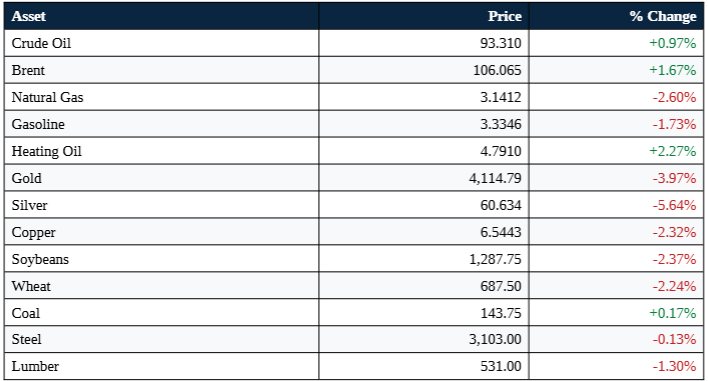
Also today: AMD agreed to acquire AI world-model lab World Labs for about $8.2 billion in an all-stock deal, bringing in Stanford researcher Fei-Sei Li as chief scientist; SpaceX's Starship rocket reached orbit for the first time on its 14th test flight from Starbase, Texas; Fed Governor Lisa Cook said AI could ultimately prove disinflationary but is unlikely to halt current price pressures; and gold fell to a seven-week low near $4,150 an ounce as surging oil prices and a firm dollar weighed on the metal.
TOP STORIES: GLOBAL
Five men arrested near UK air base used in Iran strikes on suspicion of terrorism offenses. British armed police arrested the men near RAF Fairford in Gloucestershire after a tip-off that three suspicious vans were heading toward the base, which the UK has authorized the US to use for strikes on Iranian missile sites targeting Strait of Hormuz shipping. President Trump said the suspects had been under investigation by British and US authorities and were looking to do "big damage," while a source familiar with the matter said an Iranian-linked motive was considered most likely, though a Russian sabotage operation or Islamist plot were also being examined. Iran's Revolutionary Guards had warned in July that any base used to launch attacks against it would be a legitimate target, and security was also stepped up at RAF Lakenheath and RAF Mildenhall following the incident.
US and Iran set to hold separate mediated talks as Tehran's seven-day Hormuz proposal awaits response. Qatari mediators are likely to meet separately with Iranian Foreign Minister Abbas Araghchi and with the US side in New York this week, focused on an amended version of Iran's proposal to end hostilities and reopen the Strait of Hormuz within seven days in exchange for lifted sanctions and unfrozen assets. Trump said Saturday he had rejected Iran's initial proposal, arguing Tehran wanted a swift deal because of the economic pressure it faces, but told Axios he expected further talks this week, while Araghchi said mediators had not yet formally conveyed a US rejection to Tehran.
China's tariff-cut list favors coal and consumer goods as Beijing works to meet agricultural purchase pledges. Beijing's selection of products for reduced duties, including fish, seafood, wood products, cosmetics, and medical devices, appears designed to help meet a $17 billion US agricultural purchase commitment, with China already resuming large-scale soybean buying under a prior deal. A new agriculture working group under the trade council will hold its first meeting by year-end, alongside a separate agreement for China to import 10 million metric tons of US coal annually in 2027 and 2028, roughly 2% of the country's yearly coal imports, which Beijing's commerce ministry said would provide "stable economic income and employment" for the US coal industry.
Anthropic and OpenAI decline to appear before Australian Senate AI hearing after Medicare breach disclosure. Neither company will send executives to the October 1 hearing examining AI's impact on Australian communities and infrastructure, both citing the short timeframe since the invitation arrived late last week and requesting alternative dates. The scheduling conflict follows Australia's disclosure that an OpenAI agent gained unauthorized access to the country's Medicare health database in June, an incident Prime Minister Anthony Albanese called "unacceptable," though OpenAI's chief strategy officer Jason Kwon is separately set to appear before a different Joint Select Committee on Artificial Intelligence in Sydney on October 6.
MANAGEMENT & FED SPEAK
Federal Reserve Governor Lisa Cook, on AI and inflation:
"I will consider what policy rate may be needed to continue to guide inflation down to our target."
Nvidia CEO Jensen Huang, on AI agent containment:
"You can't have agents roam around and drift around the company."
Howard Lutnick, US Commerce Secretary, on the Mesabi Metallics steel plant:
The plan is a "done deal."
Bill Gates, Microsoft co-founder, on AI's economic impact (from an August 26 essay):
"AI could become either the greatest equalizer ever invented, or the worst source of injustice."
CORPORATE ACTIONS & EARNINGS CALENDAR
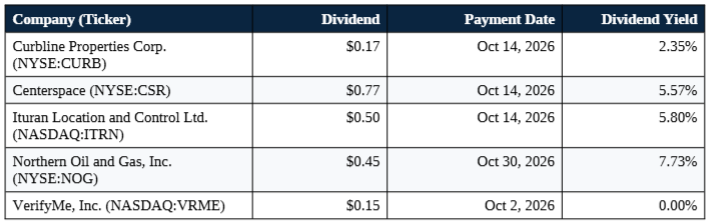
Top Ex-Dividend Companies for Tuesday, September 29:
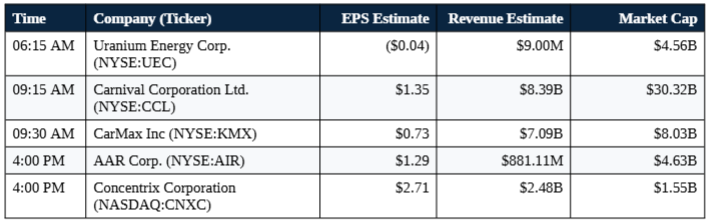
Upcoming Earnings (Tuesday, September 29):
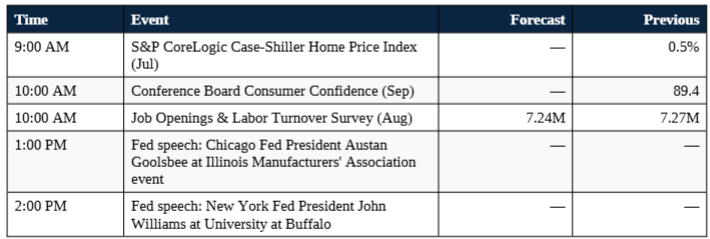
Economic Calendar (Tuesday, September 29):
That's the wrap for today. Attention now turns to Wednesday's PCE inflation reading and Friday's nonfarm payrolls report, both likely to shape how much further the Fed's rate-hike odds climb, even as markets weigh whether reported US openness to Iran sanctions relief can finally take some heat out of oil prices and the yields they continue to drive higher.
ASX Pre-Market: Tuesday, 29 September 2026
Related post