Wall Street Wrap: Pre-Market, October 6, 2026
U.S. futures rise as Treasury yields and oil prices ease and chipmakers climb, with the S&P 500 eyeing a fresh closing record ahead of Wednesday's Fed minutes. Option Care Health leads pre-market gainers on a $5.8 billion CD&R and McKesson buyout, while Constellation Energy jumps on a Google nuclear power deal. Trump's dyed-diesel order, Goldman's call for high diesel prices through 2027 and stepped-up Iranian tanker attacks add to the energy backdrop.

Futures rise as yields and oil retreat and chipmakers climb, while Option Care soars on a $5.8 billion buyout
Wall Street looks set for a firmer open on Tuesday as Treasury yields and oil prices retreat from recent highs and chipmakers rally, with Wednesday's Fed minutes the next big test.
Futures Snapshot
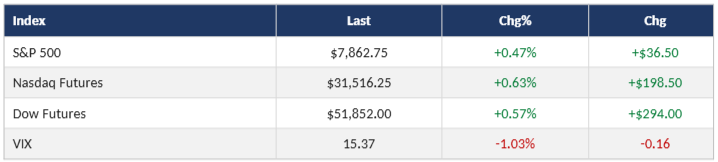
Futures rose Tuesday, boosted by gains in key technology names and declines in Treasury yields and oil prices, as the S&P 500 eyes a fresh closing record.
What's Driving the Open
The gains were led by chipmakers. Advanced Micro Devices (NASDAQ:AMD) rose nearly 2%, while Nvidia (NASDAQ:NVDA) and Broadcom (NASDAQ:AVGO) traded up just under 1%. Stocks are coming off a winning session in which the Nasdaq Composite reached an all-time high, and the tech-heavy index was set to build on that record.
Treasury yields eased from multi-decade highs. The 10-year yield was at 5.286% and the 30-year at 5.659%, after both reached levels last seen in 2002 on Monday. The Institute for Supply Management's services index came in at 54.9 in September, virtually in line with expectations and just below August's reading, while its prices index rose 1.4 points to 74. Traders now price a roughly 78% chance that the Fed keeps rates unchanged at its next meeting, according to CME's FedWatch tool, and the minutes of the September meeting, due Wednesday, are the event of the week.
Oil provided a second tailwind. Brent crude fell more than 2% to just under $98 a barrel, while WTI slipped to about $88. Morgan Stanley Wealth Management's Lisa Shalett said bonds have been volatile over the past six weeks, citing a potentially new Fed policy framework, economic growth and high oil prices as the Middle East conflict drags on, but noted that the stretch has not reached the extremes that catalyzed the 2022 equity bear market.
What could change the picture: Wednesday's Fed minutes could reset rate expectations in either direction, and any renewed attack on tanker traffic through the Strait of Hormuz would likely send oil, and yields with it, back toward their recent highs.
Overnight Markets
Asia markets closed mostly higher Tuesday. Japan's Nikkei 225 rose 1.05% to 70,683.98, while the broader Topix added 0.92% to 4,183.56. South Korea's Kospi fell 0.89% to 6,941.39, while the small-cap Kosdaq gained 2.98% to 919.92. Australia's S&P/ASX 200 advanced 0.57% to 8,735.7. Hong Kong's Hang Seng Index added 0.95%, while mainland China markets remained closed for the Golden Week holiday.
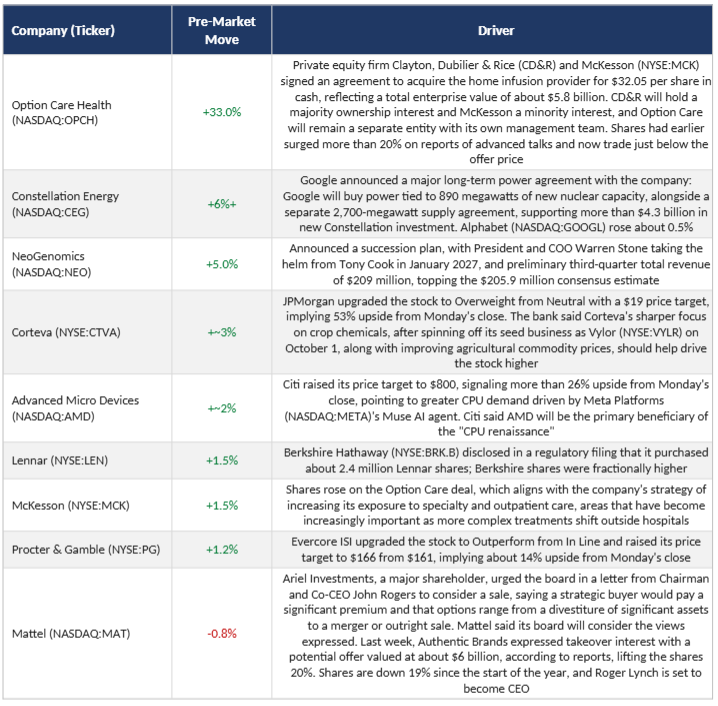
Pre-Market Movers
Rates, FX & Crypto
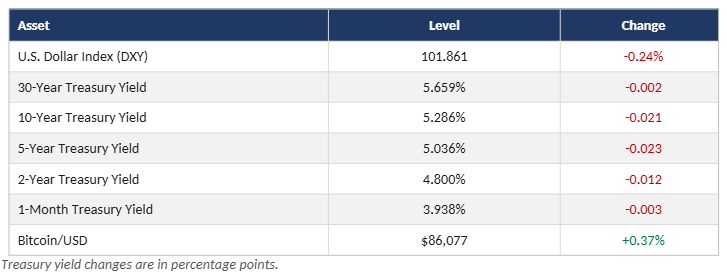
Government borrowing costs pulled back following a global selloff that pushed benchmark yields in major economies to their highest levels in decades. The German 10-year bund yield was down 5 basis points at 4:30 a.m. ET, while the French 10-year, which has come under severe pressure this year amid concerns about France's debt and fiscal spending, was down 9 basis points. Japan's 10-year yield dipped 1 basis point.
Commodities
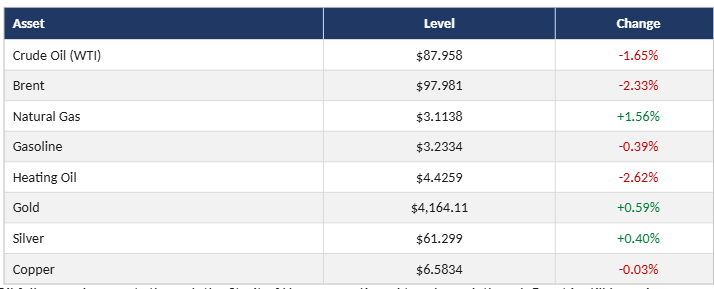
Oil fell as crude exports through the Strait of Hormuz continued to rebound, though Brent is still hovering near $100 a barrel. European gasoil futures dropped 5.75% on Friday after the G7 agreed to release 100 million barrels of crude and refined products over four months, including a front-loaded diesel release within the first 20 days.
Key Levels & Catalysts Today
Economic data
- The U.S. trade deficit widened sharply in August to $105.6 billion, the steepest since the all-time gap in March 2025, recorded just before the "liberation day" tariff announcement. Imports swelled 4.3% on an influx of goods related to the artificial intelligence buildout and the vagaries of import tariffs, pushing the imbalance 13.7% above July's and ahead of the $102 billion Dow Jones consensus. The year-to-date deficit of $138.2 billion is still off nearly 20% from the same period a year ago.
- Minutes from the Fed's September meeting are due Wednesday.
Corporate
- Anduril won an up to $2.9 billion contract with the U.S. Navy to boost submarine production, days after CEO Palmer Luckey was named to a Pentagon future weapons task force, Project Meridian, alongside former House Speaker Newt Gingrich and SpaceX (NASDAQ:SPCX) CEO Elon Musk. The company is also investing $3.7 billion to scale a new shipyard at Sparrows Point, outside Baltimore, slated to start operations in 2030. The more than 2 million-square-foot facility, dubbed Arsenal-2, will build components for the Virginia-class submarine, with some components, including torpedo tubes, made at a 160,000-square-foot facility in Orange County, California. Anduril said the site will provide $2 billion in economic output annually and create 3,100 jobs.
- Mistral unveiled Mistral Large 4, a 1-trillion-parameter model it called the strongest open-weight model developed outside China by a substantial margin. It was trained over two months on 4,000 Nvidia Grace Blackwell GPUs in Mistral's own European data centers and launches in preview to developers, cybersecurity leaders and state authorities before a wider release later this month. The French company raised 3 billion euros at a 21 billion euro valuation in September, and the new model still lags the frontier in areas such as coding. Nvidia-backed Reflection AI unveiled its first open model on Monday.
Top Stories
Trump allows cheaper, dyed diesel on highways to blunt a historic fuel cost spike ahead of the midterms. An executive order signed Monday evening temporarily lets truckers and farmers use red-dyed diesel, which is exempt from the 24.4-cent-per-gallon highway fuel tax, and defers the related taxes through the end of this year. Using dyed diesel on public roads is normally illegal and can bring fines for tax evasion, though several states have relaxed restrictions this year. The Treasury was directed to defer collection of the federal excise tax on highway diesel without interest or penalties, and to explore ways to eliminate the deferred obligation altogether. The national average price of diesel topped $6 a gallon in September for the first time, and Americans are spending about $700 million more per day on gas and diesel than a year ago, according to Rapidan Energy's Bob McNally. The White House says truckers could save more than $100 per fill-up.
Goldman Sachs says diesel prices will stay high through 2027 as refineries struggle to meet demand. The bank forecasts global diesel and jet-fuel crack spreads will average above $40 a barrel in 2027, more than twice their usual level of around $20, even as it expects Brent to stabilize near $80 as Hormuz flows normalize. Refining capacity outside China is expected to shrink by roughly 300,000 barrels per day this year, about 2 million barrels per day of Middle Eastern refining capacity remains offline, and product inventories could end 2026 below the lowest days-of-supply level since 2015. Saudi Aramco CEO Amin Nasser said emergency reserve releases "might buy us a winter," while CLSA's Baden Moore noted they solve a liquidity problem rather than the underlying stock problem, since inventories are being consumed rather than rebuilt.
Iran steps up attacks on tankers, threatening the fragile rebound in Hormuz oil exports. Nearly 20 commercial ships, mostly tankers, have come under attack over the past month, according to the Joint Maritime Information Center, and Windward estimates Iran attacked roughly two ships for every 100 that crossed the strait in the third quarter. Crude shipments averaged about 10.3 million barrels per day in the week ended Saturday, about 23% below a prewar baseline of 13.5 million, according to Kpler; Windward puts flows at 9 million to 10 million barrels per day against a 14.5 million baseline. The rebound depends on a major U.S. military commitment protecting a southern route along Oman's coast, and shipping a tanker from the Persian Gulf to China now costs about $1 million per day. Since July, at least nine sailors have died, 18 have been injured and three are missing, according to the International Maritime Organization. Lloyd's List editor Richard Meade said the oil market is becoming "more efficient at operating under sustained insecurity."
Meta's Muse agent is giving AMD a boost as AI momentum shifts toward personal agents. OpenAI released its agent, Dots, last week, following the lead of Meta's Muse, which debuted in early September and has passed 5 million downloads, according to Sensor Tower. Both agents report running on AMD-powered virtual computers, and Morgan Stanley estimates Meta's agent could account for 20% of AMD's 2026 chip sales. AMD shares have jumped 32% over the past month, beating all of tech's megacaps, and the company has joined the trillion-dollar market cap club. Futurum Group's Daniel Newman explained the shift this way: "CPUs are actually performing the workflows while GPUs are doing the thinking." Futurum now estimates $118 billion in total CPU sales in 2027, almost double its forecast from May.
The World Bank lifts its East Asia and Pacific growth outlook to 4.5% but warns of AI concentration risk. The bank raised its 2026 forecast by 0.3 percentage point from April, with Vietnam receiving the biggest upgrade among major economies, up 1.1 points to 7.4%. AI-related goods accounted for more than half of export growth in most of the region's economies and more than 70% in Malaysia, the Philippines, Thailand and Vietnam, while South Korea's September exports grew 83.5% to a record $120.9 billion, with chips making up half. The bank warned that a reversal in AI spending, which it said has reached about 6% of U.S. GDP and is expected to be partly financed by $800 billion of private credit, would remove "a key pillar" supporting growth.
Eyes on Wednesday's Fed minutes for how the committee frames its tightening cycle, and on whether oil's retreat and easing yields can carry the S&P 500 to a fresh closing record.
Related post
.png)