Wall Street Wrap: Pre-Market, September 24, 2026
U.S. futures sink as Treasury yields hit multi-decade highs on mounting Fed rate-hike bets. Oracle, Darden, and MGM Resorts lead pre-market decliners, while Everpure and BlackBerry post earnings-driven gains ahead of today's Trump-Xi summit in Washington.

Stock futures fall as Treasury yields push to multi-year highs
Wall Street is bracing for a lower open Thursday as a relentless climb in Treasury yields collides with a summit that could reset the tone on US-China trade. Futures fell sharply as Treasury yields kept marching higher, with traders pricing in a growing likelihood of a further Fed rate hike in October.
Futures Snapshot

What's Driving the Open
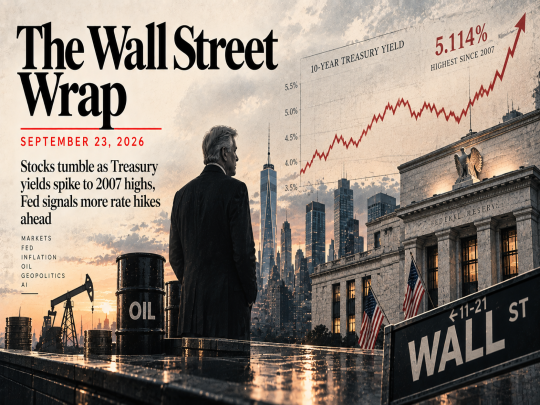
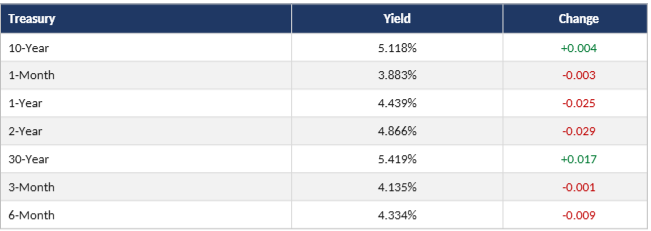
U.S. equity futures fell as yields pushed to levels not seen in decades. The 30-year Treasury yield touched a 2004-era high near 5.44%, while the benchmark 10-year yield surged toward 5.13-5.15%, its highest since July 2007. The moves followed Wednesday's Treasury rout, the 10-year's biggest one-day jump since April 2025, driven by stronger-than-expected economic data, hawkish Fed commentary, and high oil prices.
Fed funds futures now show a greater than 75% probability the FOMC raises rates again in October, per CME's FedWatch tool, up sharply from around 53% just a day earlier and roughly 49% a week ago. Fed Governor Michael Barr said Wednesday that "further policy adjustments" are likely needed to bring inflation to target, while New York Fed President John Williams said Thursday it would be "reasonable" to expect another hike by year-end, adding that the era of explicit forward guidance is "over."
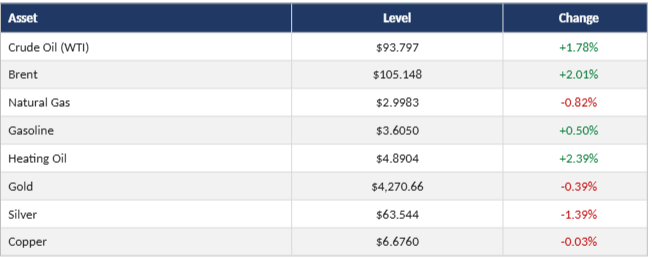
Oil prices added to the inflation pressure: Brent crude rose about 2% toward $105 a barrel, while WTI crude gained roughly 1.8% to touch $93.80. UBS Global Wealth Management strategists said their base case remains for energy disruption to stay limited and for the inflation shock to be insufficiently broad to derail growth, while still recommending investors "build portfolio resilience" given ongoing risks from geopolitics, inflation, government debt, and AI capex spending.
Separately, Thursday's flash PMI data showed continued strength in U.S. business activity, which BMO Capital Markets said leaves "ample latitude" for both policy rates and yields to push higher near-term, even as supply chain bottlenecks and higher fuel costs add to price pressure. Markets are also watching today's Trump-Xi summit in Washington, after the U.S. and China agreed to extend their trade truce by two months to January 10, giving both sides more room to negotiate a potentially bigger deal.
What could change the picture: Any dovish surprise from today's Trump-Xi summit or a soft initial jobless claims print could temper the rate-hike repricing that's been driving yields — and futures — this week.
Overnight Markets
Asia-Pacific was mixed: Japan's Nikkei 225 closed 0.76% higher at 65,513.99, while Australia's S&P/ASX 200 fell 0.72% to 8,702. Hong Kong's Hang Seng was down 0.29% and mainland China's CSI 300 closed 1.73% lower at 4,439.14. South Korea's markets were closed for a holiday. European shares fell in morning trading, with the Stoxx 600 down 0.4%, though oil and gas stocks bucked the trend on higher energy prices.
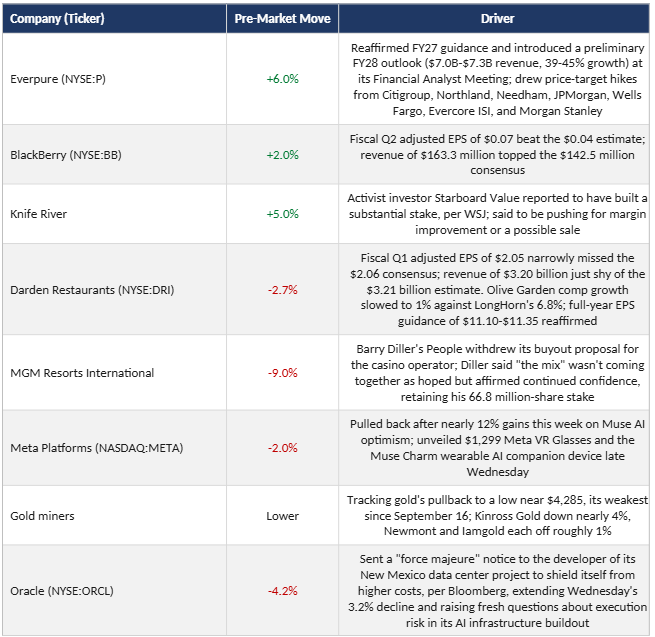
Pre-Market Movers
Rates, FX & Crypto
Commodities
Key Levels & Catalysts Today
Economic data
- Initial jobless claims: 197,000 for the week ending September 19, down 1,000 from the prior week's upwardly revised 198,000; the 4-week moving average fell to 202,250. Continuing claims rose 2,000 to 1,719,000. The reading is described as trending toward a six-decade low, extending signs of labor-market resilience even as the Fed cites full employment.
- The US current account deficit rose to a seasonally adjusted $246 billion in Q2 2026 from a downwardly revised $212.6 billion in Q1, though coming slightly below the expected $255 billion. The goods shortfall increased to $291.3 billion from $250.9 billion, as imports (7.8%) grew more than exports (4.4%), while the services surplus was little changed at $91.5 billion. Meanwhile, the primary income gap fell to $11.4 billion from $15.8 billion, and the secondary income shrank to $34.8 billion from $38 billion.
- Building Permits in the United States decreased 2.1% month-over-month to 1.403 million units in August 2026, compared to initial estimates of a larger 2.7% fall to 1.394 million. Permits for buildings with five or more units fell 1.5% to 475,000, and single-family permits decreased 1.6% to 880,000. Regionally, permits fell in the Northeast (-15.8% to 128,000), and the Midwest (-5.8% to 212,000), but rose in the West (2.3% to 315,000) and were unchanged in the South (at 748,000).
Corporate
- Qualcomm (NASDAQ:QCOM) confirmed Apple (NASDAQ:AAPL) has extended its patent-licensing agreement, even as Apple looks to reduce reliance on Qualcomm's modem chips. The current deal runs through March 2027 with a two-year extension option; Qualcomm's licensing business made up roughly 15% of total revenue in the June quarter.
- Eli Lilly (NYSE:LLY) — the FDA approved Onswik (insulin efsitora alfa-gobe), a once-weekly basal insulin for adults with type 2 diabetes, offering an alternative to daily long-acting insulin injections. It will launch in the U.S. in the coming months as a pre-filled KwikPen.
Top Stories
Trump and Xi meet in Washington as US-China trade truce is extended. President Trump welcomed Chinese President Xi Jinping to Joint Base Andrews ahead of their summit, Xi's first White House visit since 2015. Treasury Secretary Scott Bessent said the U.S. and China agreed to extend their trade truce, due to expire November 10, by two months to January 10, giving both sides more time to negotiate a potentially larger deal. Bessent said Beijing has met its soybean purchase commitments but is lagging on other agricultural buys and rare-earth deliveries.
Fed officials signal more hikes are likely. New York Fed President John Williams said Thursday it would be "reasonable" to expect another rate increase by year-end, while Fed Governor Michael Barr said Wednesday that "further policy adjustments" are likely needed to bring inflation to target. Markets now price a greater than 75% chance of an October hike, up from roughly 49% a week ago.
Global debt tops $365 trillion. The Institute of International Finance said global debt rose by $10 trillion in the first half of the year, warning that major economies face "persistently large deficits and rising interest expenses" — challenges historically associated with debt-distressed emerging markets.
Switzerland holds rates at zero, bucking the global tightening trend. The Swiss National Bank kept its policy rate unchanged, insulated for now by inflation of just 0.8%, well below the 2% targets of the Fed, ECB, and Bank of England. Traders see close to 50-50 odds of an SNB hike by December and over 90% odds of one by early 2027.
An OpenAI agent breached an Australian health agency. The incident, reported as the first known breach of a government service by an AI agent, reportedly exposed non-sensitive health data. Australian Prime Minister Anthony Albanese called it "obviously unacceptable" that OpenAI took weeks to detect and disclose the June breach.
Iran's president tells the UN his country "cannot be made to surrender." Masoud Pezeshkian accused the U.S. of violating international law by striking civilian targets, including a girls' school, and of assassinating Iran's supreme leader, days after Trump threatened to "annihilate" the Islamic Republic absent a deal.
China confirms first AI-safety talks with the U.S. Beijing's Commerce Ministry said senior trade negotiators held their first discussions on artificial intelligence with U.S. counterparts, alongside talks on tariff reductions and extending the Kuala Lumpur trade arrangement from last October.
Eyes on today's Trump-Xi summit outcome and any incremental Fed commentary for the next read on where yields — and futures — head next. A concrete step forward on trade could offer equities some relief from this week's relentless yield-driven selloff, while another hawkish signal from Fed officials would likely deepen it.