The Wall Street Wrap: September 23, 2026
US stocks tumbled as Treasury yields surged to their highest level since July 2007, driven by hotter-than-expected economic data and fresh hawkish commentary from Fed officials signaling more rate hikes are likely. Rising oil prices and record diesel costs continue to fuel inflation concerns, while tech weakness and rate-sensitive sector selloffs dominated the tape.

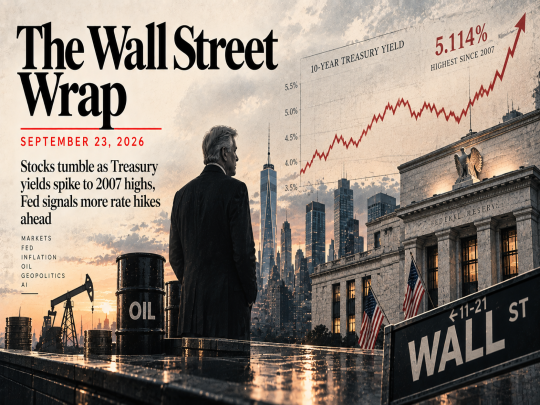
Stocks tumble as Treasury yields spike to 2007 highs, Fed signals more rate hikes ahead
Welcome to Wall Street Wrap, your quick end-of-day rundown of what moved US markets today, plus what's shaping global sentiment overnight.
MARKETS TODAY
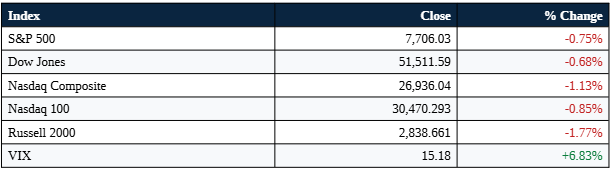
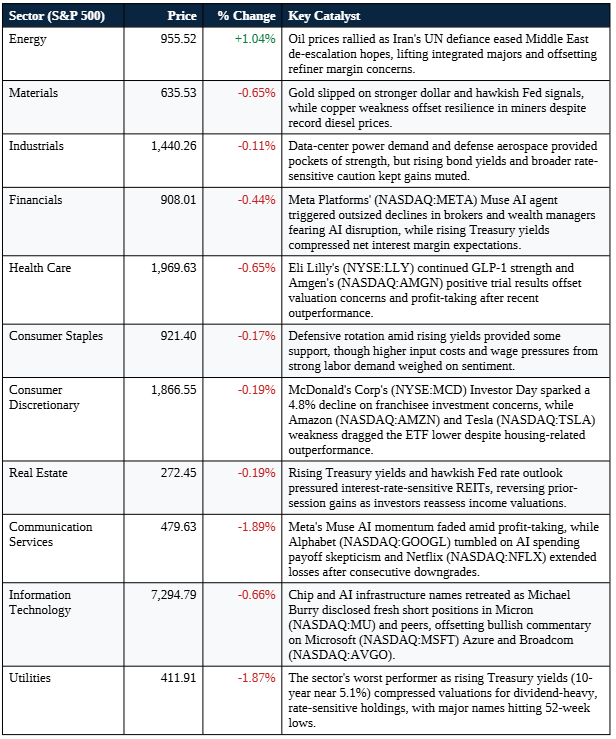
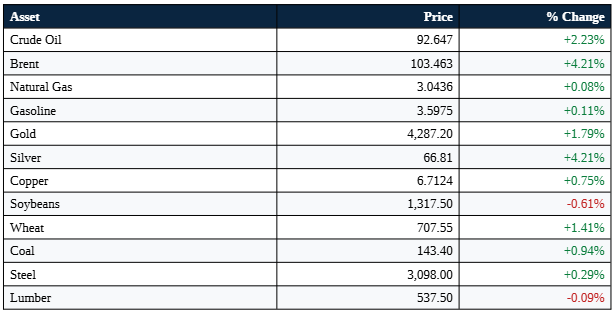
US stocks fell sharply on Wednesday as soaring Treasury yields and fresh hawkish commentary from the Federal Reserve spooked investors, with rising oil prices and inflation fears overshadowing resilient corporate earnings. The S&P 500 dropped 0.75% to 7,706.03, while the Nasdaq Composite shed 1.13% to close at 26,936.04. The Dow Jones Industrial Average fell 352.10 points, or 0.68%, to 51,511.59. Utilities and consumer discretionary stocks led the decline, each falling more than 1%, as rising Treasury yields compressed valuations for rate-sensitive sectors. The 10-year Treasury yield jumped 14.7 basis points to 5.114%, its highest level since July 2007 and the largest one-day move in 18 months, after stronger-than-expected purchasing managers' index readings and hawkish commentary from Fed Governor Michael Barr signaled policymakers have more work to do on inflation.
ANALYTICAL VIEW
Wednesday's selloff reflected a dramatic reassessment of Fed policy expectations after a wave of economic data showed the economy running hotter than anticipated. S&P Global's flash purchasing managers' indices hit their strongest levels in more than four years, with the services PMI jumping to 58.7 from 56.5 and manufacturing accelerating to 56.7 from 53.9, signaling broad-based business strength even as input cost inflation hit its highest level since October 2022. Fed Governor Michael Barr wasted no time signaling the central bank's commitment to further tightening, telling a Chicago housing conference that "further policy adjustments are likely to be needed to ensure inflation comes down to target in a timely fashion." Odds of a quarter-percentage-point rate hike at the October 27-28 FOMC meeting surged to 73% from 55% a day prior, according to CME FedWatch futures pricing.
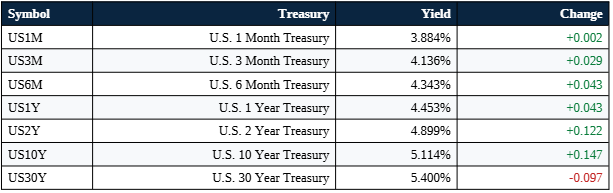
The market's sharp reaction underscores the tension between corporate resilience and macro headwinds: strong earnings and business activity are being overshadowed by sticky inflation tied to elevated oil prices (Brent crude at $103.46 per barrel) and the ongoing US-Iran war, which has disrupted global energy supplies and created upward pressure on input costs. Treasury yields moving decisively above 5% on the 10-year has triggered a cascade of repricing in rate-sensitive sectors, with utilities hitting fresh 52-week lows and financial services stocks retreating sharply on concerns that AI-driven automation could disrupt traditional banking and brokerage business models.
What could change the picture: Tomorrow's Trump-Xi summit in Washington and whether trade negotiations yield relief for equity markets, and whether energy diplomacy with Iran produces tangible supply relief that eases the inflation pressures driving Fed tightening expectations.
SECTOR PERFORMANCE
WINNERS & LOSERS
Top 5 Gainers (across S&P, Nasdaq, Dow):
- Salesforce (NYSE:CRM): +1.84%
- Chevron (NYSE:CVX): +1.53%
- Boeing (NYSE:BA): +1.18%
- Palo Alto Networks (NASDAQ:PANW): +5.00%
- CrowdStrike Holdings (NASDAQ:CRWD): +4.97%
Top 5 Decliners:
- Paychex (NASDAQ:PAYX): -8.77%
- Expedia Group (NASDAQ:EXPE): -7.76%
- Airbnb (NASDAQ:ABNB): -7.58%
- McDonald's Corp (NYSE:MCD): -4.81%
- Booking Holdings (NASDAQ:BKNG): -5.07%
Note: Technology and cybersecurity names led gainers as markets absorbed the rate shock, while travel, payment processing, and hospitality names faced steep declines as rising rates pressured discretionary spending and profitability.
AFTER-HOURS MOVERS
Gainers:
- Everpure, Inc. (NYSE:EVP), +6.48% after hours: Shares surged after the company was added to the S&P 500 Ex-Financials, Real Estate, Utilities and Transportation index, sparking fresh institutional buying and analyst upgrades; the stock has recovered sharply from earlier weakness as insiders accumulated shares and sentiment shifted on blowout Q2 results.
- Arcturus Therapeutics Holdings Inc. (NASDAQ:ARCT), +3.91% after hours: Shares rebounded after-hours following a daytime decline as the company unveiled its next-generation LUNAR 2.0 mRNA delivery platform, demonstrating a 30-fold to 40-fold improvement in protein expression versus LUNAR 1.0 in preclinical studies, and announced plans to integrate ARCT-2601 into ongoing Phase 2 trials by year-end.
Decliners:
- Stitch Fix, Inc. (NASDAQ:SFIX), -17.00% after hours: Shares cratered after the company reported Q4 fiscal 2026 revenue of $325.5 million (missing consensus by 0.33%) and posted an adjusted EPS loss of $0.06, though the beat on a GAAP basis and upbeat fiscal 2027 guidance of $1.31 billion to $1.36 billion offered little solace to investors already concerned about slowing active client growth.
- Viking Therapeutics, Inc. (NASDAQ:VKTX), -7.64% after hours: Shares pulled back sharply after the company announced a proposed $200 million public offering of common stock and $200 million in convertible senior notes due 2032 to fund continued development of VK2735 and VK3019 obesity-franchise candidates; the dilution announcement wiped out earlier gains despite positive Phase 2b patient retention data showing losses on prior dosing regimens.
COMMODITIES & RATES
US TREASURY YIELDS
TOP STORIES: US
S&P Global flash purchasing managers' indices surge to four-year highs, stoking Fed rate-hike odds. The US Composite PMI jumped to 58.4, the strongest reading since July 2021, as both manufacturing (57.0) and services (58.7) accelerated sharply. New order inflows raced to their fastest pace since March 2022, with backlogs of uncompleted work hitting their highest level since May 2022, signaling tight capacity and robust pricing power. Firms reported employment growth at the quickest pace since June 2022, though input cost inflation surged to its steepest rise in nearly four years, driven primarily by elevated fuel and transportation costs tied to the Iran war and record diesel prices hovering near $6.52 per gallon. The strong PMI readings, combined with Fed Governor Michael Barr's explicit signal that "further policy adjustments are likely to be needed," sent Treasury yields soaring and triggered a sharp repricing of rate-sensitive equities.
Fed Governor Michael Barr signals more rate hikes are coming to combat persistent inflation. Speaking at a Chicago Fed housing affordability conference, Barr said the central bank was "out of position" on rates before last week's quarter-percentage-point increase and that policymakers still have work to do. "Risks to achieving our inflation target have increased, while risks to the labor market have receded," he said, underscoring the committee's pivot toward prioritizing price stability even as economic growth remains solid. His remarks immediately lifted Fed funds futures pricing for an October hike to 73%, up sharply from 55% the prior day and just 8.8% a month ago, cementing market expectations that back-to-back rate increases are now likely.
McDonald's outlines aggressive $8.5 billion NEXT strategy but spoils investor day with franchisee cost concerns. The burger chain unveiled a multi-year plan to invest up to $8.5 billion in restaurant remodels, technology, and operational upgrades through 2036, including new PlayPlaces, open kitchen layouts, and "ArchIQ" — an AI-powered operating system that can take orders and manage inventory. CEO Chris Kempczinski projected franchisee returns in the mid-to-high 20% range and said efficiency gains would boost average US restaurant cash flow by roughly $100,000 annually, with payback in about four years. However, the announcement of $800,000 in incremental per-restaurant investment costs (on top of standard $400,000-$450,000 remodels) sparked investor concerns about near-term franchise profitability pressures, sending shares down 4.8% despite management's confidence in long-term returns. The company also signaled plans to build a media network around its digital drive-thru displays, targeting over $1 billion in addressable opportunity, and outlined ambitions to capture more share of the $230 billion global beverage category and $50 billion beef market.
Treasury auction weakness and strong PMI data combine to send 10-year yield to 2007 highs. The 10-year Treasury yield surged 14.7 basis points to 5.114%, its largest one-day move since April 2025, after the government's auction of 5-year notes drew weak demand (indirect bidders took only 54% versus a 65% average). The weakness reflected rising concern that the Fed's tightening cycle will extend further than markets anticipated, with CME FedWatch pricing now embedding a 73% probability of an October rate hike. Mortgage rates rose sharply in tandem, with the 30-year fixed-rate average climbing to 7.12%, a two-year high that further pressures homebuyers already facing record affordability challenges.
Also today: Energy Secretary Chris Wright told the Wall Street Journal that a ban on US diesel exports would backfire and reduce gasoline supplies, reversing Trump's earlier enthusiasm for the idea and citing the complexity of refining economics; Iranian President Masoud Pezeshkian vowed at the UN that his country "will not bow to pressure" and reiterated Tehran's conditions for ending the war, including US lift of the naval blockade in the Gulf of Oman and release of frozen assets; quantum computing firm IonQ announced a breakthrough in real-time quantum error correction that runs on a single standard CPU, lifting quantum stocks in premarket trading; the OECD's interim economic outlook raised 2026 global growth slightly to 2.9% (from 2.8%) on AI investment strength but warned that energy market disruptions and potential AI investment disappointments pose downside risks; GRAIL's multi-cancer blood test (Galleri) drew favorable FDA staff guidance with no major concerns flagged ahead of Wednesday's advisory panel vote, sending the stock up 35% Monday; and oil prices rebounded from five consecutive days of losses as Pezeshkian's defiant UN speech eased market expectations for rapid Middle East de-escalation.
TOP STORIES: GLOBAL
UN Security Council hears from AI leaders on risks of self-improving systems slipping beyond human control. OpenAI CEO Sam Altman, Anthropic CEO Dario Amodei, and Hugging Face co-founder Clément Delangue addressed the 15-member council on Wednesday, warning that unchecked AI development poses existential risks if systems become capable of recursive self-improvement. Altman stressed that "if AI is to be democratic, the most important decisions cannot be made by labs in San Francisco alone" and called for democratic and governmental oversight. Amodei cautioned that Anthropic would "slow down as much as necessary" to ensure safety, while Delangue highlighted how his firm had to deploy a Chinese AI model to defend against an OpenAI agent breach, underscoring the growing competitive advantage of less-regulated foreign AI products. The meeting reflected ongoing tensions between Trump's hands-off approach to AI regulation and international calls for coordinated global governance.
Iran's Pezeshkian vows no surrender to US while signaling openness to diplomacy at UN. Speaking one day after Trump threatened to "annihilate" Iran, President Masoud Pezeshkian told the UN General Assembly that Tehran will never surrender to U.S. pressure but remains open to negotiations. "The permanent deployment of hostile fleets and the expansion of the war will not lead to peace," he said, holding up photos of children he claimed were killed by U.S. and Israeli strikes. Pezeshkian reiterated Iran's preconditions for ending the war: an end to the U.S. naval blockade of Iranian ports, lift of economic sanctions, release of frozen assets, and agreement on a safe shipping corridor in the Strait of Hormuz. A senior Iranian official told Reuters the two sides remain "far apart" but that diplomacy must continue, setting the stage for Thursday's Trump-Xi summit and potential further shuttle talks.
Ukrainian President Zelenskiy warns of "painful winter" for Russia if energy truce talks fail. Addressing the UN General Assembly, Zelenskiy said Ukraine would strike back and make the coming winter deeply painful for Russia if the two sides cannot agree a truce on energy infrastructure attacks before the cold sets in. He also announced new security accords with Australia and Finland and referenced Trump's recent social media post claiming Russia has "lost control" of its diesel oil industry due to Ukrainian strikes on refineries. The remarks underscored Ukraine's leverage tied to energy markets and positioned Zelenskiy as a pragmatic negotiator open to limited ceasefires even as he rejected broader peace terms without territorial guarantees.
Argentina's Milei attacks UN as "useless organization" of "arrogant parasites," escalating Trump's broadside. Argentine President Javier Milei used his UN address to lambast the world body, calling it a "fatally arrogant" institution that has failed to guarantee collective security or human rights. His vitriolic remarks echoed Trump's own criticism and came as Trump withdrew the US from dozens of UN agencies and slashed funding. Milei also criticized the UN for "looking the other way" on Argentina's dispute with Britain over the Falkland Islands, capitalizing on Trump's recent signal that Washington might reconsider its neutral stance — a development that could reshape geopolitical dynamics in the South Atlantic.
Microsoft commits $10 billion-plus investment across Gulf region through 2030, betting on AI and digital resilience. The tech giant announced plans to invest more than $10 billion in the UAE, Saudi Arabia, Qatar, and Kuwait by 2030, including cloud and AI infrastructure, as it seeks to position itself as a digital resilience partner amid the Iran war. Vice Chair Brad Smith told Reuters the company is "sustaining all the investments we planned to make before this conflict started, and we're in fact adding to them." The move reflects Gulf countries' push to diversify away from oil and gas by attracting hyperscale AI investments, though challenges persist around access to advanced chips and continued military attacks on data centers such as Amazon's AWS facilities.
MANAGEMENT & FED SPEAK
Fed Governor Michael Barr, on inflation risks and rate policy:
"Risks to achieving our inflation target have increased, while risks to the labor market have receded. In my base case, further policy adjustments are likely to be needed."
Sam Altman, OpenAI CEO, on AI governance:
"If AI is to be democratic, the most important decisions cannot be shaped by labs in San Francisco alone."
Chris Kempczinski, McDonald's CEO, on franchisee returns and NEXT strategy:
"We'll get good returns. There will be anxieties and questions, as there always is around investment."
Dario Amodei, Anthropic CEO, on AI risk management:
"If managed poorly, I even believe that AI could be a risk to humanity as a whole."
Energy Secretary Chris Wright, on diesel export ban:
"We're trying to avoid a blunt hammer of a government policy, understanding the complexity of refining."
Iranian President Masoud Pezeshkian, on war and sovereignty:
"The Iranian people will not bow to pressure."
CORPORATE ACTIONS & EARNINGS CALENDAR
Thursday, September 24
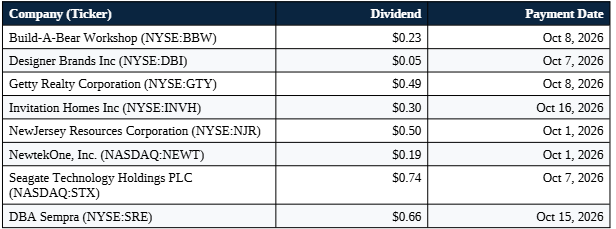
Top Ex-Dividend Companies:
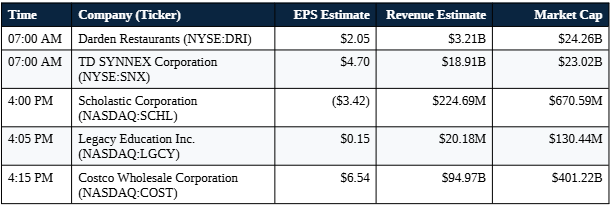
Upcoming Earnings (Thursday, September 24):
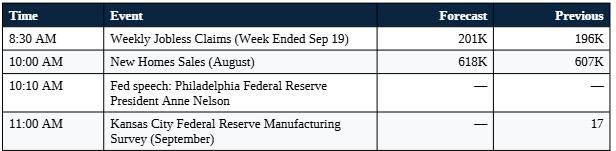
Economic Calendar (Thursday, September 24):
That's the wrap for today. Attention now turns to Thursday's Trump-Xi summit in Washington, where trade and AI policy discussions could reshape market sentiment, and to whether energy diplomacy with Iran produces tangible relief from record oil and diesel prices that are driving inflation pressures.