Anthropic's Lock-up: Results Meet Supply
Anthropic (NASDAQ:ANT) slipped below its $83 IPO price just as investors began studying its lock-up. Up to 15.5bn shares become free to sell in 23 stages through November 2027, many tied to earnings. Here is how the schedule works and what research says about expiry dates.


Anthropic's insiders will be free to sell in 23 instalments. The biggest arrive hard on the heels of its results
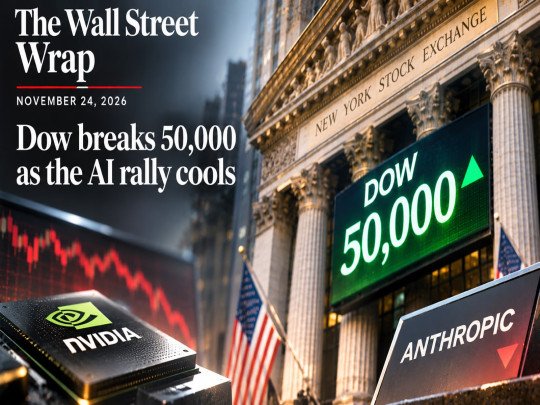
It took just four trading sessions for Anthropic to slip below its offer price. It priced the biggest initial public offering on record at $83 a share on November 18th, opened at $111.50 the next day and climbed to nearly $115. On November 24th the shares fell as low as $75.61, more than 13% down on the day at one point. SpaceX, the year's other giant listing, stayed above its offer price for more than a month.
Many things explain the slump, from a sell-off in artificial-intelligence stocks to the end of the banks' price support (more on which below). But one question will hang over the shares for the next year, and the answer is printed in the prospectus: when can the people who owned Anthropic before it listed sell, and how much? The schedule is unusual not just for its length but for how tightly it binds new supply to the company's results.
The mechanism is the lock-up, a contract in which founders, staff and early investors agree with the banks running a deal not to sell for a set period. America's Securities and Exchange Commission says 180 days is typical. Buyers in the IPO itself may trade from day one. Lock-ups exist because a new stock is still finding its price, and because, as Cooley, a law firm, notes, investors dislike watching insiders rush for the exit.
Known Knowns
In theory the end of a lock-up should be a non-event. The date is public from the start, so the market ought to have priced it in. In practice it seldom has. In a study of 1,948 American IPOs published in the Journal of Finance in 2001, Laura Casares Field and Gordon Hanka found that trading volume jumped by about 40% at expiry and stayed higher for good.
Shares underperformed the market by about 1.5% over three days, and by much more at firms backed by venture capital, whose funds sold hardest. Part of the explanation is that betting against a new issue is costly; part is that many sellers are diversifying rather than signalling anything.
Eric Nowak and Alexandra Gropp, two economists, found a similar pattern across 142 listings on Germany's Neuer Markt. Among other things, the price effect was larger at firms with a small free float, the share of stock available to trade. That is awkward for Anthropic.
Its free float is slim. The company sold 980m shares to the public, and on November 20th, with the stock still well above $83, the banks exercised in full their option to sell 147m more. That lifted gross proceeds to about $93.5bn, Reuters reported. Only about 1.1bn shares, some 8% of the roughly 13.4bn outstanding, were sold to the public, though insiders may already sell up to 315m more.
Exercising that option early had a side-effect. Banks running a new issue usually sell more shares than the base deal and cover the excess either through the option or by buying in the market, which props up a sagging price. Morgan Stanley, the deal's stabilisation agent, closed that position on day two, weeks before it had to. Reuters noted that this removed a potential source of support below $83. The shares fell by more than 11% that day, amid a broader sell-off in technology stocks.
Step by Step
The textbook lock-up is a cliff: everyone is frozen for six months, then everyone is free at once. Recent technology listings have swapped the cliff for a staircase. Snowflake released a quarter of its locked-up shares after 91 days; DoorDash released 40% early. Some lock-ups end after an earnings report, others when the share price rises far enough.
Anthropic has built an unusually elaborate staircase, with 23 steps (see chart 1). In short, supply trickles out until February, then arrives in floods tied to each set of results until November 2027. Directors, officers and employees could sell up to 10% of their holdings from the first day: the 315m shares mentioned above. Releases of 303m to 353m follow on December 15th, January 5th, January 19th and February 2nd.
Then the earnings calendar takes over. Two trading days after Anthropic reports its results for 2026, up to 1.7bn shares become free, followed by five releases of 480m each. The largest step, up to 3bn shares, comes two trading days after the results for the first quarter of 2027, or on May 17th 2027 if that is sooner. Four releases of 447m follow, then six more after the second-quarter results. The last, of up to 1.9bn, comes after the third-quarter results or by November 18th 2027. Each of the three biggest steps exceeds the whole IPO, option included.
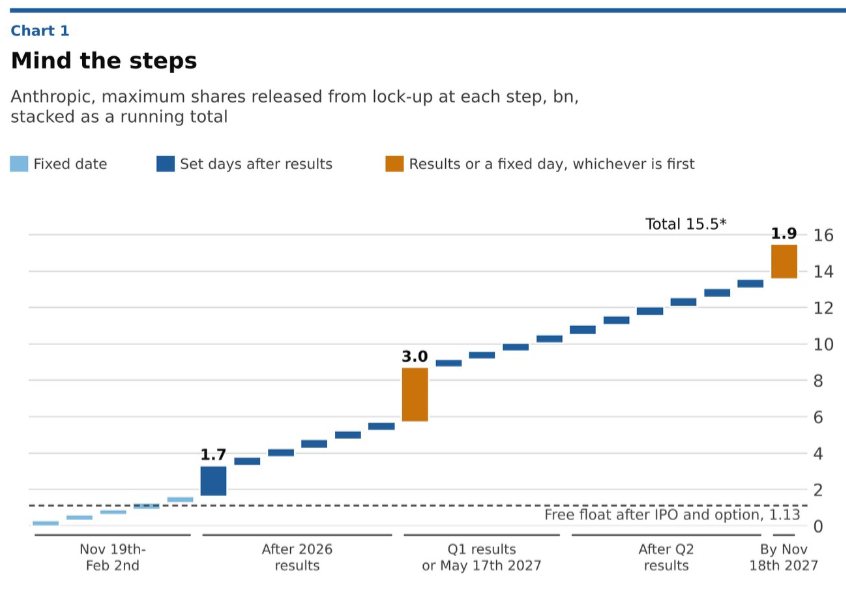
The seven founders wait longest. Each may sell up to 29% of their shares from the first-quarter step. From early June 2027 some holders may also hedge (in effect, bet against) up to a fifth of their locked-up shares, about 719m in all.
Added up, the releases come to some 15.5bn shares, more than are outstanding. That is no misprint: the locked-up holdings include stock still to be issued under employee awards and convertible notes. And every figure is a ceiling. Being free to sell is not the same as selling. Some selling is not optional, though: the lock-up lets staff sell shares to cover the tax due on vesting awards.
One block sits outside the lock-up. Google, Nvidia, AMD, Broadcom, Micron, Microsoft and TSMC bought about 313m unlisted Class N shares for $26bn. As restricted securities, they can be resold only under a registration statement or an exemption such as Rule 144, the SEC's resale rule, which has its own conditions. The prospectus says some buyers may have registration rights. Nothing suggests any of them plans to sell.
Demand Side
MSCI, an index provider, will add Anthropic to its global indices at the close on November 30th. FTSE Russell follows on December 21st, when Anthropic is also projected to join the Nasdaq-100. Index funds, including the trackers in millions of pension pots, must then buy at whatever price prevails. Intropic, an index-analytics firm, estimated before the deal was enlarged that passive demand could absorb about 28% of the shares offered, or roughly $19bn, Reuters reported. And because index weights track free float, each unlock will eventually draw more passive buying.
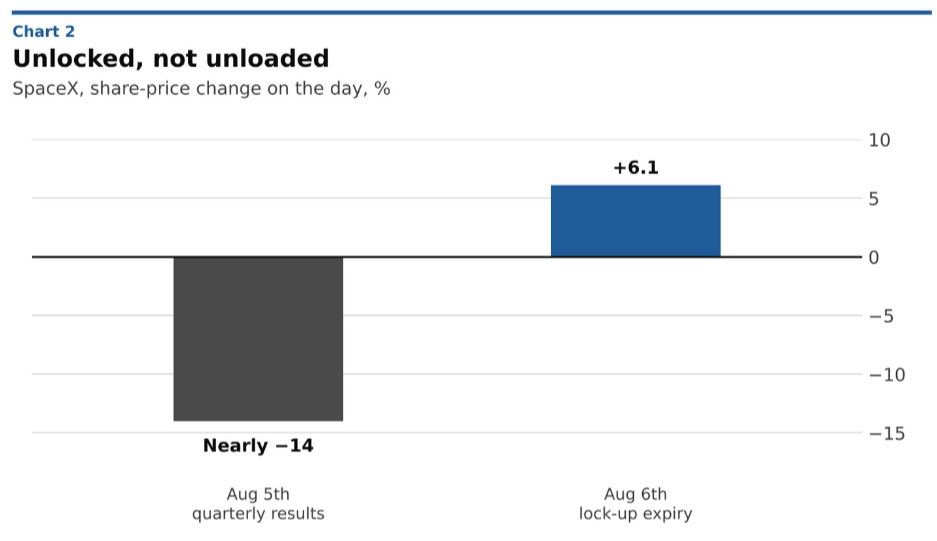
SpaceX shows that an unlock need not be a rout. Its first release, on August 6th, freed 911.5m shares and more than doubled the stock available to trade, according to Reuters. The day before, the shares had fallen by nearly 14% after quarterly results raised worries about losses and spending on AI, the Associated Press reported. On expiry day they rose by 6.1% (see chart 2). Over the next five sessions, Bloomberg reported, they gained about 35% and climbed back above their offer price.
In Lockstep
That case is reassuring only up to a point. SpaceX had to absorb one bad set of results and one release. Anthropic faces that pairing after each of its next four sets of results, starting with releases of up to 1.7bn and then 3bn shares. Tying unlocks to results has a sound logic: it reduces the risk that insiders trade on knowledge others lack. It is a trade-off, though, because good and bad news will arrive bundled with new supply. Staggering spreads the pain, and Cooley notes it can produce several smaller dips instead of one large one.
And insiders cannot sell quietly. The banks may release them early, but under Finra's Rule 5131 most such waivers for officers and directors must be announced at least two business days in advance. Officers, directors and holders of more than 10% must report their trades on the SEC's Form 4 within two business days.
None of this makes the share price predictable. The academic averages are small and the spread around them wide, and on most days interest rates, results and sentiment about AI will count for more. The lock-up is designed so that insiders cannot sell until the market knows what they know. The awkward corollary is that the market will find out at almost exactly the moment they can.
Related post