ASX Pre-Market: Monday, 14 September 2026
ASX 200 futures point to a modest recovery after Wall Street snapped a four-day losing streak, even as oil remains elevated and a hot core inflation print lifts Fed rate hike odds above 85% ahead of this week's decision.

Welcome to your morning briefing on overnight Wall Street action and what's set to move the ASX 200 at the open. (See Friday's ASX Post-Market Wrap: 11 September 2026 for the full session recap.)
ASX Futures
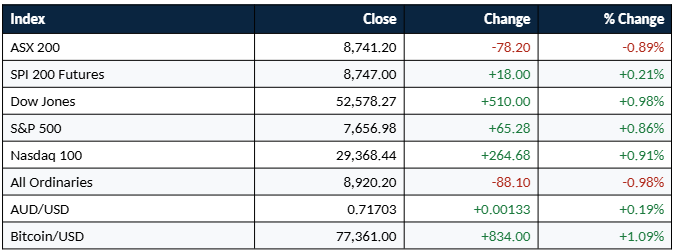
SPI 200 futures were up 18 points, or 0.21%, to 8,747, pointing to a modest bounce after four straight losing sessions locally. The tentative recovery follows Friday's local close, where the ASX 200 fell a further 78.20 points, or 0.89%, to 8,741.20, its lowest level in seven weeks, and comes as Wall Street snapped its own four-day losing streak on Friday even as the underlying inflation picture remains unresolved.
Overnight Leads + This Morning
Friday was the fourth straight losing session locally and the worst week for the ASX 200 in six months. The index dropped 78.20 points, or 0.89%, to 8,741.20, a fresh 20-day low, extending the week's decline to 3.0% and leaving the benchmark virtually flat for the year. Losses were broad-based, led by healthcare, non-energy minerals, technology and consumer stocks, while the big four banks were the standout, gaining between 0.6% and 2.5%. Major miners were hit hard: BHP Group fell 4.3%, Rio Tinto dropped 3.7%, Fortescue slipped 2.4%, South32 fell 4.4%, Northern Star Resources dropped 2.3% and Evolution Mining lost 2.0%. Deep Yellow and Paladin Energy were the index's weakest constituents, down 9.87% and 9.59% respectively. Sentiment weakened as surging crude prices raised doubts over a quick easing in Australia's inflation picture, while the country's 10-year bond yield spiked above 5.3%, its highest since May 2011, tracking gains in US Treasuries.
Overnight, Wall Street rebounded from that same pressure. Stocks snapped a four-day losing streak as oil retreated from the week's highs and traders looked past a hotter-than-expected core inflation reading. The S&P 500 rose 0.86% to 7,656.98, the Dow gained 0.98% to 52,578.27, and the Nasdaq 100 added 0.91% to 29,368.44, while the Russell 2000 rose 0.53% and the VIX fell 11.20% to 15.85. Dell Technologies and Hewlett Packard Enterprise led gainers on continued AI server demand following Oracle's strong quarterly results, while Seagate and SanDisk lagged. Oil gave back some of the week's sharp gains after Iranian state media signalled Tehran would meet Gulf states in Oman to discuss the Strait of Hormuz, though both benchmarks remained on pace for a weekly gain of more than 8%. August headline CPI rose 0.4% for the month and 3.4% annually, matching expectations, but core CPI rose 0.3%, a tenth of a point hotter than forecast, driven largely by a rebound in gasoline prices. Fed rate-hike odds for this week's meeting jumped to as high as 85% to 90% by some measures, up from around 70% before the report.
Close Levels
Analytical View
Friday's local session extended a genuinely broad-based four-day slide, with healthcare, non-energy minerals, technology and consumer stocks all under pressure and only the major banks bucking the trend. The moves in miners were particularly sharp: BHP's 4.3% fall and Rio Tinto's 3.7% decline reflect a sector now absorbing both softer commodity sentiment and a sharply higher domestic yield curve, with the 10-year bond yield's push above 5.3% marking its highest level since May 2011. That yield move tracked gains in US Treasuries directly, underscoring how exposed rate-sensitive parts of the ASX 200 remain to the global rates story. The index's 3.0% weekly decline, its worst in six months, has left it essentially flat for the year despite the past week's damage.
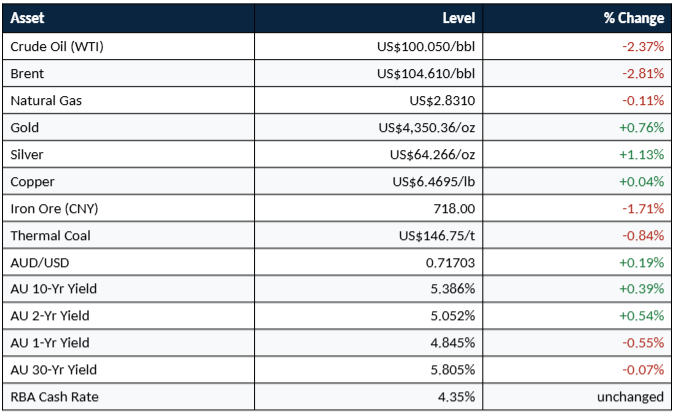
Overnight, Wall Street told a more encouraging but still unresolved story. Friday's rebound was driven by a pullback in oil rather than any resolution to the inflation picture: Brent and WTI both fell roughly 3% on the day after Iran signalled openness to talks over Hormuz, yet both benchmarks remained on pace for weekly gains above 8%, and Saudi Arabia shut its East-West pipeline as a precaution following fresh attacks. Meanwhile, core CPI's tenth-of-a-point beat complicated rather than clarified the Federal Reserve's task, pushing hike odds for this week's meeting to as high as 85–90%. The read-through for the ASX 200 is mixed: a steadier Wall Street and easing oil prices offer some relief for local sentiment, but the same hot inflation data that lifted US hike odds also reinforces the case for a further RBA move, keeping pressure on the same rate-sensitive banks, REITs and growth names that have driven the past week's local weakness.
What could change the picture: The Federal Reserve's September 15–16 meeting is the immediate catalyst, with markets pricing a high probability of a quarter-point hike, ahead of the Bank of England's decision on 17 September, the Bank of Japan's on the same day, and the RBA's own call on 29 September.
Commodities & Rates
Home & Away
Names with a foot in both camps today, ASX movers with direct overseas read-through, and overseas news with a local echo.
Seagate Technology (NASDAQ:STX) and SanDisk Corporation (NASDAQ:SNDK): lagged overnight, down 3.73% and 3.50% respectively, as storage names underperformed the broader hardware rally even as the rest of the sector rode Oracle's capex commentary higher. The divergence is notable: Seagate and SanDisk are more exposed to traditional storage demand and pricing cycles than to the AI-server buildout that lifted Dell and HPE, and Friday's session was a reminder that not every hardware name benefits equally from the same AI infrastructure story.
AstraZeneca (NYSE:AZN): fell 3.23% after hours after its breast cancer drug Etcamah, tested in combination with palbociclib, failed to meet its main goal of improving progression-free survival in a late-stage trial, though it showed a numerical improvement in previously untreated patients.
NextDC (ASX:NXT), Goodman Group (ASX:GMG) and Megaport (ASX:MP1): Oracle CFO Hilary Maxson reaffirmed the company's FY2027 capex guidance of US$90-95 billion on Thursday's earnings call, naming Dell and Hewlett Packard Enterprise as direct beneficiaries for AI racks, cooling and networking hardware, sending both to their largest single-session gains of the year on Friday, up 11.98% and 12.44% respectively. NextDC, Goodman Group and Megaport are the ASX's closest domestic equivalents to that trade, leasing capacity and connectivity into the same hyperscale AI build-out. The three have lately been more sensitive to the local bond market than to offshore AI-capex headlines, with both NextDC and Goodman sliding this week as the AU 10-year yield pushed to 14-year highs, so Friday's US enthusiasm won't automatically flow through, though it remains a genuine tailwind heading into Monday's session.
Fortescue (ASX:FMG) and Rio Tinto (ASX:RIO / NYSE:RIO): Chinese iron ore futures softened again Friday, with the Dalian contract down 1.78% to 718 yuan a tonne and Qingdao spot prices easing 8-13 yuan a tonne, as mills running at thin margins showed little appetite to restock. Adding to the pressure, China Mineral Resources Group, the state-backed importer that controls the bulk of the country's iron ore purchasing, has advised several steelmakers to avoid buying Rio Tinto's flagship Pilbara Blend product. The next test comes before Monday's local open, with China's industrial production and retail sales figures due at 22:00 AEST; given how stretched mill profitability already is, a soft print would extend the headwind rather than relieve it.
Local Catalysts
Fourth straight losing session marks worst week in six months. The ASX 200's 0.89% Friday fall took its weekly decline to 3.0%, the worst in six months, though the index remains virtually unchanged for the year. Losses were broad-based across healthcare, non-energy minerals, technology and consumer stocks, while the big four banks gained between 0.6% and 2.5%.
AU 10-year yield hits 14-year high. The 10-year bond yield spiked above 5.3% on Friday, its highest level since May 2011, tracking gains in US Treasuries and reinforcing expectations of tighter local borrowing conditions ahead of the RBA's 29 September decision.
PolarX (ASX:PXX) delivers standout copper hit at Caribou Dome, Alaska. The company's best hole returned 24.8m grading 9.8% copper and 14.5g/t silver from 2.4m, including 4.9m at 13.6% copper and 20.4g/t silver, with a second nearby hole confirming continuity at 22.6m grading 8.1% copper and 13.5g/t silver. The intercepts sit beneath the project's existing resource of 224,375 tonnes of contained copper, with mineralisation now extended an estimated 170m beneath that resource.
Sunstone Metals (ASX:STM) reports bonanza-grade hit at Bramaderos, Ecuador. The headline result returned 9.4m grading 17.23g/t gold equivalent, including a 6m section at 26.60g/t gold equivalent, while a second hole 200m south-southwest intersected 368m at 0.45g/t gold equivalent within the Melonal porphyry. Bramaderos holds a 2025 resource of 220 million tonnes at 0.50g/t gold equivalent for 3.6 million gold-equivalent ounces, with a resource update expected next quarter.
Manuka Resources (ASX:MKR) posts strong maiden results at Pipeline Ridge, NSW. The standout intercept returned 32m at 7.98g/t gold from 34m, with two further holes delivering 8m at 12.96g/t gold from 37m and 5m at 8.59g/t gold from the same depth. The company is evaluating the prospect as a satellite deposit within trucking distance of its Wonawinta processing facility.
Global News
Oil markets remain on edge over Hormuz and Bab al-Mandab. The Strait of Hormuz is effectively shut to shipping, while Saudi Arabia shut its 7 million barrel-per-day East-West pipeline after attacks in the Riyadh and Madinah regions. Houthi forces advanced to Yemen's Perim Island, tightening their grip on the Bab al-Mandab Strait, a narrower and more easily controlled chokepoint than Hormuz.
US refined product markets are tightening sharply. Diesel futures pushed above US$5 a gallon for the first time since April 2022, and the IEA cut its 2026 global oil supply forecast to a decline of 5.7 million barrels per day, warning the global refining system is "stretched to the limit."
Fed rate-hike odds have shifted sharply higher into this week's meeting. The probability of a quarter-point hike is now priced as high as 85–90% by some measures, up from around 70% before Friday's inflation data. The US 10-year Treasury yield sits just under 5%, a threshold last approached in 2023.
Iran, Russia and China use BRICS summit to criticise Western sanctions. Iranian President Masoud Pezeshkian said pressure on Iran had entered a "dangerous phase," shifting from sanctions to military aggression by the United States and Israel. Chinese President Xi Jinping called for a "consensus-based global AI governance framework" and said China will help establish a BRICS AI open-source community.
US Treasury Secretary flags new Iran-related sanctions. Scott Bessent said a large bank would be sanctioned on Monday, part of the administration's "Operation Economic Outcast," which has sanctioned nearly 60 entities, vessels and individuals since launching last month.
Anthropic's Amodei proposes AI development slowdown, drawing rare industry consensus. Anthropic CEO Dario Amodei published an essay urging AI companies to pace how quickly they improve their most advanced models. Amodei said the "toughest dilemma" is what happens if China does not adopt similar restraint. OpenAI CEO Sam Altman, Elon Musk, and Google DeepMind chair Demis Hassabis all voiced support. Separately, Altman said OpenAI will not pursue an IPO this year, calling the timing "ill-advised."
Washington faces pressure to act on AI regulation before the midterm recess. House Speaker Mike Johnson said he opposed rushed regulation, warning it could see the US "lose the race to China," while calling for a summit between government and AI industry leaders. The House is scheduled to adjourn after this week until after the November midterm elections.
Management & Fed / RBA Speak
Masoud Pezeshkian, President of Iran, on Western sanctions and BRICS trade:
Said pressure on Iran has entered a "dangerous phase," moving from sanctions to military aggression by the United States and Israel, with effects felt beyond Iran's borders. He said BRICS nations should expand the use of national currencies in trade with one another, describing food and energy security as "two fundamental pillars of economic security."
Scott Bessent, US Treasury Secretary, on upcoming Iran-related sanctions:
Said a large bank would be sanctioned Monday, without naming the institution, saying the timing was chosen to "honor the memory of our fallen citizens on 9/11." He said the action follows recent measures against the Dubai branches of Egypt's second-largest bank and the closure of a Turkish bank, part of the administration's "Operation Economic Outcast."
Dario Amodei, CEO, Anthropic, on the risks of an AI slowdown that excludes China:
Said the "toughest dilemma" about his proposal to slow AI progress is what happens if adversarial nations choose not to do the same, telling CBS News: "I think that's going to be very difficult because the incentives to pull ahead and the military advantage that you get from that are so large. And honestly, I don't know if it's possible, but we should try." He separately warned that going too slow carries its own risk, saying in a CNN interview that "the wrong people will be in charge of the technology" if the pace of development slows too much.
Corporate Actions & Earnings Calendar
Economic Calendar (Monday, 14 September):

Ex-Dividend Today (Monday, 14 September 2026):

Earnings Forecast (Monday, 14 September 2026):

Closing Line
That's the pre-market wrap for today. The ASX opens on slightly firmer footing after Wall Street snapped a four-day losing streak, with SPI 200 futures pointing to a modest 0.21% bounce following Friday's 20-day low locally. The underlying picture remains unsettled: oil stays elevated even after Friday's pullback, the AU 10-year yield sits at a 14-year high, and this week's Federal Reserve decision, followed by the Bank of England and Bank of Japan later in the week, will set the tone ahead of the RBA's own call on 29 September.

.png)