Big Tech Spends, Chipmakers Earn: Meta (NASDAQ:META), Tesla (NASDAQ:TSLA), Lam Research (NASDAQ:LRCX) and Other AI-Linked Tech Earnings
Everyone is spending on AI. Meta, Lam Research, Texas Instruments, IBM and Tesla just showed who is turning it into cash, and who is still waiting.

Key Highlights
- Meta's $9.9 billion legal charge halved operating margin to 20%, masking 26% revenue growth.
- Lam Research posted record revenue of $8.22 billion, but shares fell after hours.
- Texas Instruments revenue rose 28% as data center sales nearly doubled.
- IBM's software growth and lower taxes lifted earnings, while pre-tax income rose only 3%.
- Tesla generated $1.5 billion of free cash flow, against expectations of a burn.
On the evening of October 21, five of America's best-known companies reported third-quarter results within a few hours of one another. Meta, Lam Research, Texas Instruments, IBM and Tesla have little in common as businesses. Yet each is exposed, in its own way, to one question: when a technology cycle demands extraordinary amounts of capital, who collects the return, and how soon?
The answers differed sharply. One company is spending more than it earns in cash. Two sell the equipment and components that the spending requires. One is steadily turning a software franchise into profit. One is asking investors to value a future that its current results only hint at. The five lessons below follow the money in that order.
Meta Platforms (NASDAQ:META): Growth Is Strong, but Free Cash Flow Has Turned Negative
Meta reported revenue of $64.6 billion, up 26%, helped by a 10% rise in ad impressions and a 14% rise in the average price per ad. Reported operating income fell 37% to $13.0 billion, because the quarter absorbed a $9.89 billion charge tied to an agreement with 52 state attorneys general over teen mental health litigation. Excluding it, operating income would have been $22.88 billion, a margin of about 35%, against 40% a year earlier.
That adjusted margin still fell, and the reason is cost growth. Stripping out the charge, total costs rose about 36% (our arithmetic), faster than revenue. The headline net income gain of 264% deserves caution too: the prior-year quarter carried an effective tax rate of 87%, which flatters any comparison.
Chief executive Mark Zuckerberg said "our investments are paying off, the core business is strong."
The cash picture is the more consequential test of that claim. Operating cash flow was $32.8 billion, but capital expenditure, including finance leases, was $34.9 billion, leaving free cash flow at negative $2.1 billion. Over nine months, free cash flow was $11.0 billion, against $29.5 billion a year earlier. Meta repurchased no shares in the quarter, compared with $3.3 billion a year ago, and long-term debt stood at $80.9 billion, up from $58.7 billion at the end of 2025.
Guidance points to more of the same. Full-year capital expenditure is expected at $135 billion to $145 billion, which implies roughly $49 billion to $59 billion in the fourth quarter alone, on our arithmetic. Fourth-quarter revenue is guided to $73 billion to $76 billion. Meta also approved a non-voting Class C share, to be issued as a one-for-one stock dividend from January 2027, which would work like a two-for-one split while leaving voting power unchanged. The company says the new class will support capital raising, employee pay and acquisitions. Shares rose about 5% in extended trading. Scheduled youth-related trials remain a stated risk.
Lam Research (NASDAQ:LRCX): Record Results, Yet the Market Looked Past Them
Lam's September quarter was, by any historical standard, excellent. Revenue reached $8.22 billion, up 22% from the prior quarter and about 54% from a year earlier. Systems revenue grew roughly 62% year on year to $5.73 billion, while customer support revenue rose about 40% to $2.49 billion. Gross margin was 52.3% against 50.4% a year ago, operating margin reached 40.0% against 34.4%, and non-GAAP earnings per share of $2.20 edged past the roughly $2.17 consensus that market data providers had compiled.
Chief executive Tim Archer summed up the quarter as one of "record revenue, profit, and earnings per share in the September quarter."
The reaction was nonetheless negative, with shares down about 6% after hours. The explanation lies in expectations rather than results. Guidance for the December quarter is $8.6 billion, give or take $400 million, and earnings of $2.33 per share, give or take 15 cents. The midpoint implies sequential revenue growth of about 5%, after 22% in the quarter just reported. Market commentary noted that the shares had risen for ten straight sessions before the release, which left little room for a pause in the pace of acceleration.
Two structural points matter more than one day's trading. First, China accounted for 35% of revenue, ahead of Korea at 20% and Taiwan at 18%, and Lam's own filings list export controls among the risks that could limit sales. Second, summaries of the earnings call point to management expecting wafer fabrication equipment spending in the mid-$150 billion range this year, with a preliminary figure above $200 billion for 2027, led by memory. We have not checked those figures against a transcript, and they are forecasts.
Texas Instruments (NASDAQ:TXN): A Cyclical Recovery With a Data Center Accelerant
TI's revenue of $6.06 billion was up 11% sequentially and 28% year on year. Operating profit rose 73% to $2.87 billion, a margin of about 47%, while gross margin of roughly 64% was up 280 basis points on the previous quarter. Year on year, gross profit rose by about $1.16 billion on $1.31 billion of additional revenue, an incremental margin near 89% on our arithmetic. Management itself models a long-run fall-through of 75% to 85% before depreciation, so the quarter should be read as a strong cyclical peak in conversion rather than a new baseline.
Chief executive Haviv Ilan pointed to "continued broad growth in industrial, automotive and data center," and the end-market detail bears that out. Industrial revenue rose more than 40% and, for the first time, passed its third-quarter 2022 peak. Data center sales rose about 95% and now make up around 13% of revenue. Automotive grew in the mid-teens, while personal electronics was flat. Management also reported modest analog price increases in the second half after a flat first half, with 2027 pricing discussions under way and an update promised for January.
The cash flow comparison needs care. Free cash flow over twelve months was $8.4 billion, against $2.4 billion a year earlier, and included $1.6 billion of CHIPS Act incentives. Quarterly capital expenditure fell to $463 million from $1.2 billion, yet the company expects $2 billion to $3 billion for the full year, probably at the upper end. Timing of tool deliveries, in other words, helps the latest figures. Fourth-quarter revenue is guided to $5.8 billion to $6.3 billion, a midpoint close to flat, which is unusual for a seasonally softer quarter. The dividend rose 7% to $1.52 a share. Shares closed up about 2.5% and were little changed afterwards.
IBM (NYSE:IBM): Software Carries the Quarter, and a Lower Tax Rate Helps
IBM's revenue of $17.1 billion rose 5%, or 6% at constant currency, ahead of the roughly $16.8 billion expected by consensus. Software, at $7.8 billion, grew 8%, with Red Hat up 11%, data up 19% and transaction processing up 9%, though automation fell 3%. Consulting was flat. Infrastructure grew 4%, a blend of a 20% fall in IBM Z and a 31% rise in distributed infrastructure. Software segment profit margin improved to 35.0% from 32.9%, while consulting margin slipped to 12.2% from 12.9%.
The earnings figures deserve a second look. Operating earnings per share of $2.95 rose 11%, and GAAP earnings per share from continuing operations rose 26% to $2.31. But GAAP pre-tax income rose only 3%. Most of the gap is a lower effective tax rate, 11.9% against 28.2% a year ago. That is a legitimate gain in reported profit, but not one that implies an equivalent improvement in operations.
Chief executive Arvind Krishna cited "accelerated revenue growth and strong free cash flow."
The cash figures back the second claim: free cash flow was $3.0 billion in the quarter and $7.8 billion year to date, and management now expects full-year free cash flow to rise by more than $1 billion. Constant-currency revenue growth guidance of 4% to 5% was unchanged. The balance sheet reflects the price of that growth, however. IBM has invested $11.4 billion in acquisitions this year, total debt reached $63.8 billion, and goodwill rose to $74.9 billion from $67.7 billion at the end of 2025. The release does not separate organic growth from acquired growth, which matters when judging how durable the software acceleration is. Shares closed up 3.9% and rose roughly a further 2.5% after hours.
Tesla (NASDAQ:TSLA): Cash Flow Surprised, Operating Profit Did Not
Tesla's revenue of $28.05 billion was down 0.2% from a year ago, and deliveries of 486,532 vehicles were about 2% lower. Gross margin recovered to 19.6%. GAAP operating income was $718 million, down 56% according to market data, as research and development spending rose 69% and capital expenditure more than doubled to $4.73 billion. Non-GAAP earnings per share of $0.48 beat consensus estimates in the range of $0.43 to $0.45, though GAAP earnings per share was $0.22. GAAP net income of $787 million compares with non-GAAP net income of $1.70 billion, so the adjustments exceed half of the adjusted figure.
The surprise came from cash. Free cash flow was $1.53 billion, where analysts had expected a burn of more than $4 billion. Operating cash flow of $6.26 billion more than covered capital expenditure, and the company ended the quarter with $45.45 billion in cash and short-term investments. Management also reported record energy storage orders and backlog, the introduction of Cybercab into its robotaxi fleet and the start of Optimus production in Fremont.
The other storyline is corporate. On SpaceX's earnings call, Musk said a merger of the two companies "would be a good idea," and added that both companies have formed special committees to study a combination and that shareholders would ultimately decide. Shares rose about 3.4% in the regular session and were roughly flat afterwards. Market data puts the forward earnings multiple above 160, a figure that rests on businesses such as autonomy, robotics and energy storage that have yet to contribute much to reported profit. Whether those businesses scale as hoped, and whether any merger proceeds, are open questions.
What the Five Results Share
Capital intensity is the clearest dividing line. The table below compares each company's quarterly capital expenditure with operating cash flow, using the figures in their own releases.
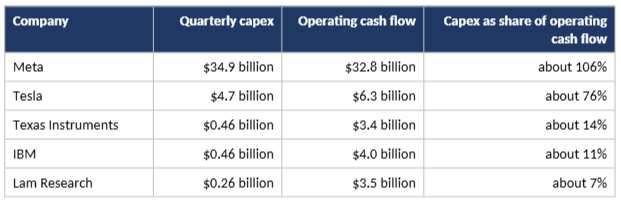
The ratios were calculated by us from reported figures, and the companies define capital expenditure slightly differently. Even so, the pattern is plain. The companies spending most heavily are those whose payoff lies furthest ahead, while the suppliers to that spending are converting revenue into cash with far less strain. Markets, for their part, did not reward results alone. Lam fell on a guidance midpoint that implied slower growth, while Meta rose on a revenue outlook that appears to reassure investors about the return on its outlay.
Each result also carries its own risk. Meta faces youth-related trials and rising debt. Lam depends on China for a third of its sales and on export policy. TI's conversion rates are cyclical and its capital spending is still to come. IBM's reported growth is tied to acquisitions and a lower tax rate. Tesla's valuation and merger outlook depend on events that have not yet happened. Probabilities, not certainties, are the right frame for all five.
This article is for information and analysis only. It is not investment advice and does not recommend buying, selling or holding any security.