Eli Lilly to Sanofi: Why Six Healthcare Stocks Carry Such Different Valuations
Healthcare touched record levels on Tuesday, yet the six stocks here were driven less by the sector than by dated events of their own: insurer earnings, litigation, restructuring and deals. DaVita fell almost 6% against the tide, while Myriad jumped 37% on an asset sale. The useful question is which valuation already allows for the risks the calendar is about to test.

Key Highlights
- Healthcare stocks sit near 52-week highs as capital rotates out of technology.
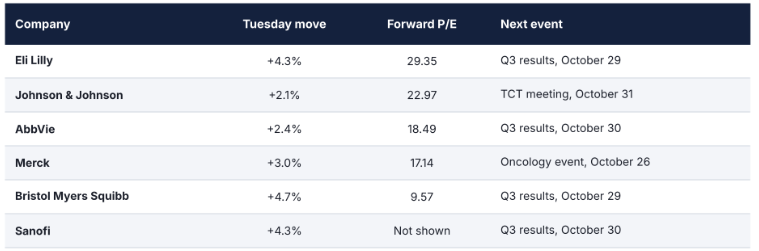
- Forward valuations span 9.57 times at Bristol Myers Squibb to 29.35 at Eli Lilly.
- Growth, patent expiries and recovery risk explain the valuation gap among six drugmakers.
- Third-quarter earnings from October 29 will test pipeline strength and the growth outlook.
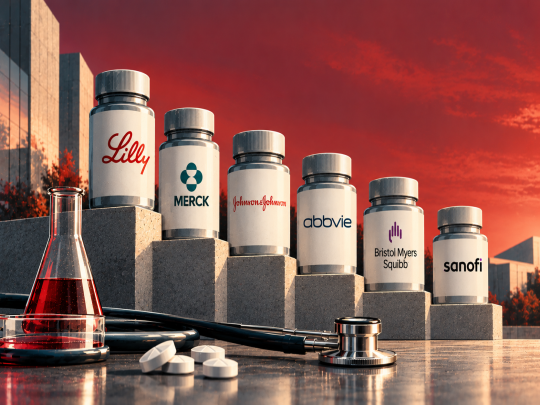
Healthcare is the market's favorite hiding place this week. The sector's main exchange-traded fund is trading near a 52-week high, up roughly 2% on Tuesday, after last week's selloff in artificial intelligence and technology shares sent capital toward defensive earners. Six large drugmakers rose with it: Eli Lilly (NYSE:LLY), Merck (NYSE:MRK), Johnson & Johnson (NYSE:JNJ), AbbVie (NYSE:ABBV), Bristol Myers Squibb (NYSE:BMY) and Sanofi (NASDAQ:SNY).
A shared rise hides a wide gap in how these stocks are priced. Bristol Myers Squibb trades at 9.57 times forward earnings. Lilly trades at 29.35 times. That gap is the story, because it shows what the market is paying for in each case. The answer falls into three groups: growth that is already visible, patent cliffs that lie ahead, and recoveries that still have to be proved.
The Setting: Why Money Is Moving Into Healthcare
Three forces explain the rotation. Technology shares have been volatile. Treasury yields near 5.1% make steady, near-term earnings more attractive than distant ones. And oil prices are swinging on Middle East tension, which favors businesses with stable demand.
The rotation carries its own warning. At least one technical strategist has pointed to possible upside exhaustion after healthcare became the market's best-performing sector over six months. A rising tide lifts all boats briefly. What separates these six stocks is what each company offers once the tide is stripped away.
Group One: Growth Already Visible
Lilly and AbbVie share one feature. The products that will drive their next phase of earnings are already on the market. What differs is how much investors pay for them.
Eli Lilly
What happened. Shares rose about 4% to roughly $1,293, close to a 52-week high of $1,311.75. A European Medicines Agency committee gave a positive opinion on Foundayo, the company's oral obesity pill. Lilly also reported that Omvoh met its primary endpoint in a Phase 3 study in children with ulcerative colitis, where half of 52 responders were in clinical remission at week 52. The study was single-arm and open-label, so its weight is limited.
Why it matters. Obesity treatment is the growth engine, and the market capitalization of about $1.22 trillion already reflects that. At 29.35 times forward earnings, Lilly carries the richest multiple of the six.
The risk. Pricing. A Pennsylvania insulin pricing lawsuit is in the news, and Novo Nordisk (NYSE:NVO) has planned Wegovy price cuts for 2027. Third-quarter results on October 29 should show early uptake of Foundayo.
AbbVie
What happened. Shares rose about 2.4% to $289.42, within reach of a 52-week high of $291.40. A Phase 2a study of its ABBV-466 combination in Crohn's disease showed 30.2% endoscopic remission at week 12, against 21.3% and 18.0% for the two monotherapies. Health Canada approved Skyrizi for pediatric psoriasis. The company also became a partner of the McLaren Formula 1 team, a branding move rather than a financial one.
Why it matters. Skyrizi and Rinvoq are replacing the earnings that Humira is losing to biosimilars. The forward multiple of 18.49 and a dividend yield of 2.39% are a cleaner guide than the trailing multiple of 81.53, which is of limited use.
The risk. Humira erosion could outrun its replacements. Results are due October 30.
Group Two: Priced for the Cliff
At the other end of the ladder, Merck and Bristol Myers Squibb trade at 17.14 and 9.57 times forward earnings. The discount has a common cause. Each depends on products that will lose patent protection, and each is spending to replace them.
Merck
What happened. Shares gained about 3% to $147.93 and are up roughly 38% this year, though below a 52-week high of $156.92. At an oncology investor event at the European Society for Medical Oncology congress on October 26, investors expect first Phase 3 data on intismeran, a personalized cancer vaccine developed with Moderna (NASDAQ:MRNA), given alongside Keytruda in melanoma.
Why it matters. Keytruda is the hinge of the story. Its approaching loss of patent protection explains the multiple, and a vaccine combination is one route to extending the franchise.
The risk. A weak readout would sharpen the patent-cliff debate. A dividend yield of 2.30% is the cushion. Third-quarter results follow on October 29.
Bristol Myers Squibb
What happened. Shares rose about 4.7% to $61.57, the largest move of the six, after a 1.5% decline on Monday. Recent positive Phase 3 data for RYZ101, iberdomide and a lower dose of admilparant helped, as did the sector rotation. Volume ran below average.
Why it matters. The lowest multiple and the highest dividend yield, near 4.10%, are the visible price of doubt. The company carries roughly $43 billion of debt, and newer products such as Breyanzi, Camzyos, Sotyktu and Cobenfy must outgrow the erosion of older blockbusters.
The risk. The replacement may arrive more slowly than the losses. Oncology presentations run from October 23 to 27, and results follow on October 29.
Group Three: Recovery Still to Be Proved
The last two stocks sit in between. Neither faces a single cliff. Each is recovering from a specific problem.
Johnson & Johnson
What happened. Shares rose about 2% to $259.06, recovering from a fall of nearly 6% after third-quarter results that included a MedTech miss and a $5.5 billion talc charge, even as 2026 guidance was raised. On Tuesday the company launched the Shockwave C2 Aero Fly coronary catheter in the United States. It delivers pulses at 2 Hz and cuts treatment time to 115 seconds from 230 seconds, which helps catheterization labs handle higher volumes. It also presented 48-week Phase 3 Tremfya data in Crohn's perianal fistulas.
Why it matters. At 22.97 times forward earnings and a 2.04% yield, and with shares below a 52-week high of $281.07, the market is still weighing whether MedTech growth can offset litigation costs.
The risk. Further charges, or another MedTech shortfall.
Sanofi
What happened. Shares rose about 4.3% to $41.26, recovering Monday's 2.6% decline. Sanofi and Teva (NYSE:TEVA) released 44-week Phase 2b data for duvakitug, an antibody that targets TL1A. At the 900 mg dose, 58% of ulcerative colitis patients were in clinical remission. The data are descriptive and the drug remains investigational. Sanofi also signed a licensing deal with private biotechnology company ScionxBio on long-acting mRNA, with no financial terms disclosed.
Why it matters. The shares sit near the bottom of a 52-week range of $39.07 to $52.68, the opposite of Lilly's position. The market is pricing a company that depends heavily on one product: Dupixent contributes roughly 19 billion euros of about 47 billion euros in annual revenue.
The risk. Concentration. Results are due October 30.
What Connects the Six, and What Could Change the Picture
The three groups show one logic. Investors pay most for earnings growth they can already see, pay less where a patent cliff is visible, and pay a recovery price where a problem is still being solved. The rotation lifted all six on Tuesday, but the valuation ladder shows the market is still discriminating.
The calendar will test that. Results from Abbott Laboratories (NYSE:ABT) and Thermo Fisher Scientific (NYSE:TMO) on October 21 will offer an early read on device and life-science demand, while Gilead Sciences (NASDAQ:GILD) reports on October 29 alongside Merck.
Risks run in both directions. A sector that has led for six months can lose momentum quickly if technology stocks stabilize, and yields near 5.1% weigh on valuations that rest on distant cash flows. In that case, the growth names with the highest multiples have the most to lose, while the discounted names depend on data and patent outcomes. Drug pricing policy and litigation are live issues for all six. Whether the rally extends will probably depend on earnings over the next ten days more than on rotation alone.
This article is for information only and does not constitute investment advice. Figures reflect Tuesday's trading session.
.png)