The Debt Story Behind Getty Images: Record Revenue, Then Bankruptcy
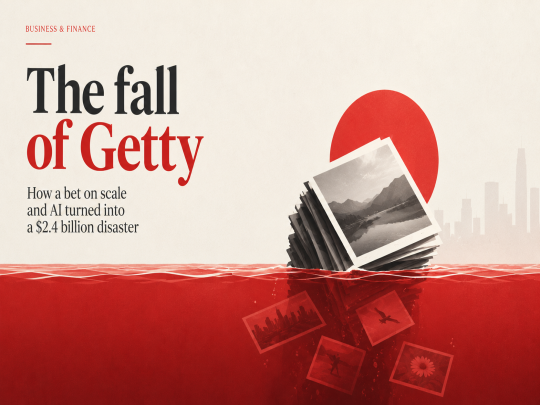
Getty booked record revenue, then filed for bankruptcy. The real reason is not the one you think. Here’s the debt trail that brought the photo giant down.

Key Highlights
- Getty Images filed Chapter 11 with a large share of its debt accelerated.
- Unsecured noteholders share a cash pool worth about 63% of face value.
- Existing shareholders get nothing as the Getty family and Koch Equity Development take full ownership.
- The Shutterstock merger died over a UK-required editorial sale, but its financing costs stayed.
- Editorial revenue is still growing, but AI pressure on creative and agency work is rising.
Getty Images booked the highest annual revenue in its 30-year history in 2025. On October 21, 2026, it filed for Chapter 11 bankruptcy in Delaware with a prepackaged plan that cancels every existing share.
The common explanation is that artificial intelligence has made stock photography worthless. The filings tell a narrower story. Getty borrowed to buy scale through a merger with Shutterstock, a UK regulator blocked the part of that deal Getty cared about most, and the company was left with the financing bill, a large court judgment and heavy debt. Its shares, reportedly down to 12 cents, were suspended on the New York Stock Exchange before the filing.
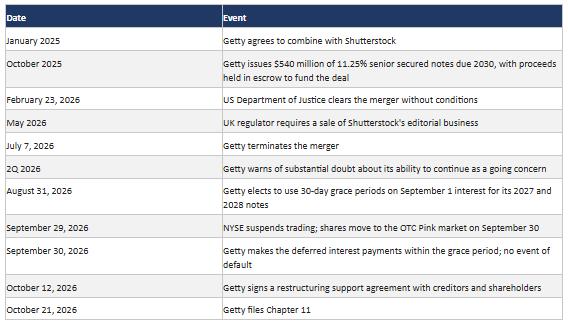
From Merger to Filing: The Key Dates
The Bet: Scale as a Defense Against AI
Getty was the buyer. In January 2025 it agreed to combine with Shutterstock, its closest rival, in what both called a merger of equals, with Getty as acquirer, surviving name and Craig Peters as chief executive. Shutterstock holders were to receive, on average, $9.50 in cash and 9.17 Getty shares per share.
The logic was defensive. Both companies license human-made images, and both face tools that generate passable images in seconds. On 2024 figures the pair would have had revenue near $2 billion, about $570 million of EBITDA (a rough measure of operating cash profit) and net debt of 3.0 times EBITDA, plus $150 million to $200 million of planned annual savings.
Getty brought a leveraged past to the table. Hellman & Friedman bought it for $2.4 billion in 2008, and Carlyle later paid $3.3 billion, mostly with debt. In 2018 the Getty family regained a majority stake and Koch Equity Development invested $500 million in preferred equity. In 2022 a blank-check (SPAC) merger returned Getty to public markets at about 15 times the EBITDA estimate then in use.
Where the Deal Broke: Editorial, in London
The Justice Department cleared the deal on February 23, 2026. The UK Competition and Markets Authority (CMA) did not. It saw no problem in stock images, partly because AI tools and rivals such as Adobe and Canva constrain both companies. Editorial photography, meaning news, sport and entertainment, was different. The CMA called Shutterstock "one of the few meaningful alternatives" to Getty, the UK market leader, and warned of less choice and higher prices for media outlets.
Its May 2026 final report allowed the deal only if Shutterstock's global editorial business (Shutterstock Editorial, Backgrid and Splash) went to an approved buyer. Getty's board decided on June 30 not to run that sale, which the merger agreement did not require it to accept, and terminated the deal on July 7.
AI cut both ways. It helped the case for clearing stock images and did little for editorial, which depends on access to live events and on rights. Editorial is also where Getty is growing. Its revenue rose 6.9% to $369.6 million in 2025 while creative revenue rose 0.7% to $556.9 million, and in the second quarter of 2026 editorial rose 9.2% while creative fell 2.6%. One plausible reading is that the required sale stripped out much of the deal's value while delay kept adding cost.
The Bill for Waiting
The escrowed notes were redeemed at par when the deal died, but a year of interest on $628.4 million at 10.5% is about $66 million, by a simple calculation. Through June 30, Getty booked $60.4 million of merger legal, accounting and direct costs, plus $30.1 million of net interest and $13.5 million of financing fees tied to the deal.
Operating results held up better than the losses suggest. In 2025 revenue rose 4.5% to $981.3 million and adjusted EBITDA rose 6.9% to $320.9 million. Yet 2024's net income of $39.5 million became a net loss of $206.2 million. Three items outside daily operations explain most of the swing: a foreign exchange loss about $115 million larger, mainly from revaluing the euro term loan; about $80 million more in litigation losses; and $41.9 million more in merger costs.
The litigation traces back to the SPAC. Getty denied attempts by Alta Partners and two CRCM funds to exercise warrants, and a New York federal court awarded the funds about $88 million plus interest in October 2023. Getty paid $110.9 million in the second quarter of 2026, partly offset by $31.5 million of insurance. Its litigation reserve stood at $99.5 million on June 30, against $205.3 million at the end of 2025.
From Going-Concern Warning to Filing
By the August 10 results, Getty had $51.6 million of cash, down $45 million in the quarter, and free cash flow of negative $122.6 million. Interest expense of $57.3 million exceeded operating income of $32.4 million, partly because of the merger notes. The revolver was fully drawn, Guggenheim Securities was hired and guidance was withdrawn.
Headline debt of $2.07 billion at June 30 overstated the problem. About $628 million was the escrowed merger notes, backed by restricted cash. Funded debt was about $1.44 billion, or near $1.47 billion after the July revolver draw. That is roughly 4.5 times 2025 adjusted EBITDA on a simple calculation, carrying coupons as high as 14%.
On August 31 Getty used the grace period on September 1 interest for its 2027 and 2028 unsecured notes, reportedly saying it had the cash but chose to use the grace window. Moody's cut its rating to Caa3 and S&P to CCC. The 14% notes were quoted near 47 cents on the dollar. The NYSE suspended trading on September 29 under its abnormally-low-price rule, and the stock moved to OTC Pink. Getty paid the missed interest on September 30, so no event of default occurred. It signed the restructuring agreement twelve days later.
What AI Has, and Has Not, Done
AI does not explain the filing on its own, but it is starting to show. Second-quarter revenue fell 2.5% to $229.1 million. Agency revenue fell 13%, creative revenue fell 2.6% to $127.4 million and adjusted EBITDA fell 8.4% to $62.3 million. Annual subscription revenue retention slipped to 88.4% from 93.4%, according to reports of the earnings call. Management pointed to customers moving agency work in-house, partly to AI tools, and to AI search answers that send less traffic to iStock.
Getty has fought AI in court and licensed to it. In the UK it largely lost against Stability AI on November 4, 2025, after dropping its main copyright claims mid-trial. A US case alleging copying of more than 12 million photographs survived most of a motion to dismiss in April 2026. A June deal to feature Getty photos in ChatGPT reportedly lifted the shares by as much as 145%, a gain that has since fully reversed. Licensing has yet to show it can offset pressure on creative revenue.
Inside the Plan: Who Gets What
Getty and six affiliates filed in Delaware under a prepackaged plan, one negotiated with major creditors in advance, which usually shortens time in court. The filing accelerated about $1 billion of dollar debt and 407 million euros of term loans, roughly $1.46 billion in total.
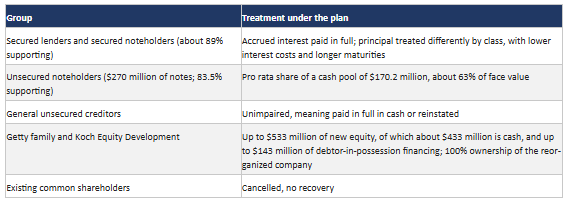
The bankruptcy loans are debtor-in-possession (DIP) financing: new money lent during a case that normally ranks ahead of older claims. Under the agreement, the cash equity is reduced by any DIP term loans still outstanding at emergence, and delayed-draw loans outstanding at emergence convert into preferred interests. Because the owners also supply the DIP, they keep control of the process. The agreement's milestones point to confirmation about December 15 and effectiveness about January 4, our calculation from the filing date, slightly after the year-end target. Completion also depends on court approval and other conditions, and the new debt's interest rates and maturities are not yet public.
What Institutional Investors Can Take From It
For event-driven and credit-focused funds, Getty is a compact case study. Four lessons stand out.
- Separate headline debt from funded debt. Escrowed merger notes inflated the headline figure, and the cost of carrying them was real.
- Compare plan value with the quoted price before judging terms. The unsecured class recovers about 63 cents on the dollar under the plan, while the 14% notes traded near 47 cents in late September.
- Price regulatory risk by segment, and count the carry. A small but central UK segment blocked a deal cleared in the US, and expensive escrowed debt turned delay into cost.
- Split AI exposure by product line. Editorial grew 9.2% in the second quarter while agency fell 13%.
Balance of Risks
The plan has real positives: lower interest costs, longer maturities, committed owners, record 2025 revenue, a growing editorial arm and no merger overhang. The risks run the other way. Confirmation could slip, creditors could object, regulatory approvals could take longer, subscription retention and agency revenue may keep weakening, and the US case against Stability AI may not settle the law. Private ownership will also mean less public disclosure.
The Takeaway
Getty's bankruptcy says less about AI than about how to respond to it. The company tried to buy scale with borrowed money, met a regulator whose price it declined to pay, and carried the cost of the wait. If the plan is confirmed, it emerges with less debt and the same strategic question: how a photo archive earns its keep when machines can make pictures.
This content is for informational purposes only and does not constitute investment advice.