CoreWeave (NASDAQ:CRWV): A Compounder in the Making, or the Most Leveraged Toll Road in AI?
The AI cloud firm has demand in abundance, but its lenders are getting paid first.

The accident that became a business
In 2017, three men in New Jersey bought graphics cards to mine Ethereum. Michael Intrator had spent years trading energy at a hedge fund. Brian Venturo ran strategy and Brannin McBee handled development. Nothing about the operation suggested a company that would one day sit at the centre of the artificial intelligence economy. It was a small, scrappy bet on a volatile digital asset, run out of rented space and powered by the cheapest electricity they could find.
Then crypto prices collapsed in 2018. The founders were left with a warehouse of expensive chips and a business whose revenue had fallen away. Many small mining operations simply shut down. This one looked at what it owned and asked a different question. The asset was no longer a coin-mining rig. It was a large, reliable cluster of GPUs that someone else might value far more than the miners did.
By 2019 the company, then called Atlantic Crypto, had become CoreWeave, and its customers were researchers and developers who needed raw computing power for machine learning. The founders had not planned for this. But the skills they brought were exactly right: they understood power markets, hardware procurement and how to run dense equipment around the clock at low cost. Energy traders think about capacity the way a landlord thinks about floor space. That mindset still shapes the firm.
Great businesses are often built from an accident combined with the right skills. The accident here was the crypto crash. The skills were industrial: finding power, buying chips fast and keeping machines running. Whether that combination can turn into a lasting franchise is the question this article tries to answer.
What CoreWeave actually sells
A useful way to understand CoreWeave is to think of a specialist landlord. A giant cloud provider such as Amazon or Microsoft rents out general-purpose space. It hosts websites, databases, email servers and thousands of other tasks. CoreWeave builds something narrower. It constructs dense, power-hungry buildings filled with GPUs wired together for training and running AI models, and it rents them out by the hour or by multi-year contract.
The comparison with a specialist kitchen helps. A big hotel can serve breakfast, lunch and dinner for hundreds of guests, but a restaurant that only cooks one cuisine can often do it faster, better and with less waste. CoreWeave's pitch is that AI workloads are different enough from ordinary computing that a purpose-built kitchen beats a general-purpose one. The customers, mostly AI laboratories, large technology companies and a growing list of enterprises, care about how quickly they can get thousands of GPUs running and how reliably those GPUs stay up.
The business model is simple to describe. CoreWeave raises money, buys chips and builds or leases data centre space. It signs customers to long contracts, often for several years, and collects payments as capacity comes online. The contracts give it a predictable revenue stream. The difficulty is the order of events. Money goes out first, often billions of dollars of it, and revenue arrives only after the hardware has been delivered, installed and powered.
That sequencing makes CoreWeave unlike a software firm, where each additional customer costs almost nothing to serve. It is closer to a railway or a power utility, where growth demands heavy investment ahead of the money it earns.
The moat question
Investors who study great companies look for competitive advantages that last. The classic sources are a trusted brand, high switching costs, a cost position competitors cannot match or a network that gets stronger as it grows. How does CoreWeave measure up?
On brand, the answer is modest. In AI infrastructure, buyers choose on availability, price and performance, not loyalty. On switching costs, the picture is mixed. Moving a large training run from one provider to another is painful, but not impossible, and customers who have worked with several providers know how to do it. CoreWeave has invested in software that makes its clusters easier to use and tune for AI jobs, and that creates some stickiness. Still, a customer with enough bargaining power can usually negotiate.
The company's real advantages are of a different kind. The first is speed. Getting power, buildings and chips lined up quickly is a hard operational skill, and CoreWeave has become good at it. The second is its relationship with its main supplier. Nvidia is both CoreWeave's key vendor and an investor, and in a market where the best chips are scarce, privileged access matters. The third is scale. The company now runs 51 active data centres with 1.5 GW of active power, and 3.7 GW of contracted power as of June 30, 2026. Securing that much power is difficult, and it cannot be copied overnight.
These are real strengths, but they are strengths of execution and access, not structural moats. Execution can be matched by a competitor with enough money, and access can change if the supplier decides to spread its chips more widely. A giant technology company that finishes building its own capacity can also stop renting. So the honest assessment is that CoreWeave has a head start, not a fortress. The question for the next decade is whether the head start can be turned into something harder to attack.
The numbers
The scale of the build-out is hard to overstate. In the second quarter of 2026, revenue was $2.575 billion, up about 112% from $1.212 billion a year earlier. The company reported an operating profit of $128 million, which is meaningful for a business at this stage of growth. Yet the quarter still ended with a net loss of $626 million. One analyst summarised the gap neatly by noting that the operating business roughly broke even, and the loss is essentially what CoreWeave paid its lenders.
That sentence captures the whole debate. The machines earn money. The financing eats it.
The order book is the strongest part of the bull case. Revenue backlog reached $104.2 billion, up 246% year over year, and that does not include more than $25 billion of net new customer commitments added in early Q3. The backlog is roughly 8.1 times the midpoint of full-year revenue guidance, which gives unusual visibility into years of future sales. It is worth remembering what the term means. Backlog is not the same as recognized revenue, and it is subject to capacity delivery and service availability. A contract is a promise. It becomes revenue only when CoreWeave switches the machines on.
Management also pointed to improving economics on new business. Contracts signed in the second quarter carry contribution margins 5 to 10 percentage points above recent quarters, which the CEO attributed to strong demand and to customers earning more from their own AI products. If that holds, it suggests CoreWeave has some pricing power, at least while chips and power remain scarce.
Capital allocation: the heart of the matter
The most important question about any growth company is what it does with money. Does each new dollar invested earn more than it costs? Does the company grow in a way that makes existing shareholders richer, or does it simply grow bigger?
For CoreWeave this question is still open. The company grows by borrowing to buy chips that wear out quickly, so each contract needs a large amount of capital before it earns anything. The latest guidance shows the scale. Capital expenditure for 2026 is expected at $35 billion to $39 billion, against full-year revenue guidance of $12.4 billion to $13.2 billion. Spending is running at roughly three times sales.
The most revealing detail came in the guidance update. At the midpoint, the company raised expected 2026 revenue by $300 million while raising expected capital expenditure by $4 billion, more than $13 of extra capex for every $1 of extra revenue guidance. This is not automatically a warning. Capex tends to arrive ahead of revenue, and a lot of the new spending will produce sales in future years, not this one. But it is a reminder that the economics depend on timing, and that any delay in power or equipment delivery hurts twice: the money is already spent and the revenue has not yet started.
Chips also age. A GPU bought today will be less valuable in four or five years as newer designs arrive. How CoreWeave depreciates its hardware, and whether the contract terms are long enough to repay the cost before the equipment loses its edge, is central. If contracts run for five years and the useful life of the chip is shorter than the accounting assumes, earnings today are flattered. Careful investors read the depreciation note in the annual report before they read anything else.
There is a clear test for whether this model works. Over time, operating profit should grow faster than interest cost, so that the share of earnings left for shareholders rises each year. If instead interest cost keeps pace with operating profit, the business is running hard to stay in place. At present, the operating engine is improving but the financing engine still absorbs most of the benefit.
Concentration and governance
A durable business usually serves many customers, none of which can hurt it badly. CoreWeave sits at the opposite end of the spectrum. One analysis estimates that Microsoft accounted for roughly 67% of CoreWeave's 2025 revenue, with OpenAI as a second pillar. In practical terms, a single customer decision can move the entire company. If Microsoft finishes building its own capacity, the most important line in CoreWeave's revenue could shrink quickly.
The picture is diversifying. The backlog grew by nearly $30 billion in about six weeks, driven in part by new business disclosed with Anthropic and Meta during the quarter. That helps, but revenue follows backlog with a lag, so concentration will remain a feature of the income statement for some time.
On governance, the founders still run the company and hold meaningful influence over it. That has benefits. People who built a business from nothing tend to think like owners and move quickly. It also has risks, because a complex capital structure, heavy debt and large related-party relationships, such as the one with its main chip supplier, call for careful reading. None of this is disqualifying. But a sceptical investor should read the debt covenants, the terms of the largest customer contracts and the notes on related-party transactions before accepting the accounts at face value.
The scorecard
It helps to put the company through three simple tests: how strong its competitive advantage is, how well it allocates capital, and how trustworthy and diversified its business is.
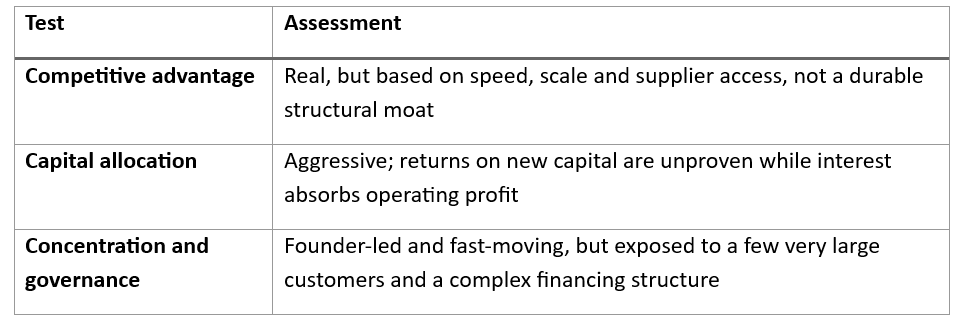 On this scorecard, CoreWeave is a strong operator in a boom, not yet a proven long-term compounder. The demand is real, the backlog is documented and the operating business has crossed into profit. What has not been shown is the quality that separates great investments from good ones: the ability to earn high returns on capital for many years without needing outside funding to survive.
What to watch
Three numbers tell the story over the next few quarters.
The first is interest expense relative to operating profit. If operating profit grows much faster than interest cost, the company is turning scale into shareholder value. If the two rise together, it is not.
The second is the share of revenue from the largest customer. As the backlog converts into revenue, this figure should fall. If it does, the business becomes sturdier. If it does not, the company stays dependent on a few relationships.
The third is the cost of new debt. Lenders are the quiet partners in this business. If CoreWeave can borrow at falling rates against long contracts with strong counterparties, the model improves. If rates stay high or lenders ask for tougher terms, growth gets more expensive.
If all three move in the right direction together, CoreWeave has a fair claim to being a lasting franchise. If they do not, it is a well-run toll road with a very large mortgage. Either outcome is possible, and the next four quarters will give a good deal of evidence.
This article is for information only and is not investment advice.