The Wall Street Wrap: November 6, 2026
US stocks bounced on Friday as chipmakers rebounded from Thursday's rout, but the Nasdaq still posted a fourth straight weekly loss. A much stronger-than-expected jobs report lifted December Fed rate-hike odds to about 80%, while Japan's Nikkei and Taiwan's Taiex fell into bear markets.

Chipmakers rebound from Thursday's rout but the Nasdaq still posts a fourth straight weekly loss, a hot jobs report revives December Fed hike bets, and Japan and Taiwan slide into bear markets
Welcome to Wall Street Wrap, your quick end-of-day rundown of what moved US markets today, plus what's shaping global sentiment overnight.
MARKETS TODAY
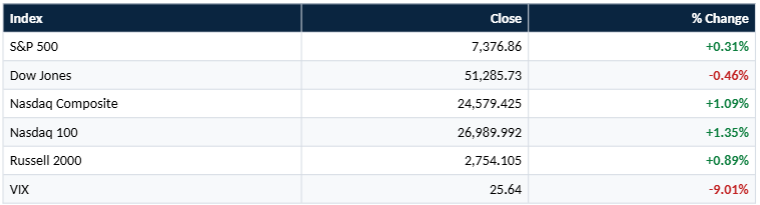
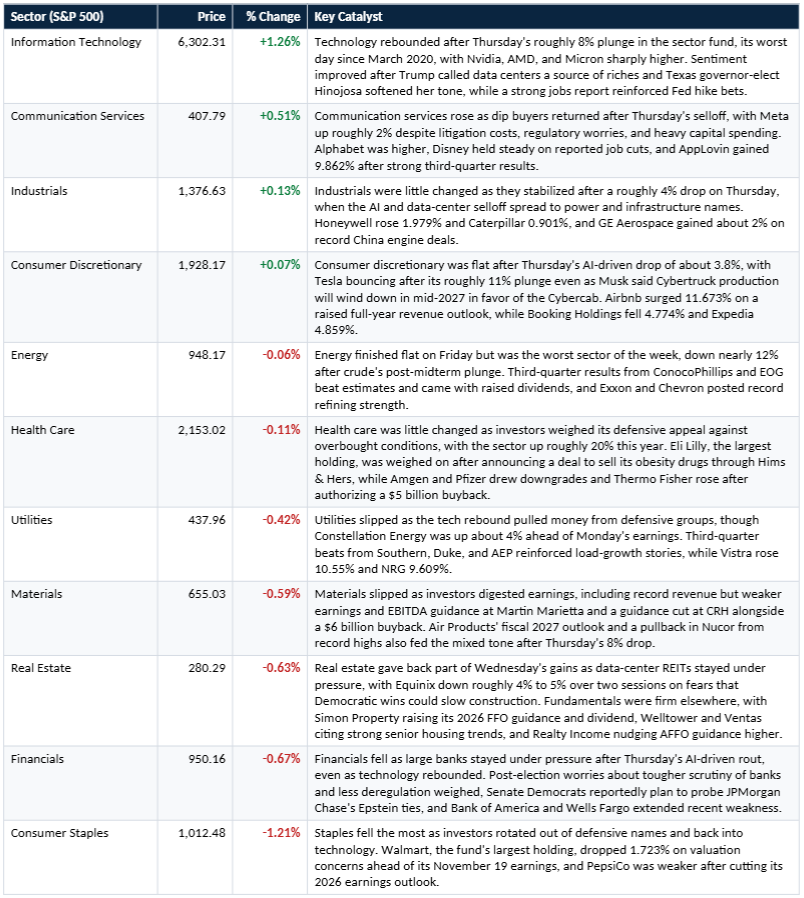
US stocks bounced on Friday after Thursday's rout, but the Nasdaq still posted a fourth straight weekly loss as investors weighed a much stronger-than-expected jobs report and the fallout from the AI trade. The Nasdaq Composite rose 1.09% to 24,579.425, the S&P 500 gained 0.31% to 7,376.86, and the Dow Jones Industrial Average slipped 0.46% to 51,285.73, a drop of about 237 points. The Nasdaq 100 climbed 1.35% to 26,989.992, the Russell 2000 added 0.89% to 2,754.105, and the VIX fell 9.01% to 25.64, while the S&P 500 headed for its worst week since June. Information technology led the 11 S&P 500 sectors with a 1.26% gain, followed by communication services at 0.51% and industrials at 0.13%, while consumer staples fell 1.21%, financials 0.67%, and real estate 0.63%. Rocket Lab jumped 15.395% and Coherent gained 13.578%, while Axon dropped 18.183% and Microchip Technology fell 10.023%.
ANALYTICAL VIEW
The bounce was a technology story, and it came from the same chip names that were crushed on Thursday. AMD rose 11.039%, Lam Research 8.229%, Intel 7.713%, KLA 6.695%, and Nvidia 2.775%, while the semiconductor index rallied. Defensive groups funded the move, with consumer staples down 1.21% and the Dow lagging as Walmart fell 1.723%, Home Depot 1.849%, and Salesforce 3.939%. One bank analyst argued that Thursday's selloff reflected lower valuation multiples rather than lower earnings estimates, and one chief investment officer said AI is still the dominant theme of this bull market. The damage is not repaired, though, as the Nasdaq remains in correction territory, more than 10% below its peak from a month ago.
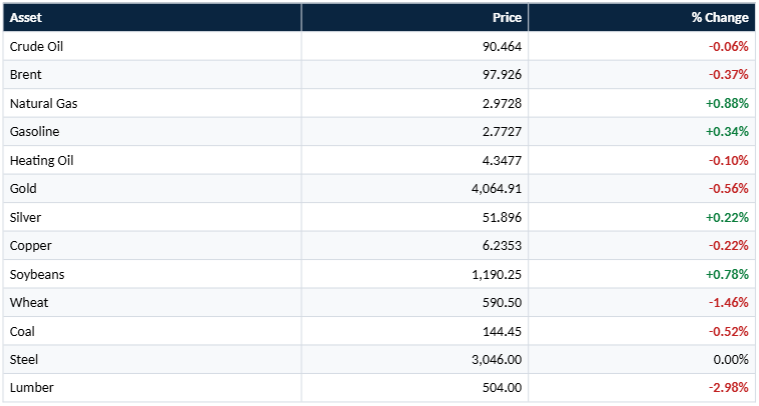
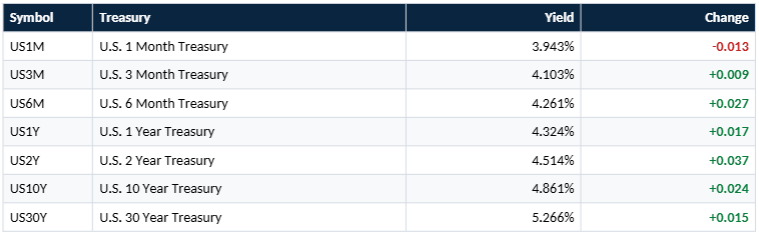
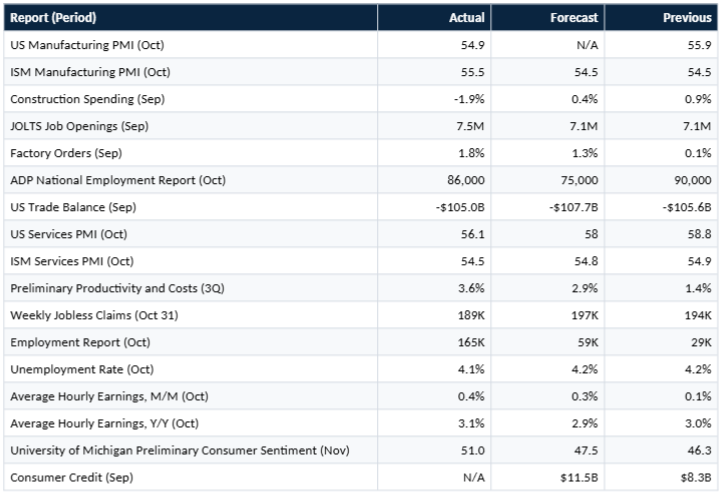
Macro data pulled the other way. Payrolls rose 165,000 against a forecast of 59,000, unemployment fell to 4.1%, and wages grew 3.1% from a year earlier, still below September's 3.7% inflation rate. The 10-year Treasury yield rose to 4.861%, and traders lifted the odds of a December Fed rate hike to about 80% from about 67% a day earlier. Strain in AI financing stayed visible even as stocks rose, with CoreWeave's 2032 bond yielding more than 16%, default swaps on Nvidia debt up 76% in a month, and Microsoft reportedly trimming its neocloud partners. Energy kept falling on the week, with Brent down more than 16%, as hopes for an end to the Iran war competed with warnings that fighting could resume.
What could change the picture: Tuesday's October consumer price report, earnings from CoreWeave, Nebius, and Cisco next week, whether Democratic governors-elect and the new Congress turn data-center rhetoric into binding limits, any move in US-Iran talks or fighting around the Strait of Hormuz, and Trump's expected meeting with Xi Jinping at the APEC summit on November 18 and 19.
SECTOR PERFORMANCE
WINNERS & LOSERS
Top 5 Gainers (across S&P, Nasdaq, Dow):
- Rocket Lab Corporation (NASDAQ:RKLB): +15.395%
- Coherent Corp. (NYSE:COHR): +13.578%
- Airbnb, Inc. (NASDAQ:ABNB): +11.673%
- Advanced Micro Devices, Inc. (NASDAQ:AMD): +11.039%
- Vistra Corp. (NYSE:VST): +10.55%
Top 5 Decliners:
- Axon Enterprise, Inc. (NASDAQ:AXON): -18.183%
- Microchip Technology Incorporated (NASDAQ:MCHP): -10.023%
- Charter Communications, Inc. (NASDAQ:CHTR): -6.189%
- Insulet Corporation (NASDAQ:PODD): -6.156%
- Dexcom, Inc. (NASDAQ:DXCM): -5.979%
Note: Airbnb rose after raising its full-year revenue growth forecast, AMD rebounded with the wider chip group, and Axon fell after its third-quarter results missed estimates and it lowered its 2026 revenue guidance. No specific cause was provided for the moves in Rocket Lab, Coherent, Vistra, Microchip, Charter, Insulet, or Dexcom. Four entries in the Dow gainers list (Amazon, Chevron, Merck, and Coca-Cola) were shown as declines and were excluded.
COMMODITIES & RATES
US TREASURY YIELDS
TOP STORIES: US
A hot jobs report revives bets on a December Fed rate hike. Nonfarm payrolls rose 165,000 in October against a forecast of 59,000, and the unemployment rate fell to 4.1% from 4.2%. Average hourly earnings gained 0.4% on the month and 3.1% on the year, August and September were revised up by a combined 84,000 jobs, and professional and business services led with 70,000 jobs, followed by healthcare with 42,000. Odds of a quarter-point hike in December jumped to about 80% from about 67% on Thursday, with the Fed's benchmark rate at 3.75% to 4.00%, and Treasury yields rose across the curve. San Francisco Fed President Mary Daly said she expects policy to tighten further, while St. Louis Fed President Alberto Musalem said inflation remains the top concern he hears from businesses.
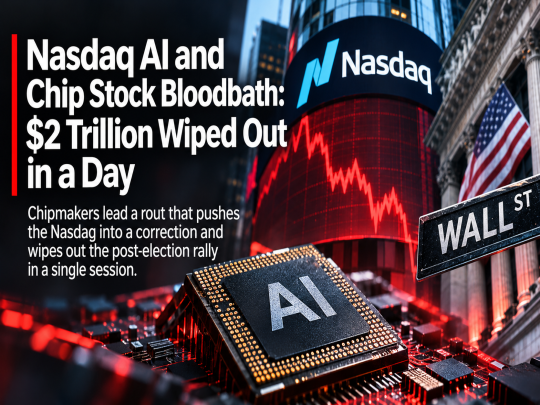
Tech rebounds from its worst day in more than a year, but the Nasdaq posts a fourth straight weekly loss. The Nasdaq Composite rose 1.09% and the S&P 500 gained 0.31%, while the Dow fell 0.46%, as chipmakers recovered from a Thursday rout that pushed the Nasdaq into a correction and wiped about $1 trillion from the Magnificent Seven in one session. Nvidia, AMD, and Micron led the rebound, Airbnb climbed after raising its full-year revenue growth forecast, and Atlassian dropped after its quarterly results. The S&P 500 headed for its worst week since June. A bank analyst said the selloff came from lower valuation multiples rather than lower earnings estimates, while a chief investment officer said the Thursday move looked like a knee-jerk reaction to the election results.
The White House defends the data-center buildout as Democrats prepare AI legislation. National Economic Council Director Kevin Hassett said he expects data-center growth to continue as projected, noting that projects scheduled over the next couple of years are not affected by the ballot measures that restricted such facilities in at least 46 of roughly 50 initiatives this week. President Donald Trump wrote on Truth Social that he is "100% in favor" of what he calls Super Intelligence and will work with states that want to get rich by hosting it. Democrats plan to introduce bills on electricity costs tied to data centers, independent testing of advanced AI systems, and liability for AI-related harm when they take control of Congress in January, though any bill faces steep odds with Trump in the White House. Texas governor-elect Gina Hinojosa has said she wants a pause on data-center approvals until the legislature passes protections for communities.
AI financing strain shows up in credit markets and in Microsoft's supplier list. CoreWeave's 2032 bond yield climbed above 16%, and its five-year credit default swaps spiked above 1,289 basis points on Thursday before easing about 8% on Friday, while swaps on Nvidia debt are up 76% over the past month. ING is reportedly seeking buyers for about $500 million of data-center loans, with bids due November 19. Microsoft is reportedly planning to use fewer neocloud partners and did not renew a rental deal with Oracle, though IREN shares jumped 16% after it said AI revenue more than doubled from the prior quarter to $200 million. Even so, five AI bond deals totaling $67 billion have priced since October 29, according to one major bank.
Trump replaces chief of staff Susie Wiles with Stephen Miller. Trump announced on Truth Social that Miller, the deputy chief of staff and a driver of the administration's immigration crackdown, will take over on Monday, three days after Democrats won both chambers of Congress. Wiles, who reportedly resigned Thursday night, will move to Trump's political operation, and Trump told reporters, "I wanted to make a change." House Minority Leader Hakeem Jeffries and Senate Minority Leader Chuck Schumer condemned the pick, and a White House official said the move shows Trump is not changing course. The shake-up follows several senior resignations at the Justice Department since Election Day.
Also today: Tesla will wind down Cybertruck production at its Texas gigafactory around the middle of 2027 to make room for the Cybercab robotaxi, Elon Musk said on X; Moderna raised its 2026 revenue growth forecast to 15% to 25% after third-quarter revenue of $1.3 billion beat the $885.1 million estimate, and its shares rose more than 10%; Under Armour cut its annual gross margin growth forecast to 170 to 220 basis points from 220 to 270 and raised its Middle East impact estimate to about $45 million from $35 million; Eli Lilly will sell Zepbound and Foundayo directly through Hims & Hers, with self-pay prices starting at $149 a month for the pill and $299 for the injectable; Fox completed its $22 billion acquisition of Roku; Firefly Aerospace signed a $1.3 billion deal to supply engines for AST SpaceMobile's planned Blacklift rocket, and Firefly shares rose about 18% after the announcement; Google acquired Crusoe's southeast Wyoming data-center site a day after announcing a $17 billion investment in it; consumer sentiment rose to 51.0 in November from 48.0 and one-year inflation expectations fell to 4.3% from 4.7%, though sentiment fell 5% among those with the largest stock portfolios; odds that Anthropic announces an IPO before December fell to 57% from over 85% on Kalshi in the past week.
TOP STORIES: GLOBAL
Asian markets sink as Japan's Nikkei and Taiwan's Taiex enter bear markets. Japan's Nikkei 225 dropped 5.96% to 57,434.77, South Korea's Kospi fell more than 6% to 5,059.69 for an 11.7% weekly loss, and Taiwan's Taiex slid 4.51% to 39,701.64, its worst week since 2001. SK Hynix plunged 10.44%, Samsung Electronics fell 6.35%, SoftBank Group tumbled 10.83%, and TSMC slid 4.69%. Mainland China's CSI 300 fell 1.44% to 4,054.28, the tech-focused Kosdaq fell 5.03% to 644.27, Hong Kong's Hang Seng was down 1.32% in its last hour of trade, and Australia's S&P/ASX 200 fell 0.49% to 9,020.8. European stocks also fell, with the STOXX 600 down about 1%, and one bank strategist said position unwinding and stop-loss selling made the rout worse.
Oil posts a steep weekly loss as traders weigh whether the Iran war resumes. Brent settled at $98.32 and US crude at $90.83, leaving Brent down more than 16% on the week and US crude down nearly 13%, with Brent set for its biggest weekly drop since 2020. Hopes for de-escalation after the Democratic midterm wins and a report that Iran sent a nuclear proposal to Washington through Qatar pulled prices lower, while Iran reported three more attacks on oil tankers in the Strait of Hormuz on Thursday. One energy consultant put the odds of fighting resuming at 80% and said both benchmarks could climb above $100. The S&P 500 energy sector headed for a loss of nearly 12% on the week, almost double that of the second-worst group.
Rate-hike bets cool abroad as traders worry about growth. Markets price about a 60% chance of a December European Central Bank hike, down from 75% a week ago, and about 42% odds of a Bank of Japan hike next month. Euro zone inflation sits at a three-year high of 4%, while French and German two-year yields fell 19 and 7 basis points on the week and the US two-year yield was on track for a second straight weekly drop of about 10 basis points. Bank of England Governor Andrew Bailey, whose bank raised rates on Thursday, said a peace process in the Middle East will not shift all of the factors behind high energy prices. The International Monetary Fund says a steep drop in AI investment could cut global output by 1.1% by 2028 in one downside scenario.
The US presses China on rare earths and farm purchases ahead of Trump-Xi meetings. Treasury Secretary Scott Bessent and US Trade Representative Jamieson Greer told Chinese Vice Premier He Lifeng on a call that Beijing must immediately implement its commitments under the Busan trade deal, particularly on rare earths, critical minerals, and agricultural purchases. China's commerce ministry has said it is open to buying more US farm goods only if the two sides implement their reciprocal tariff-cut agreement. The Busan deal expires January 10, and Trump and Xi are expected to meet at the APEC summit in Shenzhen on November 18 and 19 and at the G20 in Miami on December 14 and 15. Separately, GE Aerospace said it signed record deals worth more than $12.9 billion at the China International Import Expo, including engines for China Eastern Airlines.
MANAGEMENT & FED SPEAK
Mary Daly, President, Federal Reserve Bank of San Francisco, on policy:
"My expectation is we're going to have to tighten policy further."
Alberto Musalem, President, Federal Reserve Bank of St. Louis, on inflation:
"Inflation is a regressive tax, a distortionary tax."
Kevin Hassett, Director, National Economic Council, on data centers:
"We respect the localities that decide that's what they want to do."
Donald Trump, President, United States, on AI:
"I am 100% in favor of Super Intelligence (SI)."
Daniel Roberts, Co-Chief Executive Officer, IREN, on financing:
"Capital markets have become more selective in the last few weeks."
CORPORATE ACTIONS & EARNINGS CALENDAR
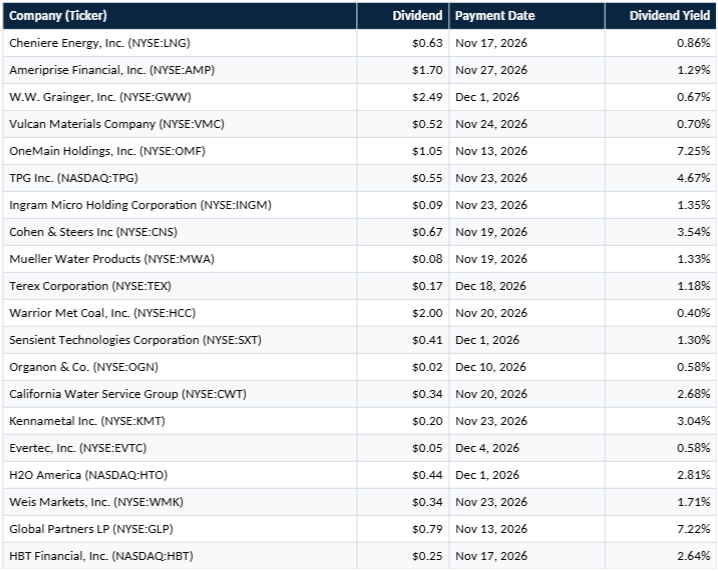
Top Ex-Dividend Companies for Monday, November 9:
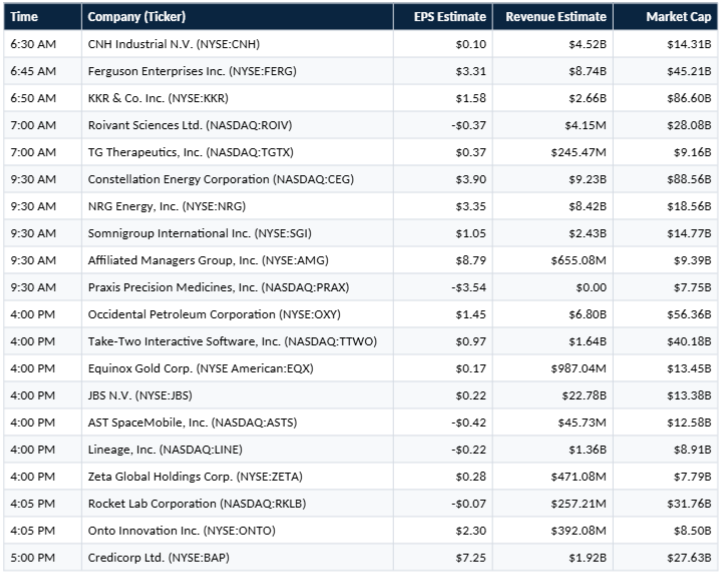
Upcoming Earnings (Monday, November 9):
Macro Data Recap (Week of November 2):
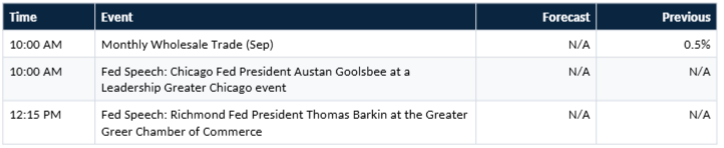
Economic Calendar (Monday, November 9):
That's the wrap for today! Next week opens with earnings from Constellation Energy, KKR, and Take-Two on Monday, followed by Tuesday's October consumer price report and a test of whether the tech rebound can hold.