Nasdaq AI and Chip Stock Bloodbath: $2 Trillion Wiped Out in a Day
Chipmakers lead a rout that pushes the Nasdaq into a correction and wipes out the post-election rally in a single session.

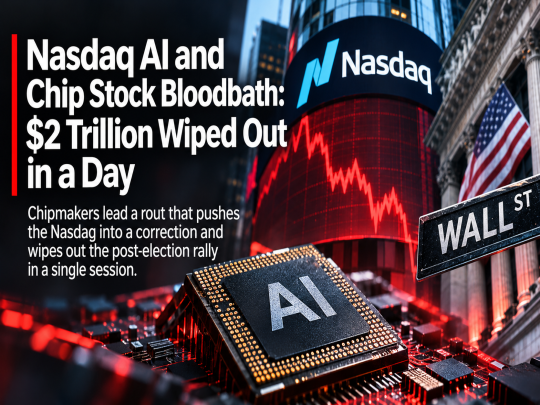
U.S. stocks plunged on Thursday as investors realized that the Democratic midterm victory could slow the data-center buildout that has powered much of the market’s multiyear advance.
The Nasdaq Composite fell about 5%, putting it in a correction, or a drop of 10% or more from a recent peak. The index last peaked around Oct. 6. The S&P 500 lost between 3.3% and 3.9%, and the Dow Jones Industrial Average dropped more than 1,500 points. The Philadelphia Semiconductor Index sank roughly 11%.
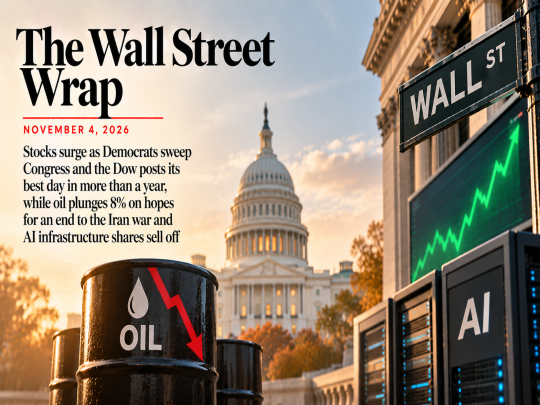
The selloff erased the prior day’s gains, when the Dow rose about 3%, or roughly 1,570 points, on relief that the election was over. It ranked among the worst days for U.S. stocks since the April 2025 tariff shock.
What Happened
The damage was concentrated in companies tied to artificial intelligence. Nvidia Corp. (NASDAQ:NVDA), Advanced Micro Devices Inc. (NASDAQ:AMD), Micron Technology Inc. (NASDAQ:MU), SanDisk Corp. (NASDAQ:SNDK), Western Digital Corp. (NASDAQ:WDC), Seagate Technology Holdings Plc (NASDAQ:STX), Qualcomm Inc. (NASDAQ:QCOM), Arm Holdings Plc (NASDAQ:ARM), CoreWeave Inc. (NASDAQ:CRWV) and Nebius Group NV (NASDAQ:NBIS) all posted steep declines, many in the high single digits or more. Tesla Inc. (NASDAQ:TSLA) and SpaceX (NASDAQ:SPCX) also fell sharply, and Bitcoin slipped.
At points in the session, about $2 trillion in market value had been erased across the broader AI complex. The VIX, Wall Street’s fear gauge, jumped sharply. Investors rushed into Treasuries, which pushed the 10-year yield lower.
“This is a true panic,” said Jay Hatfield, chief executive officer of Infrastructure Capital Advisors. He said it was “100% about the chip stocks and the potential slowdown in the AI trade.”
Why Democrats’ Win Hit Tech
On Wednesday, traders cheered the end of election uncertainty. By Thursday, they were focused on what Democratic gains could mean for the companies building the data centers that run AI.
Several results pointed the same way:
- In Texas, Gina Hinojosa defeated Greg Abbott in the governor’s race after campaigning for a temporary moratorium on new data centers, an end to some tax breaks and stronger protections around electricity and water use.
- Local ballot measures in about 40 of 41 jurisdictions across multiple states, with a heavy concentration in Ohio, approved limits, pauses or bans on data-center development.
- Senator Bernie Sanders called for a “national data center moratorium now.”
Strategists said the stakes are large. UBS analysts estimated that roughly 30% of expected U.S. data-center additions in 2028 could be at risk, with Texas accounting for a big share of planned capacity. They also flagged higher costs for developers, who may have to pay for grid upgrades.
Aidan Yao of Amundi said the midterms looked more like “a referendum on AI” than on President Donald Trump, reflecting a shift in public mood against unchecked data-center growth.
There were signs the industry is weighing its options. Meta Platforms Inc. (NASDAQ:META)’s Dina Powell McCormick said hyperscalers, the giant companies that run huge cloud and AI operations, are considering building outside the U.S. Elon Musk wrote that “data centers in space” were looking “pretty appealing right now.”
Why the Fall Was So Steep
The political news was the spark. Other factors turned it into a rout.
Crowded positioning. AI stocks had been among the market’s most popular bets. When too many investors own the same trade, a change in the story can trigger a rush for the exits. Stop-loss orders, which sell automatically at set prices, and computer-driven funds added to the selling. Some market commentary speculated about forced sales at leveraged AI-focused funds, though that was not confirmed.
Weak company news. Qualcomm Inc. gave a softer outlook for smartphone chips, citing memory shortages and weaker demand, and its shares dropped sharply. That dragged on the rest of the sector. Memory and storage makers were hit hardest because they are among the purest plays on the buildout.
Existing worries about spending. Investors had already been asking whether hundreds of billions of dollars in AI spending will pay off. Some hyperscalers are seeing pressure on free cash flow, the cash left after investments. The election gave those doubts a focus.
Background pressures. Oil rebounded on lingering Iran-related uncertainty. Yields eased on the day, but they remain high enough to weigh on growth stocks, whose valuations are especially sensitive to borrowing costs. Technology shares in other markets, including South Korea, also fell.
The Case for a Rebound
Optimists say the damage may prove temporary.
A national moratorium would face hurdles, including the president’s veto power. Many of the new limits are set by states and localities rather than Washington, so the buildout would likely face delays and higher costs rather than a full stop. Companies can also move projects to friendlier locations.
Ed Yardeni of Yardeni Research has argued that a slower buildout could even help. Financing limits, labor shortages and chip supply constraints act as “speed bumps” that force better-funded companies to spend more carefully and improve returns.
Valuations have also reset after a big run, and near-term earnings growth is still expected to be supported by AI spending. Forced selling often overshoots, and stocks have historically tended to do well after midterm elections.
The Case for More Pain
Pessimists see a bigger problem.
If local bans and pauses cut 2027 and 2028 capacity meaningfully, demand for chips, memory, power equipment and cloud services could weaken. Spending cycles can turn quickly once investors stop believing in limitless growth. And because a handful of giant companies make up so much of the major indexes, further weakness in them could drag the whole market.
A Democratic Congress and state-level action could keep the regulatory cloud overhead for years through hearings, utility and environmental rules and possible AI-safety frameworks. Voter opposition to data centers looks broad, based on the ballot results.
In this scenario, the semiconductor group falls another 10% or more, the Nasdaq keeps lagging and the S&P 500 tests lower support levels. Higher oil prices, rising yields or geopolitical shocks could add to the strain.
What to Watch
The next few weeks should help show which view is right. Investors will be looking at:
- How much of the proposed data-center restrictions turn into actual policy
- Whether hyperscalers keep guiding to large but disciplined spending
- Whether the market can broaden beyond AI, with financials, industrials and health care picking up the slack
- Oil, bond yields and any further signs of forced selling
The day showed how quickly sentiment can flip. A political result that first looked like good news for markets turned out to threaten the single biggest driver of recent gains. Whether the buildout is merely delayed or truly derailed is now the central question for the market.
The Wall Street Wrap: November 5, 2026
Related post