The Wall Street Wrap: November 5, 2026
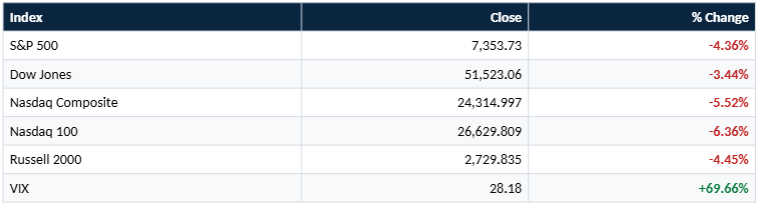
US stocks suffered their worst day since April 2025 on Thursday as fears of data-center curbs after Democratic election wins hammered chipmakers. The Nasdaq fell 5.52% into a correction, the S&P 500 lost 4.36%, the Dow dropped 3.44%, and the VIX jumped nearly 70%. After the close, Cloudflare, JFrog, and Airbnb jumped while Natera, DraftKings, and Atlassian fell.


US stocks suffer their worst day since April 2025 as fears of data-center curbs flatten chipmakers, the Nasdaq slips into a correction, and the VIX jumps nearly 70%
Welcome to Wall Street Wrap, your quick end-of-day rundown of what moved US markets today, plus what's shaping global sentiment overnight.
MARKETS TODAY
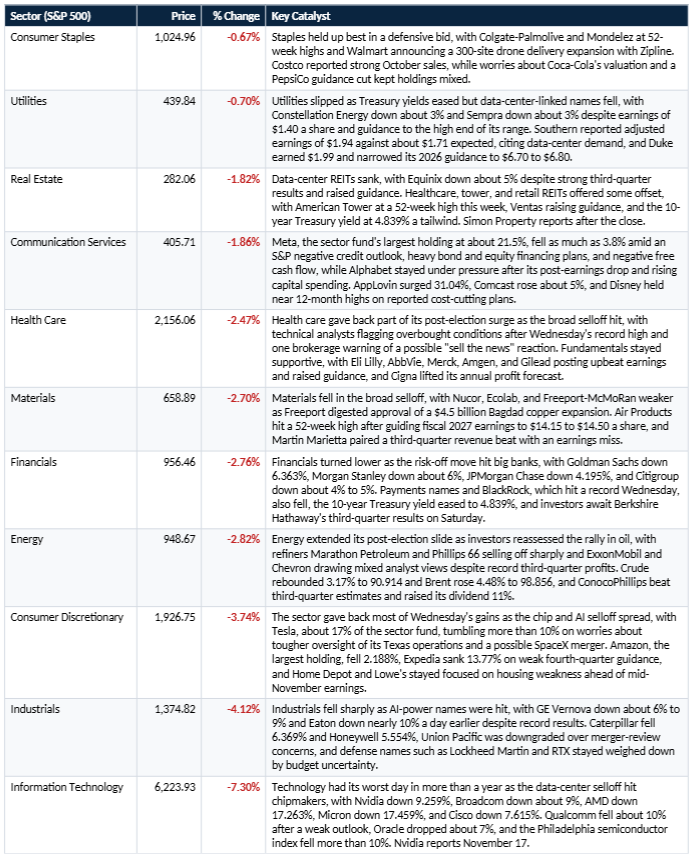
US stocks plunged on Thursday, erasing most of Wednesday's post-election rally as fears that Democratic wins would slow data-center construction hammered chipmakers and spread to the wider market. The Nasdaq Composite fell 5.52% to 24,314.997, slipping into correction territory, the S&P 500 lost 4.36% to 7,353.73, and the Dow Jones Industrial Average dropped 3.44% to 51,523.06, with all three posting their worst day since April 2025. The Nasdaq 100 sank 6.36% to 26,629.809, the Russell 2000 fell 4.45% to 2,729.835, and the VIX jumped 69.66% to 28.18. All 11 S&P 500 sectors fell, led lower by information technology at 7.30%, industrials at 4.12%, and consumer discretionary at 3.74%, while consumer staples slipped just 0.67%. AppLovin surged 31.04% and Tapestry gained 7.071%, while SanDisk plunged 22.264% and Astera Labs fell 19.618%.
ANALYTICAL VIEW
The selloff began with politics rather than earnings. Democratic gains at the federal and state level, including Texas, which holds 27% of planned US data-center capacity, led Senator Bernie Sanders to call for a "National data center moratorium now," and a voter poll found that 56% of voters called AI and data centers a crucial or major factor, with 65% of them backing Democrats. Estimates of the exposure were large, with Goldman Sachs analysts saying short-term moratoria could affect about 45% of planned US capacity expansion and UBS analysts saying about 30% of 2028 additions could be at risk. Chip and AI-hardware names took the brunt, with Nvidia down 9.259%, Micron down 17.459%, Western Digital down 17.355%, AMD down 17.263%, and Cisco down 7.615%, while information technology fell 7.30% and the Nasdaq dropped below its 200-day moving average for the first time since April.
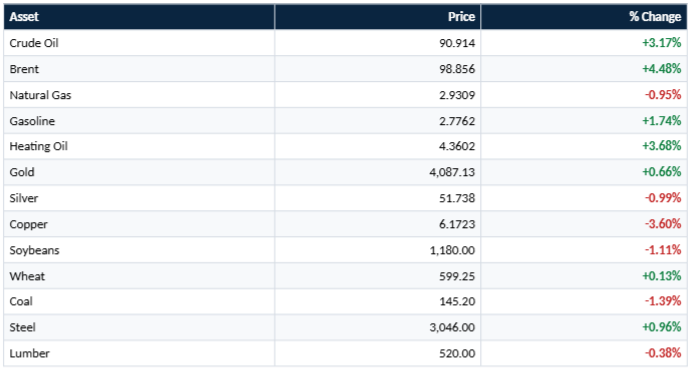
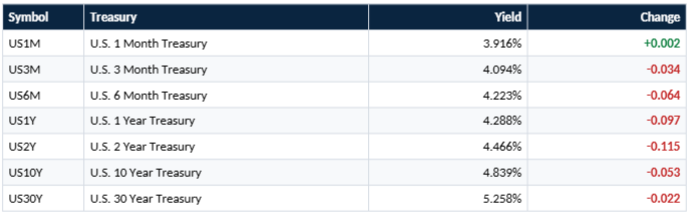
The damage spread beyond technology. Wednesday's winners gave back gains, with Microsoft down 3.575%, Amazon down 2.188%, and Apple down 1.528%, and Meta fell about 4%, while Caterpillar dropped 6.369%, Goldman Sachs 6.363%, and JPMorgan Chase 4.195% as the selloff fed on itself. Even so, the S&P 500 fell as far as 4.23% intraday, well short of the 7% decline that triggers a market-wide trading halt, and defensive groups held up better, with consumer staples down 0.67% and utilities down 0.70%. Data were firm, as weekly jobless claims fell to 189,000 against 197,000 expected and third-quarter productivity rose 3.6% against 2.9% expected, but futures pricing for a December Fed rate hike slipped to 70.1% from 82.7% a day earlier. Crude oil rebounded 3.17% to 90.914, gold rose 0.66% to 4,087.13, and the 10-year Treasury yield fell to 4.839%.
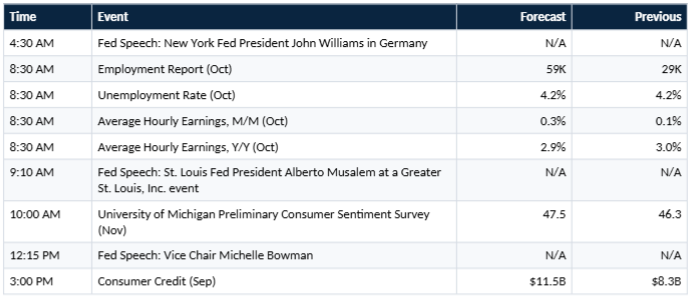
What could change the picture: Friday's October jobs report, forecast at 59,000 against 29,000 in September, the reaction in Asian markets after Korea's Kospi fell 5.28%, whether the Nasdaq can hold above its 200-day moving average, and whether Democratic calls for a data-center moratorium turn into concrete proposals.
SECTOR PERFORMANCE
WINNERS & LOSERS
Top 5 Gainers (across S&P, Nasdaq, Dow):
- AppLovin Corporation (NASDAQ:APP): +31.04%
- Tapestry, Inc. (NYSE:TPR): +7.071%
- Verisk Analytics, Inc. (NASDAQ:VRSK): +6.884%
- Corpay, Inc. (NYSE:CPAY): +6.785%
- CF Industries Holdings, Inc. (NYSE:CF): +6.169%
Top 5 Decliners:
- SanDisk Corporation (NASDAQ:SNDK): -22.264%
- Astera Labs, Inc. (NASDAQ:ALAB): -19.618%
- Lumentum Holdings Inc. (NASDAQ:LITE): -18.676%
- Micron Technology, Inc. (NASDAQ:MU): -17.459%
- Western Digital Corporation (NASDAQ:WDC): -17.355%
Note: AppLovin rose after its third-quarter results and fourth-quarter guidance beat expectations, while SanDisk, Astera Labs, Lumentum, Micron, and Western Digital fell as the data-center selloff hit chip, memory, and optical names. No specific cause was provided for the moves in Tapestry, Verisk, Corpay, or CF Industries. The Dow's gainers list showed only declines and was excluded.
AFTER-HOURS MOVERS
Gainers:
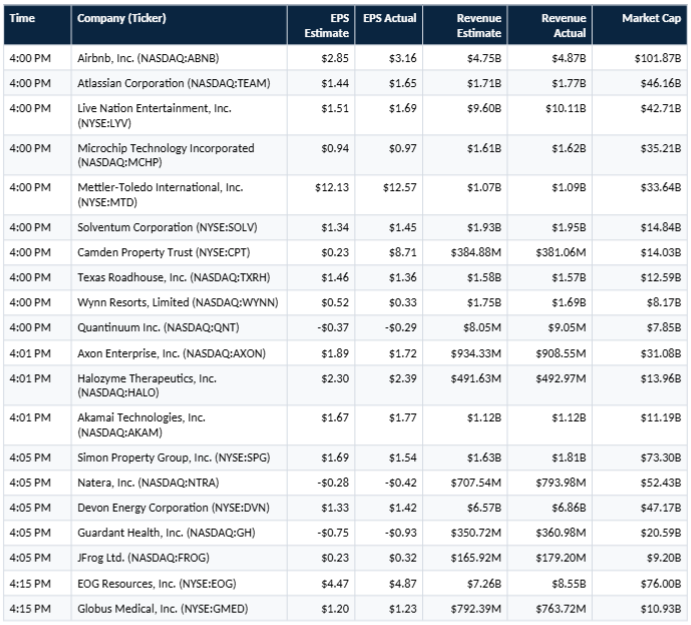
- JFrog Ltd. (NASDAQ:FROG), +20.81% after hours: Shares rose to $90.15 after third-quarter revenue of $179.2 million, up about 31% from a year earlier, topped the $165.9 million consensus, with adjusted earnings of $0.32 a share against $0.23 expected. Fourth-quarter revenue guidance of $183 million to $185 million and adjusted earnings guidance of $0.28 to $0.30 a share were also issued. The stock had closed 13.57% lower at $74.62 in the broad selloff.
- Eton Pharmaceuticals, Inc. (NASDAQ:ETON), +18.77% after hours: Shares rose to $56.00 after record third-quarter product sales of $57.9 million, up 158% from a year earlier, and non-GAAP earnings of $0.50 a share, against estimates of $0.31 and $41.98 million. The company raised its 2026 revenue guidance to more than $175 million from more than $145 million and its adjusted EBITDA margin guidance to at least 40% from at least 35%. The stock had closed 7.04% lower at $47.15.
- Cloudflare, Inc. (NYSE:NET), +18.23% after hours: Shares rose to $289.87 after third-quarter revenue of $782.5 million topped the $737.2 million consensus. Fourth-quarter revenue guidance of $845 million to $846 million and adjusted earnings guidance of $0.43 a share were well above estimates of $796.2 million and $0.38, and full-year revenue guidance was raised to about $2.96 billion from a consensus of $2.87 billion. The stock had closed 8.03% lower at $245.18.
- nLIGHT, Inc. (NASDAQ:LASR), +17.59% after hours: Shares rose to $34.50 after third-quarter adjusted earnings of $0.16 a share beat the $0.05 consensus and sales of $73.8 million, up about 10.5% from a year earlier, topped the $68.15 million expected. The stock had closed 11.06% lower at $29.34, near its 52-week low, as the semiconductor index suffered its worst day since March 2020.
- TransMedics Group, Inc. (NASDAQ:TMDX), +17.43% after hours: Shares rose to $81.00 after third-quarter revenue of $203.0 million, up 41% from a year earlier, and adjusted earnings of $0.51 a share. The company raised its 2026 revenue guidance to $764 million to $774 million, including about $14 million from PAD Aviation, and won its first European transplant logistics tender in Italy. The stock had closed 5.19% lower at $68.98.
- Airbnb, Inc. (NASDAQ:ABNB), +11.68% after hours: Shares rose to $190.00 after third-quarter earnings of $3.16 a share beat the $2.85 estimate and revenue of $4.869 billion, up 19%, topped the $4.75 billion expected, with net income of $1.89 billion. Fourth-quarter revenue guidance of $3.22 billion to $3.28 billion accompanied a raised full-year outlook of high-teens revenue growth and an adjusted EBITDA margin of about 36%. The stock had closed 3.54% lower at $170.13.
Decliners:
- Natera, Inc. (NASDAQ:NTRA), -21.93% after hours: Shares fell to $284.00 despite third-quarter revenue of $794.0 million, up 34%, topping the roughly $705 million to $707 million expected, and a raised 2026 revenue forecast of $3.005 billion to $3.035 billion from $2.85 billion to $2.91 billion. The loss of $0.42 a share was wider than the roughly $0.28 to $0.29 loss expected, and the stock traded at about 20 times sales. The stock had closed 6.97% lower at $363.76.
- DraftKings Inc. (NASDAQ:DKNG), -18.54% after hours: Shares fell to $19.16 after an adjusted EBITDA loss of $316.9 million, against a $65.9 million loss expected, and a loss of $0.53 a share, against $0.25 expected, even though revenue of $1.33 billion rose 16%. Guidance for 2026 revenue of $6.35 billion to $6.55 billion had a midpoint below the $6.66 billion consensus. The stock had closed 1.77% higher at $23.52.
- Atlassian Corporation (NASDAQ:TEAM), -17.58% after hours: Shares fell to $151.06 even though fiscal first-quarter adjusted earnings of $1.65 a share beat the $1.44 estimate and revenue of $1.77 billion topped the $1.71 billion expected. Second-quarter revenue guidance of $1.83 billion to $1.84 billion was slightly above the $1.82 billion consensus. The stock had closed 3.47% lower at $183.29.
- Axon Enterprise, Inc. (NASDAQ:AXON), -14.52% after hours: Shares fell to $327.01 after third-quarter adjusted earnings of $1.72 a share missed the roughly $1.89 expected and revenue of $908.6 million trailed the roughly $934 million estimate. Management lowered its 2026 revenue guidance to $3.61 billion to $3.63 billion, about 30% growth, from 32% to 34%, and guided fourth-quarter revenue to $990 million to $1.01 billion against a $1.07 billion consensus. The stock had closed 9.81% lower at $382.56.
- Guardant Health, Inc. (NASDAQ:GH), -11.80% after hours: Shares fell to $135.32 even though third-quarter revenue of $361.0 million, up 36%, topped the $350.72 million estimate and the company raised its 2026 revenue guidance to $1.36 billion to $1.37 billion. The loss of $0.93 a share was wider than the $0.75 loss expected, while the non-GAAP loss was $0.29 a share. The stock had closed 8.99% lower at $153.43.
- Affirm Holdings, Inc. (NASDAQ:AFRM), -8.84% after hours: Shares fell to $63.50 after fiscal first-quarter GAAP earnings of $0.47 a share were weighed down by $51.1 million of partner warrant expense and a higher tax charge, even though revenue of $1.26 billion beat the $1.21 billion expected and gross merchandise volume rose 34% to $14.4 billion. Loans 30 or more days late rose 35 basis points from the prior quarter to 2.9%. The stock had closed 7.84% lower at $69.66.
COMMODITIES & RATES
US TREASURY YIELDS
TOP STORIES: US
Stocks suffer their worst day since April 2025 as the Nasdaq enters a correction. The Nasdaq Composite fell 5.52%, the S&P 500 4.36%, the Dow 3.44%, and the small-cap Russell 2000 4.45%, which also entered a correction, while the Nasdaq 100 lost more than $2 trillion in market value and the VIX closed at 28.18, its highest level since March. The Philadelphia semiconductor index fell more than 10%, and over a quarter of the S&P 500 technology index's components were down 10% or more at one point. Nebius and IREN slid about 16% each and CoreWeave about 11%, with CoreWeave's five-year credit default spreads hitting a record. An investment firm chief executive said "the market's moving from the promise of AI to the price of AI," while another said volatility has not reached the extremes associated with capitulation points.
Democrats push to rein in the AI buildout. Voters in local referendums approved data-center restrictions, and of 41 data-center ballot measures this week, all but one went against them, according to Ballotpedia. Representative Yassamin Ansari wrote that pausing AI development should be a top priority for the new House majority, and Texas governor-elect Gina Hinojosa pledged a moratorium on data-center approvals until the legislature passes protections. Microsoft declined to expand a Texas data-center agreement with Nscale and is tightening oversight of some projects from Nebius, IREN, and Nscale, Bloomberg reported, while Google said it will invest $17 billion in a first Wyoming data center powered partly by Bloom Energy fuel cells.
Musk's companies extend losses as Texas results cloud the outlook. Tesla slumped more than 11% and SpaceX nearly 9%, leaving the two on track to lose more than $380 billion in combined market value this week, as investors worried that Democratic wins in Texas, where both are based, could slow data-center buildouts and bring tougher oversight after Musk spent nearly half a billion dollars backing Republicans. More than half of SpaceX's third-quarter sales came from renting out computing capacity, and analysts said the results could complicate a potential Tesla and SpaceX merger. The Federal Aviation Administration separately proposed streamlining rules for commercial space launches, a potential boost for SpaceX and Blue Origin.
Fed officials back gradual rate hikes as jobless claims hit a 57-year low. Cleveland Fed President Beth Hammack and Richmond Fed President Thomas Barkin both made the case for modest, steady increases, in the first Fed comments since the election, and Barkin said inflation is "the most important risk right now." Odds of a December quarter-point hike fell to 70.1% from 82.7% on Wednesday, with rates now in a 3.75% to 4.00% range. Initial jobless claims fell 6,000 to 189,000, matching the lowest level since 1969, continuing claims rose 23,000 to 1.718 million, and third-quarter productivity rose 3.6% while unit labor costs fell 0.7%, with the labor share of output at 53%, the lowest since records began in 1947.
Expedia sinks as the Iran war weighs on travel. Expedia fell 13.77% a day after forecasting fourth-quarter revenue and EBITDA below estimates, erasing more than $4.6 billion in market value, as companies from Hilton to Booking signaled that the war in the Middle East is scuttling demand. Marriott expects Middle East room revenue to fall by more than the 12% seen in the third quarter, and Hilton said the war, along with issues in Mexico and timeshare licenses, has added $60 million to $70 million in headwinds this year. Industry executives remain confident of a recovery next year, citing resilient US leisure, group, and business travel.
Also today: Cigna raised its 2026 adjusted profit forecast to at least $30.60 a share after third-quarter adjusted earnings of $7.98 beat the $7.50 consensus, and said it expects adjusted profit to grow at least 10% in 2027; Senate Democrats are preparing to investigate JPMorgan Chase's relationship with Jeffrey Epstein, focusing on decisions by Mary Erdoes, a source said, and Democrats are also expected to probe the Trump administration's energy deals; Google, Meta, and TikTok sued to block a California law limiting features for children under 16, citing the First Amendment; Blue Origin delayed New Glenn's return to flight to January 2027; food startup Wonder, founded by Marc Lore, confidentially filed for an IPO after a $9 billion valuation in its latest funding round; OpenAI released GPT-6 Cyber to a small group of vetted customers, rating it "Critical" for cybersecurity risk; the IRS raised the 2027 estate and gift tax exemption to $15.48 million per person; California's billionaire tax faces defeat, with 56% of votes counted against it.
TOP STORIES: GLOBAL
South Korea's Kospi plunges 5% as Asian markets close mixed. The Kospi fell 5.28% to 5,383.8 and the tech-focused Kosdaq fell 5.11% to 678.41, while Japan's Nikkei 225 dropped 1.79% to 61,077.9 even as the broader Topix gained 1.16% to 3,940.39. Mainland China's CSI 300 rose 0.29% to 4,113.41, Hong Kong's Hang Seng gained 3.61% in its last hour of trade, and Australia's S&P/ASX 200 added 2.61% to 9,065.1. Analysts said Asian markets could fall again on Friday, since the Nikkei and Kospi were both up more than 20% this year before the Wall Street rout.
The Bank of England raises rates for the first time since 2023 and warns more is likely. The Monetary Policy Committee voted 8-1 to lift Bank Rate to 4% from 3.75%, with one member voting for a half-point rise, and Governor Andrew Bailey said at least one more increase is likely unless the conflict in the Middle East is resolved. The bank now sees inflation peaking at 4.8% in the second quarter of next year and not returning to its 2% target until the third quarter of 2028, and it raised its growth forecasts to 1.6% this year and 1.3% next. Sterling strengthened and two-year gilt yields rose after the decision, and an economist called December's meeting "a coin flip." The FTSE 100 rose as much as 119 points to 10,948 in the morning, its highest since August 7, before slipping 0.43% to 10,782.66 late in the day.
Rheinmetall plunges 16% after cutting its outlook for the second time since August. The German defense group closed down 16.14% at 841.50 euros, taking its year-to-date loss to about 46%, after it cut its 2026 sales forecast to about 13.2 billion euros from a range of 13.7 billion to 14.2 billion euros and its operating margin target to about 18.5% from 19%. The company cited delays to the Arminius Boxer armored vehicle program and artillery ammunition acceptance testing, even as third-quarter sales rose 32% to 3.15 billion euros and operating profit jumped 62% to 553 million euros. Analysts called the news "clearly negative" and warned it could fuel concerns about traditional defense technology.
Deoleo, the world's largest olive oil company, falls about 20% on a takeover deal by its rivals. Spanish producers Dcoop and Acesur will each take a 50% stake in Deoleo in a deal that implies an enterprise value of 520 million euros, or $583.2 million, after a takeover battle that also drew bids from Italian, French, and Australian firms. Dcoop had reportedly offered 470 million euros earlier, and the stock, which had risen about 55% this year on easing olive oil prices, was last trading down 19.9%.
MANAGEMENT & FED SPEAK
Beth Hammack, President, Federal Reserve Bank of Cleveland, on the path of rates:
She prefers "more frequent smaller adjustments when possible."
Thomas Barkin, President, Federal Reserve Bank of Richmond, on the economy:
"Unemployment's near record lows, and inflation is too high."
Ariane Gorin, Chief Executive Officer, Expedia Group, on AI agents:
"We haven't seen it change the way they're actually doing booking."
Jason Robins, Chief Executive Officer, DraftKings, on the quarter:
"The third quarter marked a pivotal moment for DraftKings."
Brian Evanko, Chief Executive Officer, The Cigna Group, on strategy:
"We have a clear strategic growth framework for creating long-term value."
CORPORATE ACTIONS & EARNINGS CALENDAR
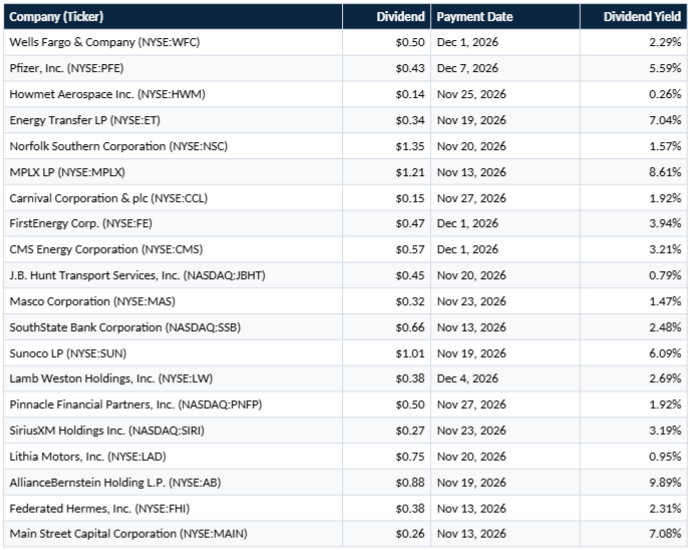
Top Ex-Dividend Companies for Friday, November 6:
Earnings Reported After the Close (Thursday, November 5):
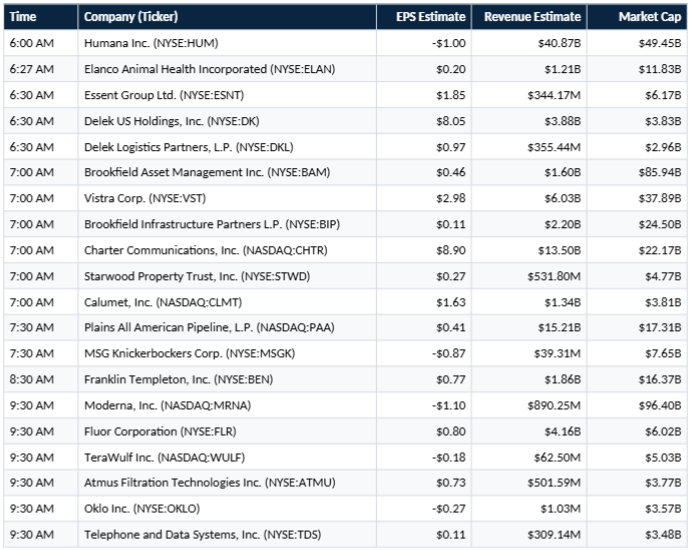
Upcoming Earnings (Friday, November 6):
Economic Calendar (Thursday, November 5):

Economic Calendar (Friday, November 6):
That's the wrap for today! Attention turns to Friday's October jobs report, results from Moderna, Humana, Vistra, and Charter Communications, and whether Asian markets can steady after Thursday's rout in US technology shares.
Related post