The Wall Street Wrap: October 6, 2026
The S&P 500 and Nasdaq closed at records on Tuesday as Treasury yields eased and chipmakers rallied, with the S&P 500 up 0.58% and the Dow up 0.49%. Google's 3,590-megawatt power deal sent Constellation Energy up 12% and made utilities the best-performing sector, while Paramount Skydance completed its $110 billion takeover of Warner Bros. Discovery. Overseas, French bond stress pushed the euro toward 17-month lows and Iran stepped up attacks on tankers in the Strait of Hormuz.

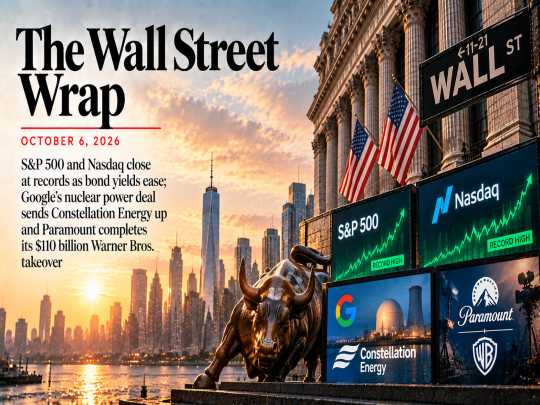
S&P 500 and Nasdaq close at records as bond yields ease; Google's nuclear power deal sends Constellation Energy up 12% and Paramount completes its $110 billion Warner Bros. takeover
Welcome to Wall Street Wrap, your quick end-of-day rundown of what moved US markets today, plus what's shaping global sentiment overnight.
MARKETS TODAY
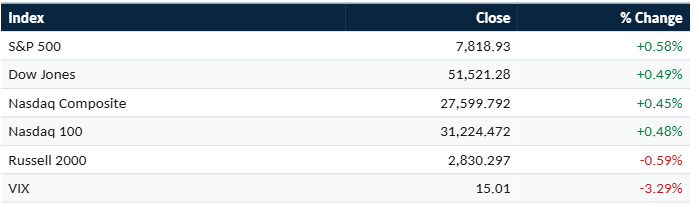
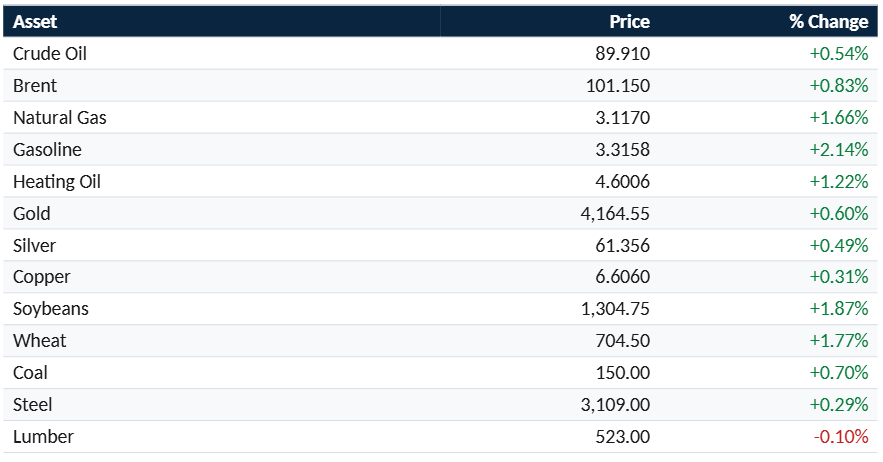
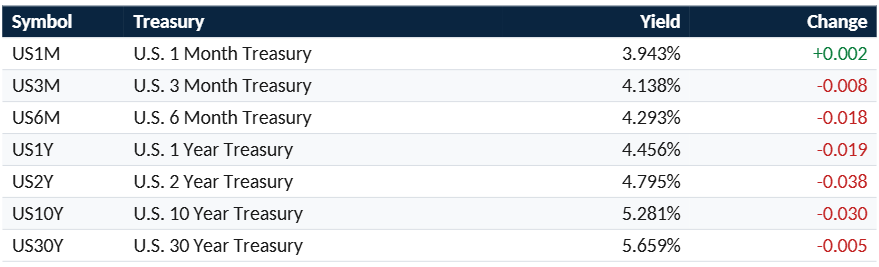
US stocks rose on Tuesday, with the S&P 500 and Nasdaq Composite both closing at records as a pause in the bond sell-off, steady oil prices and a chip-led rally in AI-linked shares lifted sentiment. The S&P 500 gained 0.58% to 7,818.93, the Nasdaq Composite added 0.45% to 27,599.792, the Dow Jones Industrial Average rose 253.38 points, or 0.49%, to 51,521.28, and the Nasdaq 100 climbed 0.48% to 31,224.472. The 10-year Treasury yield slipped to 5.281% after touching its highest level since April 2002 on Monday, while Brent crude settled at $100.58 a barrel. Utilities led the sectors on a nuclear-power rally and health care was the only sector to decline, while the Russell 2000 fell 0.59%.
ANALYTICAL VIEW
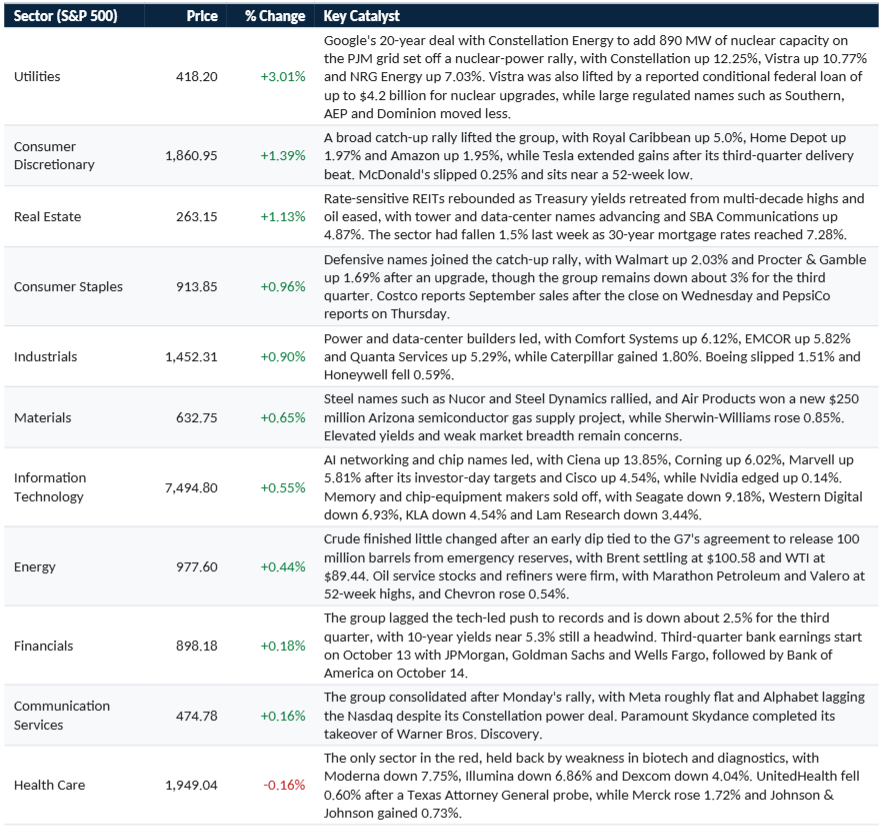
Investors looked past still-high bond yields and oil on Tuesday, and the chip and networking trade did most of the work. The S&P 500 and Nasdaq Composite closed at records as the 10-year yield eased to 5.281% from Monday's 5.349% peak and Brent held near $100 a barrel, and one chief investment officer said investors are "looking through the inflation concerns" and leaning on earnings growth and AI spending. Beneath the surface, breadth was uneven: the Russell 2000 fell 0.59%, the transport index slipped 0.45%, and tech's 0.55% gain was held back by a sharp sell-off in memory and chip-equipment names, with Seagate down 9.18% and Western Digital down 6.93%.
The bond market is also reshuffling who gets paid for waiting. High-yield dividend funds have given back ground as Treasury yields climbed, with the Invesco S&P 500 High Dividend Low Volatility ETF down 7.59% over the past month, and real estate, utilities and materials stocks have been among the sectors most squeezed as bonds look more attractive by comparison. Tuesday was the exception: utilities jumped 3.01% because Google's nuclear power deal tied them to AI power demand, not because yields fell. Corporate bonds now pay around 6%, yet dividend funds still drew $46.2 billion through September, according to State Street. With the Fed having raised rates by 25 basis points on September 16, traders price roughly an 80% chance that it holds at its next meeting, which puts Wednesday's minutes at the center of the week.
What could change the picture: Whether Wednesday's Fed minutes show policymakers leaning toward another hike while the 10-year yield sits above 5.2%, and whether the start of third-quarter earnings season justifies the AI spending that has carried stocks to records.
SECTOR PERFORMANCE
WINNERS & LOSERS
Top 5 Gainers (across S&P, Nasdaq, Dow):
- Ciena Corporation (NYSE:CIEN): +13.847%
- Constellation Energy Corporation (NASDAQ:CEG): +12.249%
- Vistra Corp. (NYSE:VST): +10.774%
- Astera Labs, Inc. (NASDAQ:ALAB): +7.579%
- Nebius Group N.V. (NASDAQ:NBIS): +7.439%
Top 5 Decliners:
- Seagate Technology Holdings plc (NASDAQ:STX): -9.183%
- Moderna, Inc. (NASDAQ:MRNA): -7.751%
- Western Digital Corporation (NASDAQ:WDC): -6.929%
- Illumina, Inc. (NASDAQ:ILMN): -6.861%
- Twilio Inc. (NYSE:TWLO): -6.813%
Note: Power producers and AI networking names led the gainers, while memory-storage makers fell on reports that Toshiba plans to take a bigger share of the market, and Moderna, Illumina and Twilio also dropped.
AFTER-HOURS MOVERS
Gainers:
- Neogen Corporation (NASDAQ:NEOG), +8.86% after hours: Shares rebounded to $13.02 after the food-safety testing company beat on fiscal first-quarter results and raised its full-year outlook, having closed 8.07% lower at $11.96 in the regular session. Revenue was $222.8 million, up 6.5%, against about $208.2 million expected, and adjusted EPS was $0.08 versus $0.05 expected, with adjusted EBITDA margin improving to 18.7%. Fiscal 2027 guidance rose to $885 million to $890 million of revenue and $181 million to $183 million of adjusted EBITDA, though a GAAP net loss of $11.9 million tempered the headline, and the earlier slide followed a late-September FDA warning letter tied to its HYCOAT product and the shareholder-investigation announcements that followed. Investors now look to the earnings call and the October 7 Investor Day.
- Black Hills Corporation (NYSE:BKH), +5.20% after hours: Shares rose to $74.42 after the utility announced agreements, effective September 30 with terms through 2048, to serve a planned Google data center in Cheyenne, Wyoming. It plans to invest $1.8 billion in 564 MW of company-owned gas generation during 2027 to 2029, expects about $150 million of net income in 2030 and about $2.4 billion of unlevered free cash flow through 2048, and says there is no cost shifting to other customers. Google has also advanced $399 million that is refundable, and the stock had closed 0.37% higher at $70.74.
- ZIM Integrated Shipping Services Ltd. (NYSE:ZIM), +4.62% after hours: Shares rose to $30.55 after the container shipper raised its full-year 2026 guidance, citing strong market demand and favorable freight-rate momentum. It now expects adjusted EBITDA of $2.7 billion to $3.0 billion, up from $2.0 billion to $2.4 billion, and adjusted EBIT of $1.4 billion to $1.7 billion, up from $700 million to $1.1 billion, with the midpoints up 30% and 72%. The pending $4.2 billion takeover by Hapag-Lloyd still faces objections from Israeli government officials, and the stock had closed 0.93% higher at $29.20.
Decliners:
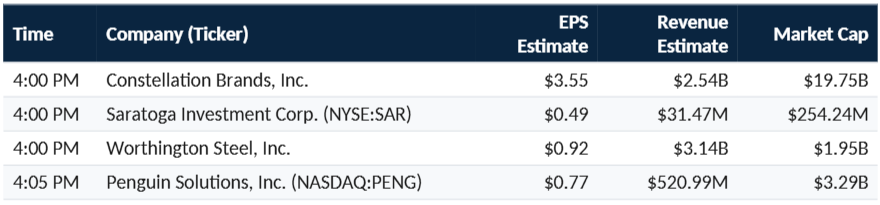
- Constellation Brands, Inc. (NYSE:STZ), -5.10% after hours: Shares fell to $110.00, below their recent 11-year low of $110.60, even though fiscal second-quarter results beat on the headline numbers. Revenue was $2.63 billion against about $2.54 billion expected and adjusted EPS was $3.74 against $3.55, but the company only affirmed fiscal 2027 adjusted EPS guidance of $11.20 to $11.90 and announced the SpikedAde RTD acquisition, with $75 million upfront and up to $278 million contingent. Investors appear focused on soft beer depletions, with Modelo and Corona down, after a run of analyst target cuts, and the stock had closed 2.29% higher at $115.91.
- Worthington Steel, Inc. (NYSE:WS), -3.77% after hours: Shares fell to $36.75 after fiscal first-quarter adjusted EPS of $0.57 missed the roughly $0.68 consensus and fell from $0.77 a year earlier. Net sales rose 212% to $2.73 billion, with the majority-owned Kloeckner acquisition contributing $1.77 billion and sales excluding Kloeckner up 9%, while adjusted EBIT rose to $78.5 million from $55.5 million, the company reported a $7.0 million net loss, or $0.14 per share, and it held its $0.16 quarterly dividend. The stock had closed 2.38% lower at $38.19, and investors now look to the October 7 call for comment on integration and synergies.
- Constellation Energy, -2.25% after hours: Shares gave back some of the day's gains, slipping to $293.65 after a 12.25% regular-session surge to $300.40 on its 20-year agreement with Google. The stock remains down roughly 20% or more year to date, and analysts have recently trimmed targets, though consensus is still Buy-leaning.
COMMODITIES & RATES
US TREASURY YIELDS
TOP STORIES: US
Google contracts 3,590 megawatts from Constellation Energy, sending nuclear and power stocks sharply higher. The package covers the PJM grid, the largest in the US, with new nuclear capacity making up about a quarter of the supply, and Constellation will invest more than $4.3 billion in its fleet to deliver it. It pairs a 20-year, 890-megawatt agreement for power from nuclear plants that will be upgraded, with first deliveries expected in 2028, with a 15-year, 2,700-megawatt supply agreement not tied to a specific plant. The deal answers a proposal by the grid operator that would force large data-center customers to bring their own power or risk being cut off at peak demand, in a region where capacity prices have risen more than 11-fold since 2024. Constellation closed 12.25% higher at $300.40, Vistra rose 10.77% and NRG Energy gained 7.03%, and utilities were the best-performing S&P 500 sector, up 3.01%.
Paramount Skydance completes its $110 billion takeover of Warner Bros. Discovery, creating a media group called Skydance. Its shares moved from Nasdaq to the New York Stock Exchange on Tuesday and now trade under the ticker SKYD. The combined company, led by David Ellison with Ynon Kreiz as co-CEO, carries about $80 billion of debt and is targeting $6 billion in savings, much of it from non-labor sources such as merging technology and cloud providers. It plans to fold HBO Max and Paramount+ into a single streaming service and to release at least 30 films a year, while CNN and CBS News leadership stays in place, and Warner Bros. shareholders received an extra $41.9 million ticking fee based on the days between the end of September and closing.
Uber agrees to buy catering platform ezCater for $2.3 billion in cash to narrow DoorDash's lead in US delivery. ezCater, which lets companies order food for events, meetings and workplace meals, generated more than $2.5 billion in gross bookings over the past 12 months, with average order values above $400, and Uber expects the deal to lift margins. The purchase would combine ezCater with Uber Eats' restaurant network and Uber for Business' corporate customers, and follows Uber's $14.8 billion agreement in July to buy Delivery Hero. The deal needs regulatory approval and is expected to close in the coming months, while Uber's shares have fallen 15% this year as investors weigh the threat from robotaxis.
Anduril wins a Navy contract worth up to $2.9 billion to boost submarine production and plans a $3.7 billion Baltimore shipyard. The shipyard at Sparrows Point, slated to open in 2030 and create about 3,100 jobs, will build components for the Virginia-class submarine, with some parts such as torpedo tubes made at a 160,000-square-foot facility in Orange County, California. The award came days after co-founder Palmer Luckey was named to the Pentagon's Project Meridian task force on future weapons, a role that has raised questions about defense tech's sway in Washington, which the Pentagon's chief technology officer dismissed by saying there was "nothing to see here."
The US trade deficit widens to $105.6 billion in August, its largest since March 2025, as AI-related imports surge. Imports jumped $17.2 billion to a record $420.8 billion, led by crude oil and nonmonetary gold in industrial supplies and by semiconductors and other machinery in capital goods, while exports rose $4.5 billion to $315.2 billion. The gap was up 13.7% from July and wider than the $102 billion economists expected, though the year-to-date deficit of $138.2 billion is still down nearly 20% from a year ago. Goldman Sachs cut its third-quarter growth tracking estimate to 3.1%, down 0.3 percentage point, and the Atlanta Fed's GDPNow tracker eased to 3.7%.
Also today: Nvidia-backed cloud company Lambda is raising up to $4 billion at a $14.5 billion pre-money valuation in its final round before a planned 2027 IPO, the Wall Street Journal reported, with Blackstone and Coatue leading and its order backlog up to $50 billion in September from $15 billion in June; Kalshi launched a perpetual future tracking a Kalshi index of 500 large US companies and will add low-volume tags, accuracy scores and live trade feeds to its election markets ahead of the midterms; JPMorgan named veteran dealmaker Rob Sweeney a global chair of investment banking as it expands, having hired more than 1,000 bankers this year; the Emmys will leave broadcast television for Amazon's Prime Video in 2027 under a six-year exclusive global streaming deal; Google began defending a lawsuit worth more than £1 billion in London over Play Store commissions of up to 30%; Ray Dalio, founder of Bridgewater Associates, said the Treasury market could face more disruption if demand from China and Japan pulls back, adding that they are "starting to get squeezed"; and investor Michael Burry wrote that the stock market is in the "first stage of grief, denial" over the AI trade, noting that similar stages lasted six to nine months in 2000 and 2008.
TOP STORIES: GLOBAL
French bond contagion fears push the euro to a 17-month low below $1.12. The currency fell to that level on Monday, leaving it down more than 4% this year, as investors dumped French government bonds and bought safer German debt, pushing the yield gap between the two to its widest since the 2010 to 2012 euro-zone debt crisis. France is trying to pass an unpopular 2027 budget in a divided parliament, Spain's prime minister called a snap election on Monday, and Chancellor Friedrich Merz's party suffered the worst regional election defeat in postwar Germany last month. One bank estimates that each further 10 basis point widening in the French spread would knock 0.4% off the euro against the dollar, though the euro bounced 0.33% to about 1.126 on Tuesday and euro-zone business activity grew at its fastest pace in nearly three and a half years in September.
Iran steps up attacks on tankers in the Strait of Hormuz, threatening a fragile rebound in Gulf crude exports. Nearly 20 commercial ships, mostly tankers, have come under attack over the past month, according to a group of US-allied militaries that tracks maritime security, and at least nine sailors have died since July, according to the International Maritime Organization. Crude shipments through the strait averaged about 10.3 million barrels per day last week, roughly 23% below the prewar level, according to Kpler, while higher freight and insurance costs have pushed the cost of moving a cargo from the Gulf to China to about $1 million per day for each tanker. Goldman Sachs expects diesel prices to stay elevated through 2027 as refinery constraints meet recovering demand, forecasting diesel and jet-fuel margins above $40 a barrel, about twice the usual level, even with Brent easing toward $80.
DeepSeek is set to raise more than 80 billion yuan, about $11.9 billion, ahead of a domestic IPO, a source says. The round, which began in July targeting a valuation of 500 billion yuan, or about $74 billion, has drawn commitments above its original 50 billion yuan target, with battery maker CATL and Tencent among the largest backers, and is expected to wrap up in October. It follows a first outside round of about $7.4 billion earlier this year, and the company has hired CITIC Securities to prepare a possible STAR Market listing, though timing and size are undecided. DeepSeek has also partnered with Huawei on programming tools for its Ascend chips, part of China's push to cut reliance on Nvidia's ecosystem.
MANAGEMENT & FED SPEAK
David Ellison, CEO, Skydance, on the Warner Bros. merger:
In a memo to employees, Ellison said the goal was not simply to get bigger but "to take on the biggest players in our industry."
Joe Dominguez, Chairman, President and CEO, Constellation Energy, on the Google agreement:
Dominguez called the arrangement a "model for how technology companies and the energy industry can work together," a template he said delivers grid-wide benefits funded by private entities.
Donald Trump, President of the United States, on the Paramount-Warner Bros. merger:
Asked about the deal, Trump told reporters: "That's a great merger. I'm glad they let it go."
Tarek Mansour, Co-founder and CEO, Kalshi, on stock index perpetual futures:
Mansour said "perps are the best way for our traders to get this exposure" as Kalshi pushes toward becoming a full-service exchange, and called the midterms the "first meaningful prediction market election."
CORPORATE ACTIONS & EARNINGS CALENDAR
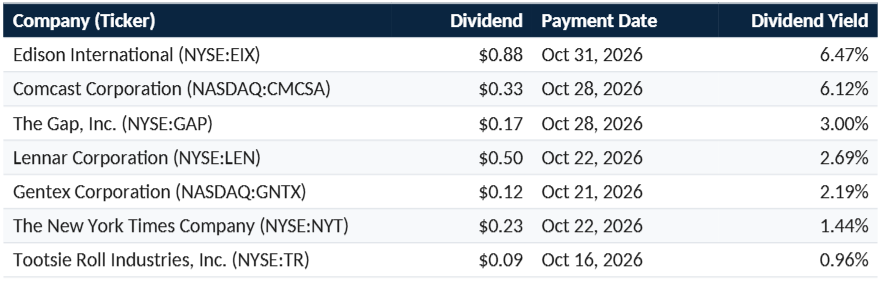
Top Ex-Dividend Companies for Wednesday, October 7:
Upcoming Earnings (Wednesday, October 7):
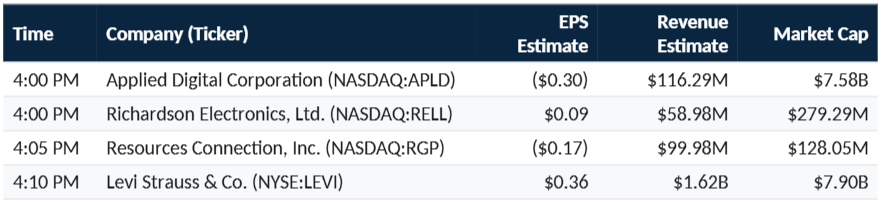
Earnings Reported After the Close (Tuesday, October 6):
Economic Calendar (Wednesday, October 7):

That's the wrap for today! Attention now turns to Wednesday's release of the Fed's September meeting minutes, which could show how far policymakers are willing to go on rates as bond yields hover near two-decade highs and the third-quarter earnings season approaches.
Related post
.png)