The Wall Street Wrap: September 15, 2026
Stocks fell Tuesday as Treasury yields surged past 5% for the first time since 2007 and oil extended its rally on a deepening Middle East crisis, with traders bracing for Wednesday's Fed decision. Saudi Arabia issued rare security alerts over Mecca and Jeddah as Houthi attacks intensified, Nvidia's Jensen Huang and Anthropic's Dario Amodei offered dueling views on AI safety at Dreamforce, and the Senate blocked crypto's Clarity Act from advancing.

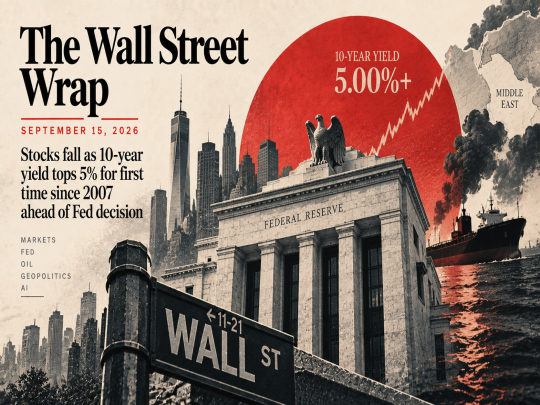
Stocks fall as 10-year yield tops 5% for first time since 2007 ahead of Fed decision
Welcome to Wall Street Wrap, your quick end-of-day rundown of what moved US markets today, plus what's shaping global sentiment overnight.
MARKETS TODAY
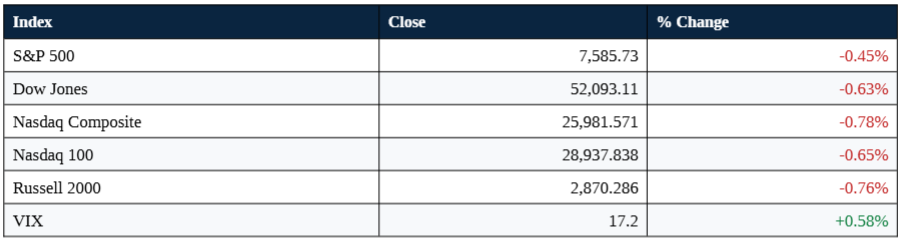
Stocks fell Tuesday as traders looked ahead to the Federal Reserve's policy decision this week and Treasury yields surged to multiyear highs. The Dow lost 328.09 points, or 0.63%, to close at 52,093.11. The S&P 500 fell 0.45% to 7,585.73, while the Nasdaq Composite dropped 0.78% to 25,981.57. Losses in the S&P 500 and Nasdaq were tempered by a partial rebound in AI-related stocks that had been under pressure the prior session, with Coherent (NYSE:COHR) adding nearly 2%, AMD (NASDAQ:AMD) gaining 2%, and Qualcomm (NASDAQ:QCOM) advancing more than 4%.
Close Levels:
ANALYTICAL VIEW
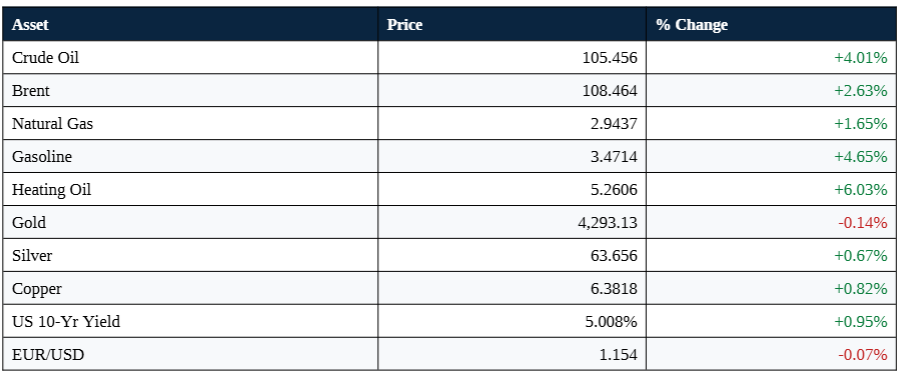
The 10-year Treasury yield rose to its highest level since 2007 on Tuesday, touching 5.041% intraday before paring the move to end near 5.008%, as fears mount that the prolonged US-Iran war will fuel inflation and push the Federal Reserve toward a more hawkish path. Global bond yields have been under pressure for weeks, with mounting US government debt, now past $40 trillion, compounding the concern. Oil added to the unease after Saudi Arabia's East-West pipeline remained shut following last week's attack, with Brent crude rising nearly 3% to $108.75 a barrel and West Texas Intermediate up more than 4% to $105.83, extending Monday's gains that followed the pipeline shutdown.
The Fed's policy decision on Wednesday is now the dominant focus for markets, with futures pricing in a more than 94% likelihood of a quarter-point rate hike from the current 3.5% to 3.75% range. Barclays strategists warned that the approaching 5% threshold in 10-year yields marks a historically significant inflection point beyond which rates tend to become a more persistent headwind for equities, even as earnings have so far offset the drag. Wolfe Research, notably less hawkish than consensus at 50-50 odds of a hike, said that even if the Fed does raise rates, history suggests stocks typically recover and push into positive territory within six to twelve months of a first hike in a cycle.
What could change the picture: the Federal Reserve's rate decision on Wednesday is the immediate catalyst, with markets watching closely for Chair Kevin Warsh's tone on future policy given the Fed's recent lack of forward guidance.
Further reading: Fed Decision Tomorrow: What the September Rate Hike Means for Stocks, Bonds, and Your Portfolio
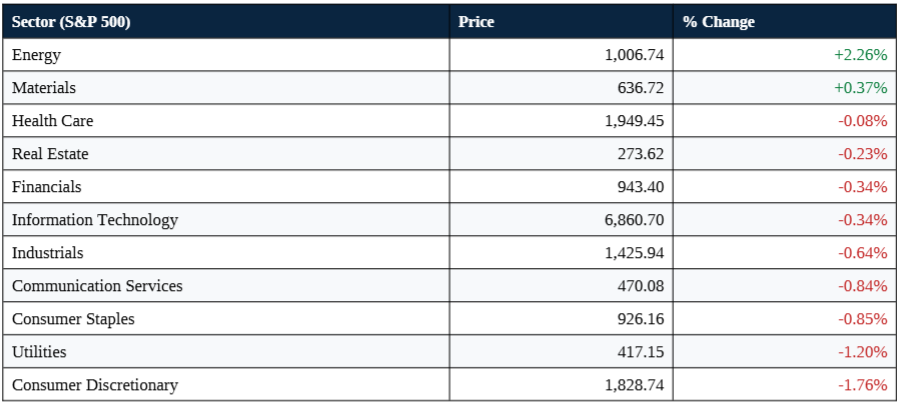
SECTOR PERFORMANCE
WINNERS & LOSERS
Top 5 Gainers (across S&P, Nasdaq, Dow):
- Skyworks Solutions (NASDAQ:SWKS): +13.55%
- Revvity (NYSE:RVTY): +9.11%
- APA Corporation (NASDAQ:APA): +5.29%
- F5 (NASDAQ:FFIV): +4.71%
- Thermo Fisher Scientific (NYSE:TMO): +4.61%
Top 5 Decliners:
- Coinbase Global (NASDAQ:COIN): -10.10%
- Axon Enterprise (NASDAQ:AXON): -9.81%
- Jack Henry & Associates (NASDAQ:JKHY): -6.37%
- Chipotle Mexican Grill (NYSE:CMG): -5.94%
- Carvana (NYSE:CVNA): -5.60%
Note: Energy names led gainers as oil extended its rally, while Coinbase and Axon led decliners after the Senate blocked the Clarity Act's crypto framework from advancing.
AFTER-HOURS MOVERS
Gainers:
- Tempest Therapeutics (NASDAQ:TPST), +29.76% after hours: Shares surged after the company announced an exclusive option agreement with Hebei Senlang Biotechnology for a CD7-targeted lentiviral in vivo CAR-T platform, complementing its existing lipid nanoparticle technology. Tempest's lead candidate under the deal targets BCMA and GPRC5D and is in a Phase 1 trial for relapsed or refractory multiple myeloma.
- FTAI Aviation (NASDAQ:FTAI), +3.49% after hours: Shares stabilized following Monday's steep post-earnings decline, as investors continued digesting a mixed second-quarter report in which revenue beat estimates by more than 10% on record Aerospace Products performance, even as EBITDA and earnings per share both missed significantly.
Decliners:
- Beta Bionics (NASDAQ:BBNX), -9.00% after hours: Shares fell after the insulin-delivery device maker announced plans for a $125 million underwritten common stock offering, plus a 30-day option for underwriters to purchase an additional $18.75 million, with proceeds earmarked for commercialization of its Mint product, manufacturing expansion, and research and development.
- Ethos Technologies (NASDAQ:LIFE), -4.82% after hours: Shares reversed a regular-session gain after a critical report highlighted concentration risk in the company's business, noting that TruStage and two other carriers account for 88% of Ethos's revenue and that its largest distributor by headcount ranked the company last in partner sentiment.
COMMODITIES & RATES
TOP STORIES: US
Treasury yields top 5% for the first time since 2007 as Fed decision looms. The 10-year yield touched 5.041% intraday before easing slightly, as investors weighed mounting government debt, persistent inflation, and oil above $100 a barrel ahead of Wednesday's Fed meeting, where futures markets are pricing in a more than 94% chance of a quarter-point hike. Treasury Secretary Scott Bessent, testifying before the House Financial Services Committee the same day, defended the department's bond buyback program, saying yields would have been higher without it, and said he is working on deficit-reduction plans to help ease borrowing costs.
AI industry debates safety pacing, from Dreamforce to closed-door talks. At Salesforce's (NYSE:CRM) Dreamforce conference, Anthropic's Amodei said slowing AI development is "the way to lead the industry forward, to set an example," while Nvidia (NASDAQ:NVDA) CEO Jensen Huang countered that speed and safety "are not mutually exclusive" and that market forces already discipline the industry. Behind the scenes, OpenAI, Anthropic, and Google have been discussing coordinated safety standards since Google DeepMind chair Demis Hassabis proposed a US-led "Standards Body" in July, with Sam Altman calling pacing a "primary topic" at OpenAI recently.
Senate blocks crypto's Clarity Act from advancing. A procedural vote to advance the market-structure bill failed 50 to 49, short of the 60 votes needed, despite a revised version with new ethics provisions released over the weekend. Bitcoin fell roughly 3% on the news, and Democratic Senator Ruben Gallego said Republicans cared "more about making sure the president keeps making money than actually bringing regulations."
Meta (NASDAQ:META) details custom AI chip plans and expands its subscription push. Meta said it will deploy its MTIA 450 chip, code-named Arke, in the first half of 2027, followed by the MTIA 500, or Astrid, by the end of that year, both built with Broadcom (NASDAQ:AVGO) and TSMC (NYSE:TSM), after committing to more than a gigawatt of custom silicon capacity and scrapping a costlier combined training-and-inference chip called Olympus in favor of cheaper inference at scale. Separately, the company's new Meta One subscription, which bundles AI and creator tools across Instagram, Facebook, and WhatsApp starting at $2.99 a month and running up to $19.99 for premium bundles, has already reached 15 million subscriptions and trials, giving Meta a new recurring-revenue lever beyond advertising.
Also today: ExxonMobil (NYSE:XOM) won Texas approval for a $5 billion-plus carbon capture project after regulators narrowly approved its Rose CCS project; Google (NASDAQ:GOOGL) launched Gemini 3.8 Live and Extended Thinking, two real-time voice AI models supporting 97 languages; federal prosecutors charged two Robinhood (NASDAQ:HOOD) employees with insider trading tied to Hyperliquid token listings; Odyssey unveiled Odyssey-3, a general-purpose "world model" for robots, autonomous vehicles, and drones; Coca-Cola (NYSE:KO) said it plans to invest $10 billion in US infrastructure system-wide from 2026 through 2030; the utilities sector fell to a fresh 52-week low as the 5% Treasury yield made dividend stocks less attractive, with NRG Energy (NYSE:NRG), Exelon (NASDAQ:EXC), CMS Energy (NYSE:CMS), and Public Service Enterprise Group (NYSE:PEG) all touching 52-week lows; and the Air Force confirmed for the first time that the Space Force has deployed weapons in orbit.
TOP STORIES: GLOBAL
Amazon (NASDAQ:AMZN) says it cannot restore cloud facilities in Bahrain and the UAE damaged by drone strikes. More than six months after Iran-linked drone strikes damaged AWS data centers during the early days of the Iran war, the company said the destruction in Bahrain exceeded what its infrastructure was designed to withstand and that data hosted exclusively there cannot be recovered, while one of its UAE availability zones is also unrecoverable. The incident has raised questions about the security of Gulf data center buildouts tied to the AI boom, including the UAE Stargate project backed by OpenAI, Nvidia, Oracle (NYSE:ORCL), and Cisco (NASDAQ:CSCO), which the UAE is reportedly now considering redesigning with underground sites and blast-resistant construction.
Saudi Arabia issues rare security alerts over Mecca and Jeddah amid escalating attacks. The alerts, the widest-ranging since last week's escalation and the first ever in Mecca during the war, were swiftly lifted with no confirmed impacts. Houthi forces have intensified strikes on Saudi Arabia over the past week, including an attack on an air base Monday, and have taken effective control of nearly the entire western coast of Yemen after seizing the port of Mokha and the strategic island of Perim.
China's Global Times and officials continue to push back on Western AI slowdown calls. Following last week's criticism of Amodei's essay, Chinese state media and officials have maintained that calls to slow AI development amount to an attempt to curb the country's technological progress, even as the US and China are expected to hold AI safety talks this month.
Germany and the US deepen defense industry cooperation. German Defense Minister Boris Pistorius signed a letter of intent with US Defense Secretary Pete Hegseth to strengthen cooperation between the two countries' weapons makers, alongside a planned German purchase of Tomahawk cruise missiles still being finalized.
UN accepts Trump's nominee to lead the World Food Programme. Secretary-General Antonio Guterres accepted the nomination of Luke Lindberg, a senior US agricultural official, from a field of 54 candidates, with confirmation by the WFP board expected Friday. The UN says nearly 300 million people face crisis levels of hunger this year, with the Iran war worsening the situation.
MANAGEMENT & FED SPEAK
Scott Bessent, US Treasury Secretary, on AI safety and Chinese competition:
Testifying before the House Financial Services Committee, Bessent said Chinese AI companies pose a greater threat than US firms, citing what he described as the first known example of a Chinese AI model's involvement in a breach: "Kimi had a breach and sent Chinese weapons plans back to Anthropic." He also pushed back on AI labs seeking liability protection, saying "what we shouldn't do on safety is give these labs a liability exemption, which is what they're asking for," and argued the US needs more open-source models so that "large labs" cannot "capture, have regulatory capture."
Sarah Friar, CFO, OpenAI, on pacing AI development:
Friar she is not worried about AI agents using weapons of mass destruction, but said "we do need to take safety seriously." She said that if slowing down is what researchers recommend, "absolutely, we're going to listen to our researchers and do that," adding that as CFO she has to make business decisions around that pacing while "taking that safety and alignment really seriously."
Jensen Huang, CEO, Nvidia, on AI safety and regulation:
Speaking at Salesforce's Dreamforce conference, Huang said pursuing both speed and safety in AI development "is a false choice. You could definitely have both at the same time." He said companies should "run as fast as you can" but pause if a product isn't safe to release. A day earlier, on a call with President Trump at the All-In Summit, Huang told the president, "we're not going to let that happen, sir," in response to concerns about opposition to AI data center construction.
CORPORATE ACTIONS & EARNINGS CALENDAR
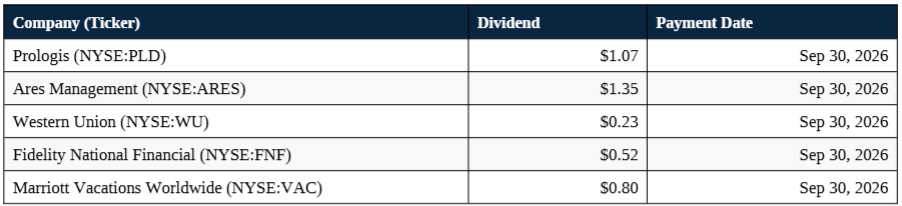
Top Ex-Dividend Companies for Wednesday, September 16:
Upcoming Earnings (Wednesday, Sept 16):

That's the wrap for today. The Federal Reserve's policy decision on Wednesday is the next major catalyst, with markets pricing in a high probability of a rate hike after a run of hot inflation data and surging Treasury yields.