When the Crowd Becomes the Analyst: Inside the Rise of Prediction Markets
A contract trading at sixty-seven cents means thousands of strangers just told you, with real money, what they think the odds actually are. That's the whole idea behind prediction markets, and in the eighteen months since the 2024 election, it's gone from a curiosity to a $30-billion-a-month industry. Here's how a decades-old academic experiment became one of the fastest-growing instruments in finance.

Key Highlights
- Event contracts are legally structured as swaps under the Commodity Exchange Act, deriving value from outcome probability rather than underlying asset prices.
- Unlike traditional derivatives, prediction markets price information directly, collapsing complex multi-leg hedging strategies into a single binary contract.
- The 2024 US presidential election generated more than $4.2 billion in combined trading volume on the election outcome and validated prediction markets as real-time information infrastructure.
- Kalshi's platform-wide trading volume ran roughly $20 billion to $30 billion in June 2026, depending on the estimate, though the surge was driven substantially by the concurrent 2026 FIFA World Cup rather than by political or economic event contracts alone.
- Regulatory clarity, distribution through major brokerage platforms, and institutional market-making have accelerated the industry's shift from niche to mainstream, though growth remains closely tied to marquee sporting and political events.
A New Instrument for an Old Problem
Prediction markets are having a moment. A contract is trading at sixty-seven cents: not for a share of a company, a barrel of oil, or an ounce of gold, but for a yes. Somewhere, thousands of strangers with money on the line have collectively priced the odds of a real-world event, an election result, a Federal Reserve decision, whether a flight gets cancelled, at sixty-seven percent. Nobody voted on that number. Nobody polled for it. The market simply arrived there, one trade at a time.
That is the entire mechanism, reduced to its simplest form. It sounds almost too plain to matter, and yet it describes one of the fastest-growing instruments in finance.
Financial markets have always aggregated information, whether anyone thinks of them that way or not. Equity prices reflect collective expectations about future earnings. Bond yields encode views on inflation and credit risk. Commodity futures let producers and consumers hedge against uncertainty they cannot otherwise control. Each instrument takes knowledge scattered across thousands of minds and compresses it into a single, publicly observable number.
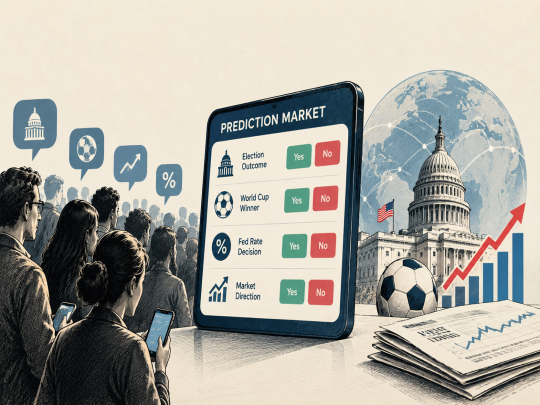
Prediction markets do the same thing, but they skip a step. Instead of buying shares in a company and implicitly betting on an election outcome, a trader on a prediction market buys a contract on the election outcome directly. There is no proxy asset standing in for the real question, just the question itself, priced continuously, dollar for dollar. The crowd, in effect, becomes the analyst.
The legal classification behind that simplicity matters for anyone approaching this space seriously. Event contracts are structured as swaps under the Commodity Exchange Act, placing them under the jurisdiction of the Commodity Futures Trading Commission rather than the Securities and Exchange Commission. Like other CFTC-regulated derivatives, they derive value from an underlying commodity, in this case the outcome of an event itself. Contracts typically carry a fixed payout, a defined expiry, and a binary resolution: it happened, or it didn't.
How Event Contracts Differ From What Investors Already Know
For investors familiar with equity options or futures, the comparison is worth making because it clarifies both the appeal and the limits of prediction markets.
A conventional equity option derives value from movements in an underlying asset price. Trading options requires fluency in strike prices, expiry mechanics, implied volatility, and the Greek sensitivities that connect contract price to changes in the underlying. The analytical infrastructure required to trade options profitably is substantial, and the instruments can be combined into complex multi-leg strategies to express nuanced directional views.
An event contract is structurally simpler in form but broader in subject matter. It has no underlying asset price to track, no delta to manage, no volatility surface to model. It is bounded between zero and one, and settlement is binary. The relevant question isn't what an asset will be worth, but whether a specified outcome will occur. That simplicity of form masks a real analytical challenge, though: the information edge in prediction markets often comes not from quantitative modeling but from domain knowledge, network access, and real-time information processing.
The more fundamental distinction is what the instrument prices. Traditional derivatives price risk on assets. Event contracts price information on outcomes. A fund manager building a portfolio of equities, bonds, and currency positions to express a view on a Federal Reserve rate decision is using asset prices as an indirect proxy for an information bet. Prediction markets eliminate the proxy. The position is taken directly on the outcome itself, with the market price continuously updated to reflect the collective information of all active participants.
This dynamic drew institutional interest well before prediction markets became publicly visible. Kalshi's founders, Tarek Mansour and Luana Lopes Lara, have described encountering the problem during internships at quantitative trading firms while at MIT: professional investors building elaborate multi-instrument positions not because they had specific views on the underlying assets, but because there was no direct market in which to express their actual thesis. Prediction markets resolve that inefficiency, at least in principle. What remained unresolved for decades wasn't the logic of the instrument but its legal footing.
Three Decades From the Classroom to Capital Markets
The intellectual foundation of prediction markets predates the platforms now attracting billion-dollar valuations. The Austrian economist Friedrich Hayek identified the central challenge as early as the 1940s: information relevant to economic decisions is scattered across millions of individuals, and no central authority can aggregate it efficiently. Markets, in his framework, were the mechanism by which dispersed knowledge was continuously converted into prices. By the 1980s, economists were exploring whether structured prediction markets could formalize that aggregation for specific future events.
The University of Iowa launched the Iowa Electronic Markets in 1988, the first serious modern prediction market, originally built as an academic research tool for forecasting US presidential elections. Subsequent studies found the platform frequently outperformed traditional opinion polling. The CFTC issued a no-action letter in 1992 permitting the market to operate as a not-for-profit research and education tool, and later approved HedgeStreet Inc. in 2004 as the first designated contract market authorized to list binary options. HedgeStreet was renamed the North American Derivatives Exchange, or Nadex, in 2009.
For roughly two decades after that, regulatory ambiguity kept the industry constrained. The Dodd-Frank Act of 2010 gave the CFTC authority to prohibit certain categories of event contracts deemed contrary to the public interest, a provision that became a recurring point of contention as the industry scaled. International platforms attempting to serve American users without regulatory authorization faced enforcement action. The commercial opportunity was visible; the legal path wasn't.
That changed in November 2020, when Kalshi received CFTC approval as a designated contract market, becoming the first regulated American exchange dedicated entirely to event contracts. It was a meaningful structural shift, but the platform remained a niche product used by a relatively small number of active traders in its first years. Volume was modest, institutional participation minimal. Then a single event catalyzed a transformation no regulatory ruling alone could have produced.
The 2024 Election as the Industry's Inflection Point
The US presidential and congressional elections of November 2024 weren't simply a large trading event for prediction markets. They became a proof-of-concept moment that changed how financial professionals, media organizations, and retail investors saw the asset class.
In the months before the vote, the CFTC moved to prohibit Kalshi from listing contracts on which party would control Congress, arguing the contracts constituted unlawful gaming. Kalshi challenged the determination in federal court, and in September 2024 the US District Court for the District of Columbia ruled in Kalshi's favor, finding the CFTC had exceeded its statutory authority. The CFTC initially appealed and won a temporary stay, but the contracts returned to the platform ahead of the election, and the agency later dropped its appeal entirely. In the week of the vote alone, Kalshi processed approximately $749 million in trading volume, more than the platform had handled across much of its prior operating history. Combined trading volume across Kalshi and Polymarket on the election outcome exceeded $4.2 billion. Polymarket, founded as a crypto-native decentralized exchange operating largely outside US regulatory jurisdiction at the time, contributed a significant share of that volume through its international platform, drawing a globally distributed participant base that Kalshi's regulated domestic structure couldn't yet reach.
The more consequential development wasn't the volume but the accuracy. While conventional polling stayed clustered within margins of error that offered little discriminating power, prediction market prices moved in real time as new information arrived, and in the final days moved ahead of the polling consensus toward the eventual result. Major media networks began incorporating prediction market probabilities into live coverage. Financial data providers folded event contract prices into their feeds alongside traditional economic indicators. The implicit validation from institutional media partners carried real reputational weight for an industry that had spent years arguing for mainstream credibility.
Industry participants often compare the moment to the arrival of the browser for the early internet: a technology that had existed in functional form for years suddenly finding its mass-market application. For prediction markets, the 2024 election played that role. Combined weekly trading volume across Kalshi and Polymarket rose from roughly $50 million before the election to more than $6 billion by early 2026, according to industry estimates based on Dune Analytics data, a more than hundredfold increase in about twenty-four months, before a further surge tied to the 2026 FIFA World Cup pushed volumes higher still.
The Wisdom of Crowds and Its Structural Limits
The 2024 election offered the clearest recent evidence for a case that predates the platforms themselves. The theoretical argument for prediction markets as information aggregators is well established in the academic literature. When participants put financial stakes behind their forecasts, they have stronger incentives to research, challenge their own priors, and update as new information arrives. The aggregate of individually imperfect but financially motivated forecasts can outperform expert consensus, particularly for well-defined binary outcomes with clear resolution criteria.
That case comes with qualifications institutional investors should hold alongside the growth narrative.
Liquidity is not uniform across contracts. Markets on major political events, widely followed financial indicators, or high-profile sporting events attract large numbers of participants and deep order books, producing price signals with genuine discriminating power. Markets on niche or obscure events may attract thin liquidity, where a small number of large trades can move prices substantially without reflecting genuine shifts in aggregate information. Price and probability aren't the same thing when liquidity can't support the equivalence.
Market manipulation and insider information remain structural vulnerabilities. Binary contracts on verifiable outcomes create direct financial incentives for participants with material non-public information. Regulators and platforms have already flagged concrete concerns here, including scrutiny of paid or incentivized trading activity designed to distort reported market odds. The surveillance infrastructure for managing these risks is developing, but it hasn't reached the maturity of established equity markets.
Finally, accuracy depends critically on the precision and completeness of contract rules. A contract that pays out based on an ambiguous outcome definition, or one where resolution is open to contestation, produces prices that reflect expected resolution behavior rather than genuine probability estimates. As the industry has expanded into sporting events, geopolitical developments, entertainment outcomes, and complex conditional scenarios, the contract-writing problem has become as consequential as the trading mechanics. Regulatory classification also remains contested. More than a dozen US states have brought legal action against Kalshi and other platforms over sports-related contracts, arguing they amount to unlicensed gambling rather than CFTC-regulated derivatives, a dispute still unresolved in the courts as of August 2026 and one some observers expect will eventually reach the Supreme Court.
Conclusion
Prediction markets are not a speculative novelty. They are a decades-old instrument class that has reached commercial scale through regulatory clarity, retail distribution infrastructure, and a single high-profile event that demonstrated their information value to a global audience. The core mechanic, converting collective probability assessments into tradeable prices, is analytically sound and grounded in a well-established body of economic theory.
What has changed is the scale of participation, the breadth of outcomes being priced, and the level of institutional attention now directed at the space. Kalshi's monthly trading volume, which estimates put somewhere between $20 billion and $30 billion for June 2026, and its pursuit of a $40 billion valuation, a round still in talks with backers including Sequoia Capital and Wellington Management as of mid-August 2026, up from the $22 billion valuation set at its May 2026 Series F, are less signs of speculative excess than reflections of how quickly a market can grow once its regulatory status is clarified and its distribution reaches mainstream brokerage platforms. It's also worth noting that a substantial share of that June volume figure was tied to concurrent World Cup betting activity rather than the political and economic contracts that are the primary focus of this analysis, a reminder of how closely current volume figures track individual calendar events.
Whether the industry's infrastructure, its contract-writing standards, its settlement processes, and its regulatory framework can keep pace with that growth is a separate and more complex question. That question, and the institutional capital increasingly being deployed to answer it, is what comes next.