The Wall Street Wrap: September 4, 2026
US stocks closed lower Friday as a blowout August jobs report revived Fed rate-hike bets, undoing Thursday's rally. Nvidia's growing equity-investment stake, Amgen's FTC antitrust overhang, and a strong week for chip and memory names rounded out a busy session ahead of next week's make-or-break CPI print.

Stocks slip as hot jobs report revives rate-hike bets ahead of the weekend
Welcome to Wall Street Wrap, your quick end-of-day rundown of what moved US markets today, plus what's shaping global sentiment overnight.
Markets Today
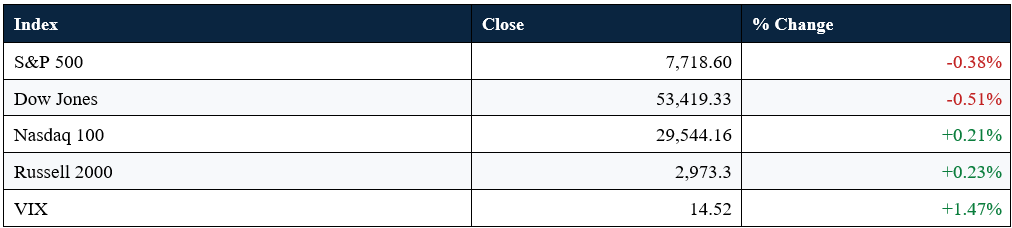
Wall Street pulled back on Friday after August's jobs report came in far hotter than expected, undoing much of Thursday's rate-cut optimism. The Dow led the decline, weighed down by steep drops in Apple (NASDAQ:AAPL) and Microsoft (NASDAQ:MSFT), while the Nasdaq 100 managed to eke out a small gain on strength in chip and memory names. Treasury yields ticked higher across the curve, and traders moved to price in meaningfully higher odds of a rate hike at this month's Fed meeting. For the week overall, the S&P 500 still finished modestly higher, though the Dow ended the week lower.
Close Levels
Analytical View
Today's move was almost a mirror image of Thursday's rally, and the cause was the same category of data: jobs, just this time pointing the opposite direction. Nonfarm payrolls grew by 162,000 in August, roughly triple the 53,000 economists had expected, with upward revisions to both June and July on top of that. The unemployment rate held steady at 4.1%, in line with forecasts. Coming just a day after Fed Governor Christopher Waller signaled openness to holding rates steady, the much-stronger-than-expected print flipped the market's rate-hike odds sharply higher, from roughly 49% to 58% by some measures, as traders concluded the labor market has little need for policy support right now.
The reaction underscores how sensitive this market has become to a single monthly data point. One portfolio manager described the report as a reminder that the payrolls number has turned highly volatile lately, and noted the debate now shifts squarely to next week's inflation data. With Fed Chair Kevin Warsh having already struck a hawkish tone at Jackson Hole, there appears to be a clear bias toward action if inflation doesn't show further improvement. Adding a political wrinkle, President Donald Trump praised the jobs number publicly while renewing pressure on the Fed to cut rates regardless, at one point threatening trade consequences for countries the US runs a deficit with if the central bank doesn't comply.
What could change the picture: Next week is a holiday-shortened one, with US markets closed Monday for Labor Day. The real test comes Thursday and Friday: August's Producer Price Index lands first, followed by the Consumer Price Index on September 11, which economists expect to show a 0.4% monthly rise (0.2% at the core). One strategist noted the Fed has spent months stressing its commitment to price stability, and that rhetoric will eventually need to be "backed by action" if inflation doesn't cool further, while another framed it more simply: the September 15-16 Fed decision "does kind of come down to one print." Fed funds futures were last pricing a 57% chance of a hike. Beyond the data, Oracle's Thursday earnings will offer a read on AI infrastructure spending, and the Treasury Department begins a larger buyback program for longer-dated debt next week, a move seen as an attempt to ease upward pressure on yields.
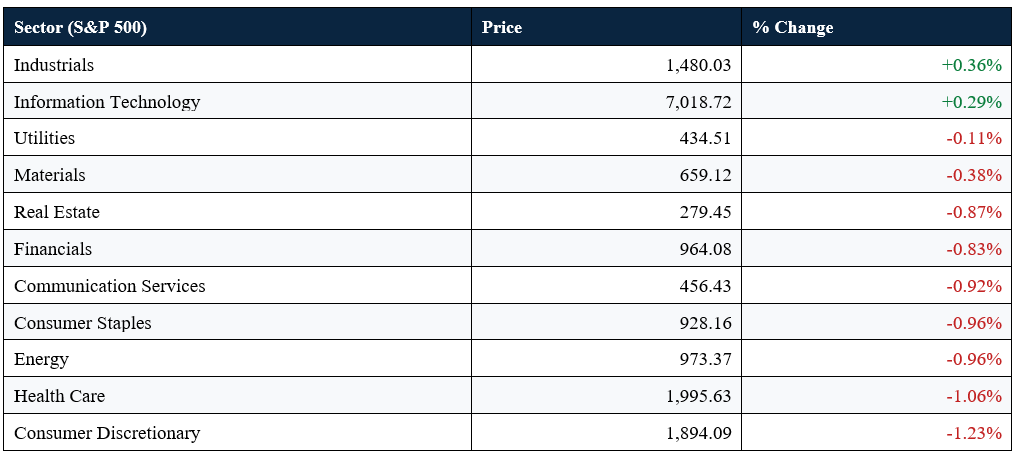
Sector Performance
Winners & Losers
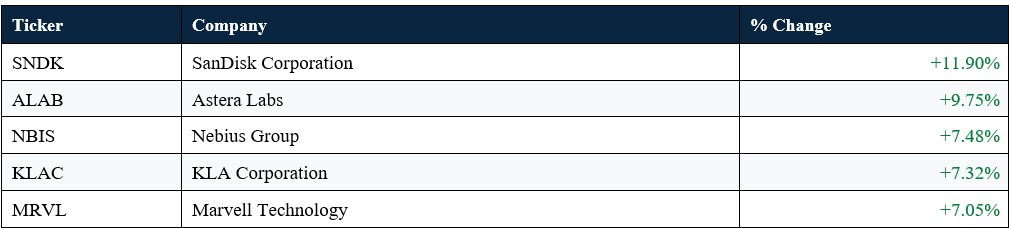
Top 5 Gainers (across S&P, Nasdaq, Dow)
Top 5 Decliners
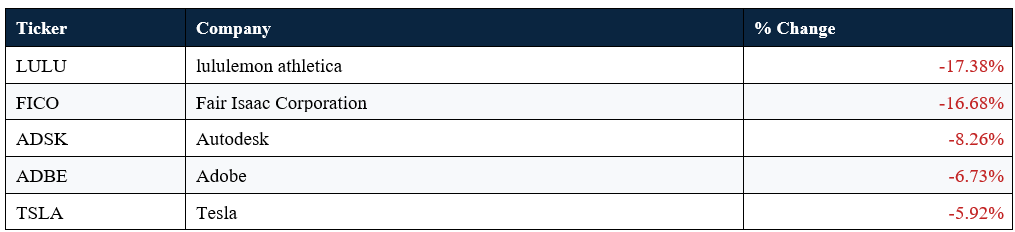
Note: Chip and memory names led today's gainers broadly, while yesterday's earnings casualties (Lululemon, Fair Isaac) continued to weigh, alongside a fresh drop in Tesla tied to its Cybercab launch.
After-Hours Movers
Gainers
- P (NYSE:P) (Everpure, formerly Pure Storage), +2.45% after hours: Shares extended a post-earnings rally that began after the company's August 26 beat, adjusted EPS of $0.70 versus $0.19 expected on 37.7% revenue growth, with sentiment further boosted by news the company will join the S&P 500 and recent heavy institutional buying, including a new stake from an activist-oriented fund.
- BE (NYSE:BE) (Bloom Energy), +6.22% after hours: S&P Dow Jones Indices confirmed Bloom Energy will join the S&P 500 later this month, capping a strong week driven by AI-related power demand and an expanded financing framework with Brookfield. The stock still faces valuation scrutiny and an ongoing securities class-action lawsuit tied to supply-chain disclosures.
- HUBS (NYSE:HUBS) (HubSpot), +3.88% after hours: Shares gained after hours on news of the company's promotion to the S&P MidCap 400.
Decliners
- IONS (NASDAQ:IONS) (Ionis Pharmaceuticals), -12.22% after hours: The FDA approved the company's Zanvastro as the first disease-modifying treatment for Alexander disease, but sentiment soured following a Phase 3 trial miss for a partnered cardiovascular drug candidate and the discontinuation of a Huntington's disease program, prompting a split among analysts on the stock's near-term direction.
- AMGN (NASDAQ:AMGN) (Amgen), -5.23% after hours: The Federal Trade Commission filed an amicus brief in an antitrust case alleging Amgen illegally acquired exclusive rights to patent applications shaped specifically to cover Enbrel, a biologic used to treat rheumatoid arthritis and other inflammatory conditions, in a way that extended the company's monopoly over the drug.
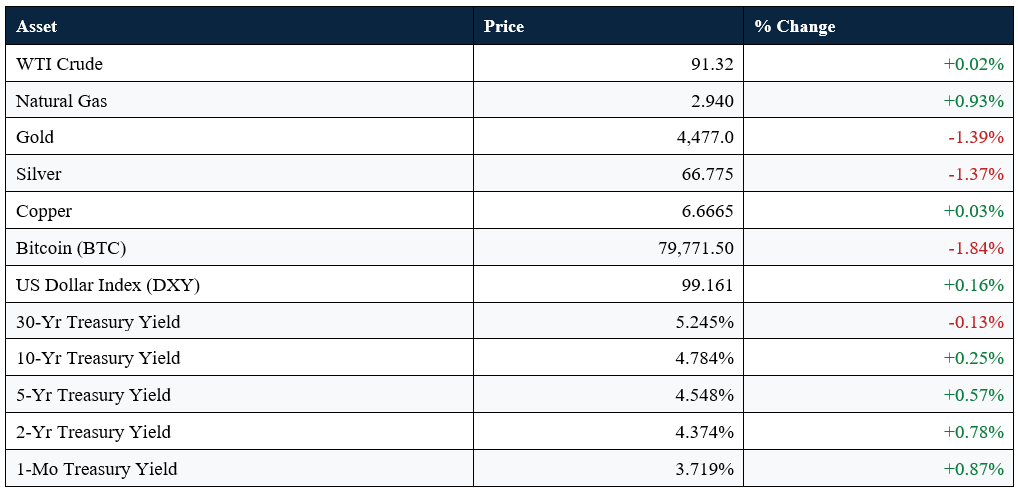
Commodities & Rates
Top Stories: US
- August jobs report reignites rate-hike debate. Nonfarm payrolls surged by 162,000 in August, nearly triple consensus estimates, with June and July both revised higher. The blowout print pushed the market-implied odds of a September rate hike up to 58% from about 49% a day earlier, as traders concluded the labor market has little need for policy support right now.
- Trump praises jobs number, renews pressure on the Fed to cut rates. President Trump celebrated the strong payrolls print publicly while simultaneously demanding the Fed cut rates anyway, going as far as to threaten trade restrictions against countries running a trade surplus with the US if the central bank doesn't comply, a stance directly at odds with a labor market that, on today's evidence, looks like it needs little help.
- Tesla (NASDAQ:TSLA) slides after Cybercab launch leaves analysts wanting more. Tesla shares fell more than 6% Friday, marking the stock's worst day since a 15% plunge on July 23, after the company's long-awaited Cybercab launch left several Wall Street analysts with more questions than answers. The decline erased the prior session's gains.
- Diesel prices hit a record as global refinery disruptions bite. The average price of diesel at US pumps climbed to $5.85 a gallon nationwide, up nearly 60% from $3.71 a year ago, as the wars in Ukraine and Iran continue to knock refining capacity offline and squeeze global supply. Prices are running even higher in California, at $7.70 a gallon, nearly $2 above the national average.
- Nvidia's (NASDAQ:NVDA) equity investment portfolio has grown more than tenfold in a year. Nvidia's stake in other tech companies is now valued at $99 billion, up from roughly $7 billion a year ago, as the chip giant leans on its cash pile to fund AI infrastructure and emerging cloud providers. Nvidia still trails Alphabet and Amazon, which each hold over $100 billion in equity investments, but the pace of dealmaking marks a significant shift in how the company deploys its capital.
Top Stories: Global
- European natural gas prices hover near a three-year high. Gas on the Dutch TTF, Europe's benchmark contract, closed above 73 euros (about $84.90) per megawatt-hour earlier this week, not far off the multi-year high touched in early 2023, before pulling back roughly 3% intraday to around 71.30 euros. Europe's gas storage sits only about two-thirds full, according to inventory tracking data. Energy prices on the continent, which spiked after Russia's 2022 invasion of Ukraine, have come under renewed pressure from the ongoing US-Iran conflict, a particular strain for the many European nations that rely heavily on imported energy.
- Trump envoys to visit Moscow and Kyiv this weekend. Ukrainian President Volodymyr Zelensky said that US envoys Steve Witkoff and Jared Kushner will travel to both Russia and Ukraine this weekend to discuss proposals aimed at ending the war, with Zelensky voicing hope the talks would be substantive. The diplomatic push came as a Russian drone strike hit the headquarters of Ukraine's domestic security service in Kyiv.
- Norway's sovereign wealth fund proposes cutting its US Treasury holdings. Norges Bank Investment Management, which oversees Norway's $2.3 trillion sovereign wealth fund, has recommended reducing the government bond share of its portfolio from 70% to 50%, a shift that would cut its Treasury allocation from 34.1% to 21.9%. The proposal comes as long-dated Treasury yields sit at decade highs, and one prominent economist said the move signals that traditional buyers of US government debt are becoming less reliable.
- World food prices hit highest level since late 2022. The UN's Food and Agriculture Organization said its price index averaged 133.3 points in August, the highest reading since November 2022, as extreme weather in Europe, a looming severe El Nino pattern, and war-related trade disruption near Ukraine and Iran squeezed supply expectations. Cereal and sugar prices led the increase, hitting three-year and one-year highs respectively.
Management & Fed Speak
Donald Trump, President of the United States, on interest rates and trade:
Trump said in the Oval Office that the US should be paying the lowest interest rate of any country in the world, arguing that each percentage point of interest costs the country roughly $650 billion. He said he would be willing to cut off trade with countries that run surpluses with the US if that's what it takes to force rates lower, citing Canada as an example and claiming ending trade there specifically would save $90 billion. The comments followed an earlier Truth Social post in which he tied the threat directly to Friday's strong jobs report, arguing a stronger US economy deserves a lower borrowing cost, not a higher one. Economists note that trade deficits are not inherently harmful, and that surplus countries often recycle their dollars back into US Treasurys.
Bill Pulte, Director, Federal Housing Finance Agency, on the major credit bureaus:
Pulte said the three major credit reporting agencies, Equifax, Experian, and TransUnion, have been "overcharging Americans for far too long" and that the practice "will end soon." He said regulators are seriously weighing a bi-merge approach along with other, stronger fixes, and warned that his agency will not allow these companies to keep taking advantage of American consumers.
Adam Aron, CEO, AMC Entertainment, on Robinhood's prediction-market operations:
Aron questioned how Robinhood, as a US company, can run a prediction-market operation out of Jersey, an offshore jurisdiction roughly 3,000 miles from the mainland, while marketing a product that resembles a security tied to AMC without complying with US securities law. He called the arrangement "shocking and shameful."
Corporate Actions & Earnings Calendar
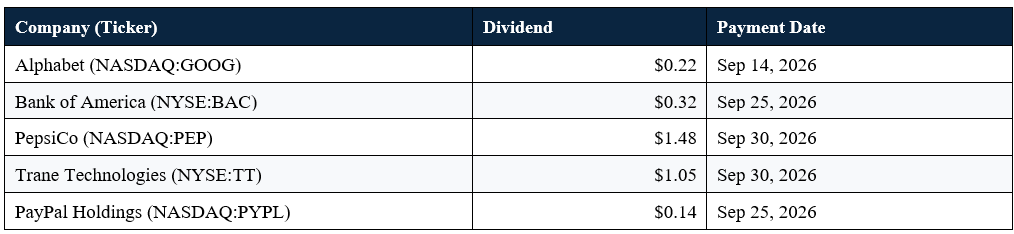
Top 5 Ex-Dividend Companies Today by Market Cap (Sept 4)
Upcoming Earnings (Tuesday, Sept 8)

Note: US markets are closed Monday, September 7 for Labor Day.
That's the wrap for the week. Markets are closed Monday for Labor Day, then it's straight into next week's CPI print, the real tiebreaker for whether the Fed hikes at its September 15-16 meeting.
.png)