Why Moderna (NASDAQ:MRNA) Stock Jumped 14% to a 52-Week High: Nasdaq-100 (NDX) Return and NIH Cancer Vaccine Push Explained
Index-fund buying and a national cancer vaccine plan landed on the same day, lifting a stock that has already run more than 600% this year

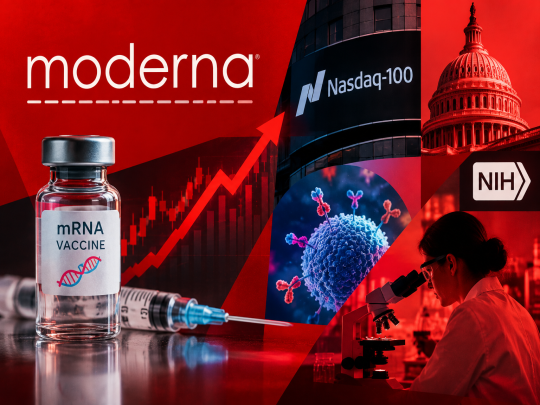
Moderna Inc. (NASDAQ:MRNA) shares closed up about 14.2% at $225.00 on Friday, October 9, 2026, from a prior close of $197, hitting a multi-year and 52-week high. The move answered the question that filled search bars all day: why is Moderna stock up today? Two very different catalysts arrived on the same morning, one mechanical and one fundamental, and together they turned an already hot stock into one of the market's most-watched movers.
Why Is Moderna Stock Up Today? Two Catalysts, One Big Move
Moderna rejoined the Nasdaq-100 Index (NDX) before the opening bell. Separately, a New York Times report described a planned national push on personalized cancer vaccines led by the National Institutes of Health (NIH). The first forced buying by index-tracking funds. The second reminded the market that Moderna sits near the center of the mRNA cancer vaccine race.
The rally built through the session. By late morning the shares were up about 5%, trading near $208, before accelerating into the close.
Catalyst One: Moderna's Nasdaq-100 (NDX) Re-Inclusion Explained
Nasdaq announced on October 1 that Moderna would replace Warner Bros. Discovery in the Nasdaq-100 Index (NDX), which tracks 100 of the largest non-financial companies listed on the exchange. Warner Bros. was leaving because of its merger with Paramount Skydance.
For Moderna, it is a homecoming. The company was dropped from the index in December 2024, when the post-pandemic collapse of its COVID-19 vaccine business pushed its market value below the cutoff. Its market capitalization stood at roughly $75 billion when the change was announced.
The reason index inclusion matters is simple. More than 200 investment products, with over $800 billion in assets, follow the Nasdaq-100 (NDX), including widely held exchange-traded funds such as the Invesco QQQ Trust (NASDAQ:QQQ). When a stock enters the index, those funds must buy it around the effective date, regardless of price. That creates mechanical, price-insensitive demand.
It does not, however, change Moderna's sales or its drug pipeline. The shares had already climbed ahead of the change, closing at $203.21 on October 6. The open question is how much support remains once the rebalancing is finished and attention returns to the science.
Catalyst Two: The NIH Cancer Vaccine Initiative
The second driver was a New York Times report by Gina Kolata on a proposed national effort to speed up cancer vaccines. The plan envisions a public-private partnership among the NIH, the Foundation for the NIH, academic researchers, drugmakers and biotech companies, advocacy groups, philanthropies and patients. It is modeled in part on the national push that produced COVID-19 vaccines.
A senior clinical officer at the Foundation for the NIH told the Times she expects the program to launch in December. The initial focus is on pancreatic, liver and colorectal cancers, along with certain pediatric tumors.
A quick explainer helps here. Preventive shots for COVID-19, measles and flu stop disease before it starts. Personalized cancer vaccines go after a cancer that already exists, and each one is tailored to a single patient's tumor. That is the territory Moderna has been working in with Merck (NYSE:MRK).
Investors treated Moderna as a prime beneficiary. The report places mRNA cancer vaccines at the center of a national research effort, and it noted that the technology had fallen out of favor with the current administration, which makes the shift notable.
The Foundation: Moderna's Personalized Cancer Vaccine With Merck
The real engine behind the 2026 rerating is clinical data. In August, Moderna and Merck reported that their Phase 3 INTerpath-001 trial of intismeran autogene (mRNA-4157), combined with Merck's Keytruda, met its primary goal in patients with resected, high-risk melanoma. The vaccine delayed recurrence, and it also met a key secondary endpoint, distant metastasis-free survival. It was the first positive late-stage readout for an mRNA tumor therapy.
The partners are also testing the approach in lung, kidney and bladder cancer. Full data are due at the European Society for Medical Oncology (ESMO) congress in Madrid on October 24, and that presentation is now the next major test.
The stock has gone from a 52-week low near $22 last November to $225, a gain of more than 600% this year.
How Other Vaccine and Biotech Stocks Reacted
The NIH news lifted several peers. In late-morning trading, BioNTech (NASDAQ:BNTX) was up about 3% near $94.50, Pfizer (NYSE:PFE) was up less than 1% near $28, and the iShares Biotechnology ETF (NASDAQ:IBB) was up about 2%. Novavax (NASDAQ:NVAX) and Merck (NYSE:MRK) also rose on the news.
Moderna outpaced all of them, which suggests the move was specific to the stock, with index buying amplifying the sector-wide optimism.
The Counterargument: Is Moderna Stock Overvalued After a 600% Run?
Not everyone is cheering. Citi analyst Geoff Meacham has pointed out that Moderna shares gained roughly 222% after the interim trial results, and he estimated that under Citi's assumptions, the company would need about $26 billion in annual cancer treatment sales to justify a price near $200. That is a very high bar for a product that has not yet been approved.
Several risks sit alongside that valuation concern:
- Index effect fades. Forced buying is temporary. Once funds finish rebalancing, the stock depends on fundamentals again.
- Data risk. The October 24 ESMO presentation could confirm the August results or raise new questions about durability or side effects. Stocks that rally into a data release can fall on it, even when the data are good.
- A plan is not a payout. The NIH initiative is still a proposal expected to launch in December. It does not guarantee funding, partnerships or revenue for any specific company.
- Commercial scale. Moderna is preparing for a potential launch and production scale-up of its cancer treatment, which carries execution risk.
What Should Investors Do With This News?
This is not investment advice, but a few practical steps can help anyone weighing a decision.
Separate the mechanical from the fundamental. Roughly part of Friday's jump came from funds that had to buy, not from investors who changed their view of the science. Index-driven moves can reverse quietly.
Avoid chasing a one-day spike. A 14% jump to a multi-year high means optimism is already in the price. Consider what has to go right from here, and whether $225 reflects it.
Check your existing exposure. Anyone who owns a Nasdaq-100 (NDX) fund such as QQQ now holds Moderna automatically. Look at how much of your portfolio sits in biotech or in a few fast-rising names.
Mark October 24 on the calendar. The ESMO data is a major event, and position size matters more than prediction. A holding small enough to survive a bad outcome is easier to manage.
Plan entries and exits before emotions take over. Decide in advance what price or news would change your view. Limit orders and staged purchases can reduce the risk of buying at a peak.
Watch the December NIH launch. Look for details on funding, participants and whether Moderna is named, since that will show how much of Friday's enthusiasm is justified.
Consider professional guidance. A licensed financial advisor can help match a volatile, high-momentum stock to your goals and risk tolerance.
The Bottom Line
Moderna's 14.2% surge to $225.00 was part technical and part fundamental. Nasdaq-100 (NDX) inclusion created guaranteed buyers, while the NIH cancer vaccine report strengthened the story that mRNA could play a central role in the next wave of cancer treatment. Beneath both sits real clinical progress from the Merck partnership.
But after a gain of more than 600% this year, the shares leave little room for disappointment. The next few weeks, especially the October 24 data in Madrid, will show whether Friday marked a durable breakout or a peak driven by index flows and headlines.
This article is for informational purposes only and is not investment advice. Prices and percentage moves are approximate and based on reported market data. Investing in individual stocks involves risk, including the loss of principal.
Related post