Wolfspeed (NYSE:WOLF) Stock Surges 25% After Hours on Department of War Loan Commitment
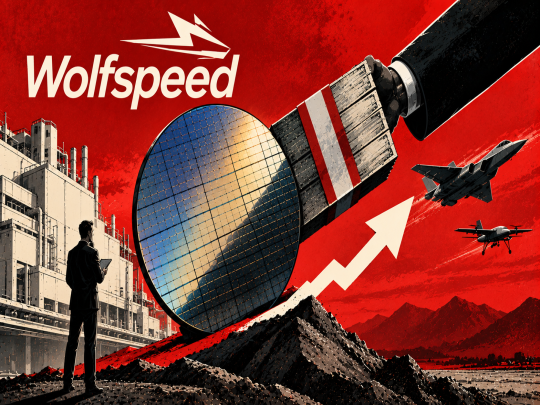
Wolfspeed shares jumped about 25% in after-hours trading on Wednesday after a conditional $1.5 billion, 30-year Department of War loan commitment, with warrants over up to 7.5% of equity attached.

Key Highlights
- Wolfspeed shares gained 25.06% after hours to $39.23, against a regular close of $31.37, down 1.45%.
- A conditional commitment of up to $1.5 billion would be a 30-year senior secured delayed-draw term loan.
- Warrants over up to 7.5% of fully diluted equity would be issued as each tranche is funded.
- The facility is close to the company's market value of about $1.63 billion at the close.
- Short interest near 50% of the free float and negative gross margins keep the risk profile wide.
The After-Hours Move
Wolfspeed (NYSE:WOLF) turned a quiet session into one of Wednesday's sharpest after-hours moves. The shares had closed down 1.45% at $31.37, within a day range of $30.46 to $32.30, then rose 25.06% to $39.23 in extended trading. The trigger was a conditional Department of War commitment for up to $1.5 billion of 30-year financing, a sum close to the company's entire market value.
Extended-hours trading is thin, so prices can swing widely on modest volume. Even after the jump, the shares sit at roughly half their 52-week high of $80.82.
What the Loan Would Fund
The commitment comes from the Department of War through its Office of Strategic Capital. Its stated aim is to anchor domestic production of silicon carbide materials and wide bandgap power devices, a goal that fits the administration's push for onshore chip manufacturing.
The planned uses are specific. Wolfspeed intends to upgrade gallium nitride epitaxy for communications infrastructure and electronic warfare, onshore low and high-voltage GaN power devices, advance GaN-on-SiC wafers for radio-frequency systems and build radiation-hardened versions of current and future chips. End uses cited include drones, radar, missile defence, high-performance engines and AI applications. Production would draw on sites in North Carolina, New York and Arkansas.
Why the Balance Sheet Drove the Reaction
Wolfspeed emerged from Chapter 11 in September 2025. Market data shows a trailing loss of about $10.69 per share, falling revenue and negative gross margins. Long-dated capital speaks to refinancing risk more directly than to profitability, which helps explain the size of the jump.
The scale matters too. A $1.5 billion facility is roughly the equity value the market assigned to the entire company at the close.
The Price of State Backing
The Department of War would receive VWAP-based warrants over up to 7.5% of fully diluted equity, issued pro rata as tranches are funded. Dilution would therefore scale with usage rather than arrive at once. The loan would also be senior and secured, ranking ahead of shareholders in any future restructuring. That lowers funding cost but raises the stakes if operations disappoint.
How Wolfspeed Compares with Peers
Silicon carbide competition is crowded. STMicroelectronics (NYSE:STM) and onsemi (NASDAQ:ON) both supply power devices, yet each runs a diversified business that can cushion weakness in any single end market. Wolfspeed is a focused pure play, which sharpens both upside and downside sensitivity.
Canadian companies sit upstream or alongside rather than head to head. 5N Plus (TSX:VNP), a Montreal producer of ultra-high-purity compounds including gallium and germanium, serves space solar power and other specialty semiconductor markets. Toronto-based POET Technologies (NASDAQ:POET) develops optical interposer chips for AI data centres. Neither competes with Wolfspeed directly, but both show the theme reaching beyond power devices.
Chinese silicon carbide suppliers add further pressure, which gives a domestic supply chain strategic as well as commercial value.
Why After-Hours Gains Can Fade
The commitment is conditional, not yet a loan. It depends on diligence, definitive agreements, governmental approvals, appropriations and third-party consents, and there is no assurance that financing will be provided. The after-hours price reflects expectations, not cash received.
Short interest near 50% of the free float can amplify moves in either direction. Markers to watch include the Form 8-K terms, the timing of definitive documents, the first tranche drawn and any improvement in gross margins. Outcomes could range from a stabilised balance sheet to a financing that is delayed or reshaped.