ASX Post-Market Wrap: 8 September 2026
Oil's surge past $95 a barrel drove Australian shares to a 20-day low, hitting rate-sensitive banks and property hardest as markets priced higher odds of an RBA hike. Inflation at 3.5% keeps pressure on policymakers, while HSBC's forecast of a 13% house-price fall added to the day's gloomy mood.

Welcome to ASX Post-Market Wrap, your quick end-of-session rundown of what moved the Australian market today, plus what's shaping global sentiment into tonight's Wall Street open.
Markets Today
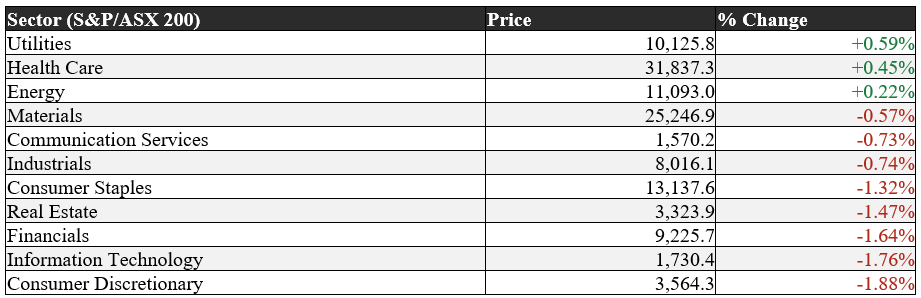
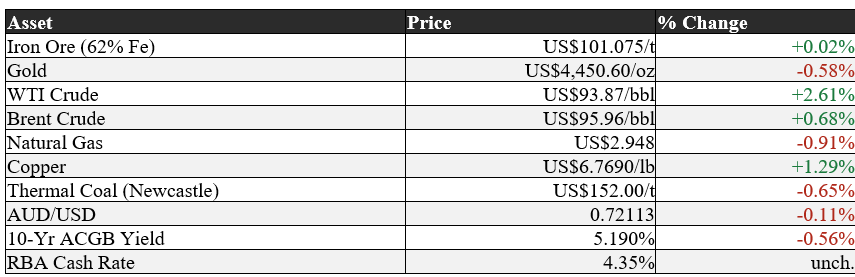
The ASX 200 had its worst session since early June, marking a new 20-day low, as rising oil prices and mounting fears of an RBA rate hike weighed on banks, real estate and retail stocks. The benchmark dropped 90.10 points, or 1.00%, to 8,920.80, and has now lost 1.61% over the past five sessions and sits 4.04% below its 52-week high. The All Ordinaries lost 86.3 points, or 0.94%, to 9,114.3. Eight of the eleven sectors finished in the red, with only energy, utilities and defensive health care stocks managing gains, and BlueScope Steel was the single worst-performing constituent in the index. Brent crude pushed above US$98 a barrel for the first time in seven weeks, and that same oil strength that lifted energy stocks also fed directly into the inflation and rate-hike fears that dragged everything else lower.

Analytical View
Today was more a banks story than a miners one. The ASX 200 Banks index dropped 1.76%, matching the broader Financials sector's 1.63% decline and helping drag the benchmark to its worst session since early June, while Materials held up comparatively better, down just 0.57% despite diesel price concerns and BHP and Rio Tinto both falling even as LME copper futures hit record highs on a tightening supply crunch. Rate-sensitive real estate and consumer discretionary stocks added to the pressure, with swaps now pricing a 68.8% probability the RBA raises its cash rate at this month's meeting, which would be its fourth hike this year. VanEck's head of investments and capital markets, Russel Chesler, said oil prices will remain higher for longer, and the market seemed to agree: banks and technology led the session's losses as investors priced in less room for the RBA to hold.
Overnight, Asian markets traded a mixed picture on soft cues out of Europe and a lack of direction from Wall Street, as traders stayed focused on the Middle East and the fresh spike in crude following reports of US and Iranian attacks on tankers in the Gulf. China's trade data beat expectations, with the surplus widening to US$119.09 billion on stronger exports, while UK retail sales growth undershot forecasts and Germany's trade balance came in well ahead of expectations. Fed funds futures are now pricing around a 60% chance of a 25 basis point US rate hike next week on the back of strong jobs data, with fresh US inflation figures due later this week to test that view. In Japan, second-quarter GDP was revised up to an annualised 1.4%, a third straight quarter of growth and further evidence the region's largest economy is holding up better than expected even as the oil-driven inflation story dominates sentiment elsewhere.
What could change the picture: US CPI data later this week, which will shape the Fed's rate call next week, and the RBA's own decision on 29 September.
Sector Performance
Winners & Losers
Top 5 Gainers:
Sunrise Energy Metals (SRL): +21.19% to $19.39
Amplitude Energy (AEL): +12.31% to $1.87
Fortifai (FTI): +9.33% to $0.82
Ainsworth Game Technology (AGI): +8.60% to $1.20
Arafura Rare Earths (ARU): +7.69% to $0.21
Top 5 Decliners:
Dateline Resources (DTR): -8.99% to $0.081
Vulcan Steel (VSL): -8.36% to $5.15
Peet Ltd (PPC): -7.10% to $1.635
Ai Private Opportunities Trust (AIX): -6.06% to $9.30
Bluescope Steel (BSL): -5.84% to $30.66
Commodities & Rates
Top Stories: Australia
Consumer confidence slumps on rate and fuel fears. Westpac-Melbourne Institute's consumer sentiment index fell 5.2% to 84.4 in September, reversing a 6% gain in August, as households worried about further interest rate rises and climbing fuel costs. The index is now down almost 12% on a year ago.
HSBC tips 13% national house price fall. HSBC is forecasting Australian house prices will drop 13% nationally by mid-2027, pointing to the government's property tax changes and higher interest rates as the key drags on buyer demand.
Balmain refuses to bankroll Bathla's administrators. Balmain chief executive Andrew Griffin said the private credit fund would not support the administrators of collapsed Sydney developer Bathla, arguing it doesn't need the failed company's resources and would rather protect its own secured position. He said doing otherwise would put his investors further away from safety.
Rio Tinto buys Queensland bauxite mine from Glencore. Rio Tinto has agreed to acquire the Aurukun bauxite mine in Cape York from Glencore and its Japanese joint venture partner Mitsubishi Development for an undisclosed price, expanding its existing bauxite footprint in the region. The deal still needs Queensland government and other regulatory approvals, and the project has a mineral development licence but no mining lease yet.
$3 billion pipeline to connect Beetaloo gas to the east coast. Queensland has fast-tracked assessment of APA Group's proposed North to East Australia pipeline, an 899-kilometre link that would carry Beetaloo Basin gas from the Northern Territory into the state's gas network. The project could support around 800 construction jobs, and Federal Resources Minister Madeleine King called first gas reaching Darwin an exciting moment for the Northern Territory and for Australia.
Business confidence stays weak, building approvals slide. NAB's business confidence index came in at -8 for August, a touch worse than July's -7 reading, while building approvals fell 3.6% in July, matching forecasts but a sharp reversal from the prior month's 7.2% gain.
Management & RBA Speak
Sarah Hunter, Assistant Governor (Economic), Reserve Bank of Australia, on inflation risk:
Speaking at the AFR's Property Summit, Hunter said the RBA remains focused on getting inflation back within its 2-3% target band after headline inflation ran at 3.5% for the year to July, hotter than economists expected. She flagged housing costs, food inflation and high oil prices tied to the Middle East conflict as the main drivers, and said “we are definitely concerned.” She added the board has little tolerance for inflation staying above target for an extended period, though she noted one month's data shouldn't be over-read given how volatile conditions remain.
Luci Ellis, Chief Economist, Westpac, on the timing of the next hike:
Ellis said the odds of another RBA hike have risen enough to make a November move Westpac's base case again, joining ANZ and CBA in that call, while NAB is still tipping September. She said “tactically, we believe RBA leadership would strongly favour a November hike over September,” noting the board has previously said it wouldn't overreact to a single noisy monthly print, though she didn't rule out a September move if internal members judged the situation urgent enough. Ellis doesn't expect real rate relief for households until August 2027, which she expects to be the first of three cuts.
Corporate Actions & Reporting Calendar
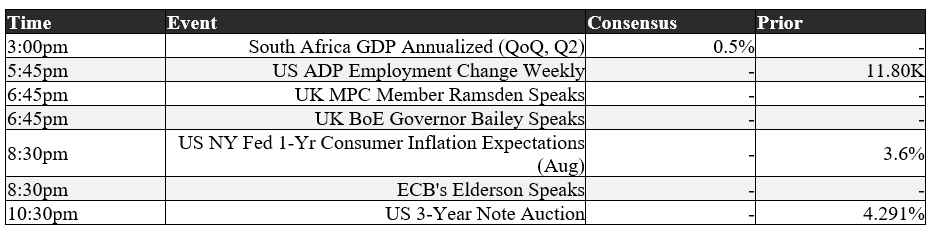
Economic Calendar (Upcoming, AEST):
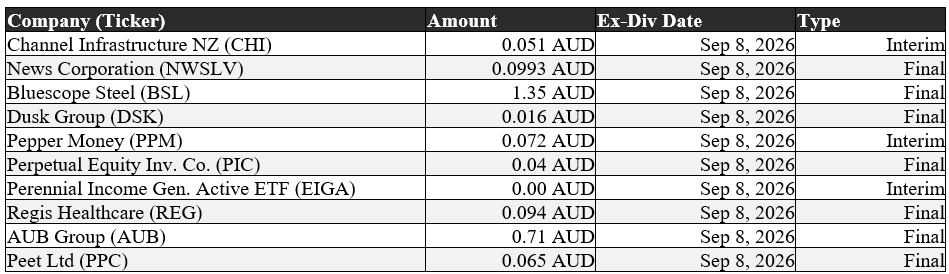
Ex-Dividend Today:
Closing Line
That's the wrap for today's session. With US inflation data due later this week and the Fed's rate call next Wednesday, plus the RBA's own decision now just three weeks away on September 29, rate expectations both sides of the Pacific are about to get a lot more concrete.
The Wall Street Wrap: September 8, 2026
Related post