How a chatbot rewired America's power grid — and turned dull utility stocks into an AI trade
Data-centre electricity demand barely moved for a decade — then ChatGPT launched, and the grid never looked the same. We trace the numbers behind the shift, and the utility stocks now riding America's biggest electricity re-rating in a generation.

The great re-acceleration
For most of the twenty-first century, the electricity business was where growth investors went to die. Regulated utilities offered a bond-like promise: mid-single-digit earnings growth, a fat dividend, and the tranquillity of a sector in which the most exciting event of the decade was a rate case. Demand for power in America, the world's largest economy, had been essentially flat since roughly 2007. Efficient light bulbs, efficient factories and a de-industrialising economy conspired to keep the grid's growth rate near zero. Even the rise of cloud computing and streaming video, which multiplied the number of processors running around the clock, barely moved the needle: hyperscale data-centre operators became so good at squeezing more computation from every watt that consumption crept up only gently.
Then, in November 2022, OpenAI released a chatbot.
ChatGPT's significance was not, in the end, mainly about chatbots. It was proof that large language models, trained on eye-watering quantities of computing power and then run billions of times a day for inference, were commercially viable at a scale nobody had budgeted for. The result has been the fastest reappraisal of electricity demand in a generation — and a data trail, drawn from the International Energy Agency (IEA), the Lawrence Berkeley National Laboratory (LBNL) and the Electric Power Research Institute (EPRI), that shows a strikingly clean break between the "before" and "after" of the generative-AI era.
Flat, then not flat
Start with the shape of the pre-ChatGPT world. Global data-centre electricity consumption grew at around 12% a year from roughly 2017, according to the IEA — respectable, but nothing extraordinary set against a base of only 200-300 TWh in the mid-to-late 2010s. In America, the picture was flatter still. LBNL's estimates put American data-centre consumption at just 58-76 TWh in the mid-2010s, or 1.5-1.9% of the national total, a share that barely moved for the better part of a decade. Efficiency gains — better cooling, higher utilisation, virtualisation — were running roughly in step with the growth in computing demand from cloud services and streaming. Total American electricity demand, unusually for a rich, growing economy, was close to flat.
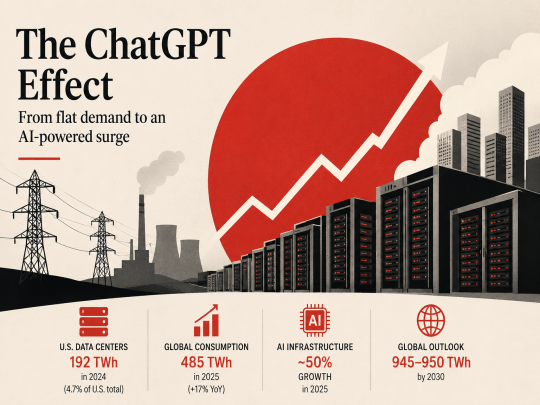
That equilibrium has since broken. IEA figures show global data-centre consumption reaching about 415 TWh in 2024 and 485 TWh in 2025 — a jump of 17% in a single year, with AI-focused facilities alone growing by roughly 50%. In America the LBNL puts 2024 consumption at 192 TWh, or 4.7% of the national total, roughly two-and-a-half times the share that prevailed for most of the 2010s. The IEA's base case has global consumption very nearly doubling again, to 945-950 TWh, by 2030; LBNL's reference case sees America alone reaching 649 TWh, or 11.8% of forecast national demand, with a plausible range stretching to 15.3%. Accelerated servers — the GPU and TPU clusters that do the heavy lifting for AI training and inference — are growing at roughly 30% a year in the IEA's base case, more than three times the rate of conventional servers.
The table below lays out the arithmetic of that break. What it shows, in essence, is a structural shift rather than a cyclical one: efficiency-constrained, low-single-digit growth beforehand, and compounding, double-digit growth afterward, concentrated overwhelmingly in the United States and China, which together are expected to account for roughly four-fifths of global growth to 2030.
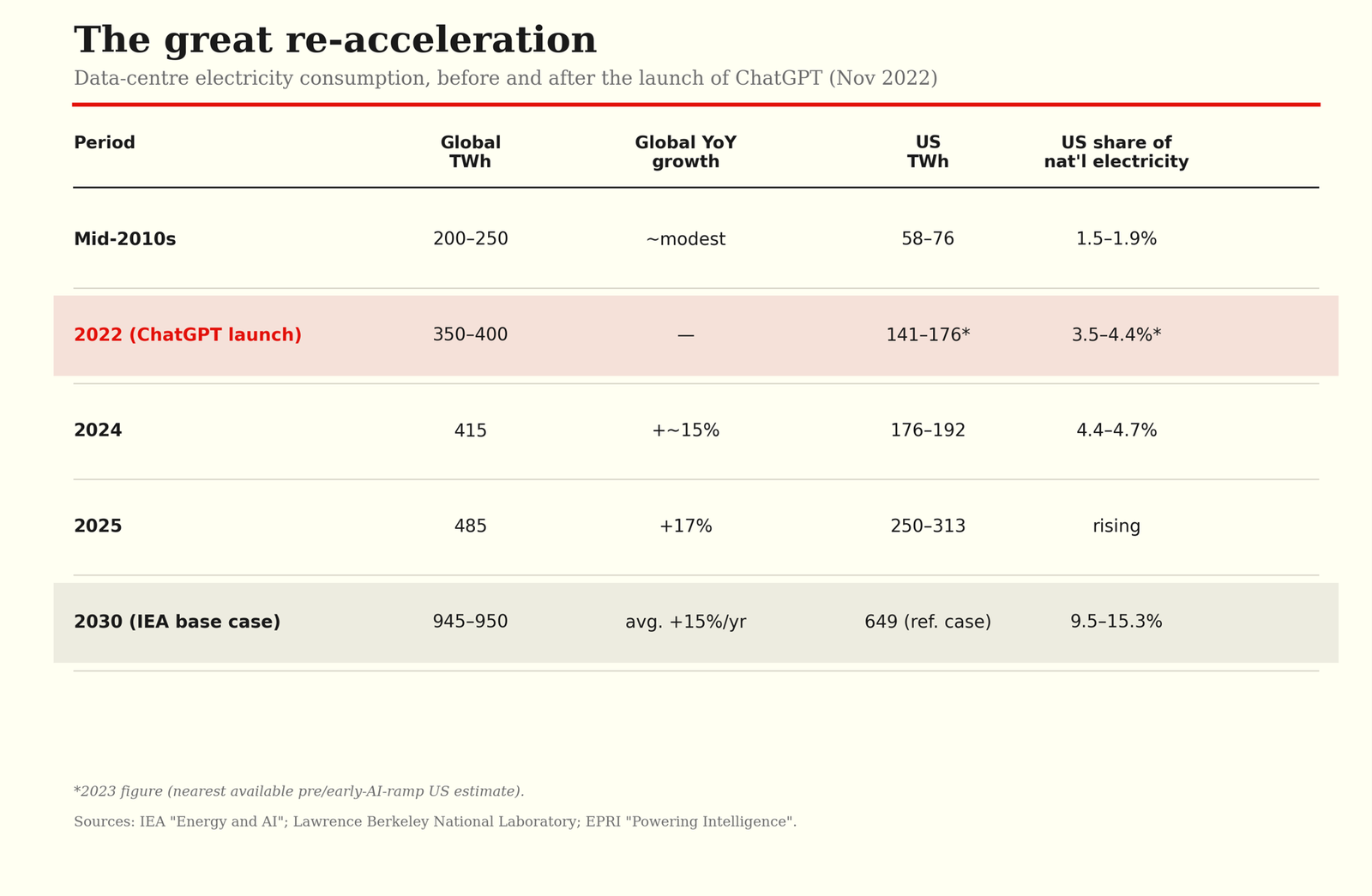 Data-centre electricity consumption, before and after ChatGPT. Sources: IEA; LBNL; EPRI.
Three forces sit behind the acceleration. The first is simple scale: hyperscale operators have committed hundreds of billions of dollars a year in capital expenditure to GPU clusters, and that capital is being deployed faster than efficiency gains can offset it. The second is power density. An AI-optimised server rack can draw as much electricity as several dozen households, a load that many older data centres were never engineered to carry, forcing new-build construction rather than retrofits. The third is geography: AI infrastructure clusters around cheap land, cheap power and fibre connectivity, which concentrates the strain on particular grids rather than spreading it evenly. Virginia's "Data Center Alley," which now accounts for more than a fifth of the state's electricity consumption, is the starkest example, but Oregon, Iowa and a widening list of other states are following the same trajectory.
From bond proxy to growth stock
The consequence for investors has been a genuine repositioning of an entire sector. Regulated utilities earn a return on their "rate base" — the capital they have invested in generation, transmission and distribution, as approved by state regulators. For most of the post-2007 period, flat demand meant a slowly growing rate base and, in turn, the low-single-digit earnings growth that made utilities a defensive, income-oriented holding rather than a growth one. Data-centre demand has changed that calculus directly: more load justifies more capital investment, which regulators can fold into rate base, which supports higher earnings. The Edison Electric Institute now projects roughly $1.4trn of sector-wide capital investment between 2026 and 2030, and a number of utilities have raised their long-term earnings-growth targets into the 6-9% range — genuinely high by the standards of a sector historically compared to a bond.
The clearest beneficiary is Dominion Energy (NYSE: D), whose Virginia service territory sits at the physical centre of America's data-centre build-out; the company has disclosed tens of gigawatts of contracted or pipeline demand and has expanded its capital plan accordingly. A tier of large regulated utilities with heavy data-centre exposure has followed a similar script: American Electric Power (NASDAQ: AEP), Alliant Energy (NASDAQ: LNT), DTE Energy (NYSE: DTE), Xcel Energy (NASDAQ: XEL), CenterPoint Energy (NYSE: CNP) and Southern Company (NYSE: SO) have all raised load forecasts and capital plans on the strength of multi-gigawatt commitments from hyperscale customers. Among independent power producers and generators with direct exposure to nuclear and gas-fired capacity, Vistra Corp (NYSE: VST) and Constellation Energy (NASDAQ: CEG) have benefited from long-term supply contracts with hyperscalers, including agreements tied to nuclear-plant restarts and life extensions. NextEra Energy (NYSE: NEE), meanwhile, has pursued growth through both its renewables platform and corporate consolidation, including a large proposed transaction involving Dominion.
The market noticed well before the earnings did. Utility stocks delivered some of their strongest multi-year returns in two decades as investors began pricing in the AI-driven demand story from late 2023, a striking result for a sector that had spent fifteen years being priced as a bond substitute. That re-rating has not been linear — valuations ran ahead of execution in places, and there have been pullbacks as investors interrogated the pace at which contracted demand actually converts into delivered, billable electricity. But the underlying thesis has held: utilities and power producers are increasingly discussed by investors as a "picks-and-shovels" play on AI infrastructure, in the same register as semiconductor-equipment makers or data-centre landlords, rather than as defensive income vehicles.
Reasons for caution
None of this is a one-way bet. Interconnection queues — the process by which new generation and large loads get approved to connect to the grid — remain long in most of the country, often running to several years. Equipment lead times, particularly for large power transformers and gas turbines, are extended well into the back half of the decade. Some announced data-centre projects will be delayed, scaled back or cancelled outright as hyperscalers recalibrate capital spending against the pace of AI revenue; not every gigawatt of "contracted" demand should be read as a gigawatt of delivered demand. And utilities face the unglamorous but politically potent problem of ratepayer allocation: regulators in several states are already working on mechanisms to ensure large new industrial loads, rather than residential customers, bear the cost of the infrastructure built to serve them, which is a sensible policy response but a real risk to the economics of any given project if it is implemented badly.
There is also a modelling uncertainty that cuts both ways. The IEA's own scenarios span a wide range depending on assumptions about chip efficiency, model architecture and the balance between training and inference workloads; a genuine breakthrough in AI efficiency — a smaller, cheaper model that matches today's frontier performance — could blunt the growth curve considerably. Conversely, if inference demand (the electricity cost of actually running AI models for hundreds of millions of users, as opposed to training them) continues to scale with adoption rather than plateauing, current base-case projections could prove conservative.
The bottom line
The data are nonetheless unambiguous about the shape of the last three years. A sector that spent the better part of two decades absorbing rising computational demand through efficiency gains alone has run out of room to do so. Global data-centre electricity consumption is on a trajectory to roughly double between 2025 and 2030; American consumption, which held near 2% of the national grid for most of the 2010s, is plausibly headed toward 10-15% by the end of this decade. That is not a rounding error in the energy system — it is one of the largest peacetime reallocations of electricity demand in American history, and it has been compressed into less than a decade.
For utilities and their investors, the result has been a rare thing: a genuinely new growth story arriving in a sector that had not had one in a generation. Whether that story is fully priced in, or still under-appreciated, is the question the market will spend the rest of this decade answering.
This article draws on data from the International Energy Agency, Lawrence Berkeley National Laboratory, the Electric Power Research Institute, and company disclosures. It is intended for informational purposes and does not constitute investment advice. No positions, long or short, are held in the securities discussed.
The Wall Street Wrap: September 3, 2026
Related post