Oil Beats Silicon: TSX Edges Higher as Nasdaq and S&P 500 Slide on AI Selloff, October 16, 2026
On Friday, October 16, 2026, the Nasdaq (^IXIC) fell 2.14% on fresh doubts about the AI buildout, while Toronto’s S&P/TSX Composite (^GSPTSE) edged up 0.11% on oil near $100. The two moves were one story: dearer energy means dearer money, and dearer money hurts tech.

On Friday afternoon, as traders in New York reached for their coats, two screens told contradictory stories. In the United States the Nasdaq Composite (^IXIC) had shed 2.14%, closing at 26,140.03, a fall of 572.99 points. The S&P 500 (^GSPC) dropped 1.09% to 7,659.44. Both recorded their worst week since June. A few hundred miles to the north, the S&P/TSX Composite Index (^GSPTSE) of the Toronto Stock Exchange had edged up 0.11% to 36,176.55, a gain of 39.45 points. Same continent, same Friday, nearly opposite verdicts.
The easy reading is that Canada was lucky. A better one is that the two moves are a single story, told from either end of a pipeline.
The anatomy of a wobble
Begin in America, where technology and communication services did the damage. Chipmakers and companies tied to artificial intelligence suffered most, as investors aired a doubt that has hovered over the sector for months: whether the vast sums being poured into data centres will earn returns large enough to justify them. The Russell 2000 (^RUT) of smaller companies fell about 1.7% to 2,721.37, which suggests the unease was not confined to the giants. The Dow Jones Industrial Average (^DJI), stocked with banks, industrials and other unfashionable firms, slipped just 0.34% to 52,002.41 and still finished the week higher. Index composition is destiny. The Dow’s indifference to silicon spared it.
Worry about the AI buildout is old news. What gave Friday its edge was a second ingredient, higher borrowing costs. Technology shares are long-duration assets, their worth resting on profits expected years from now. The higher the rate at which those profits are discounted, the less they are worth today. A sceptic of the boom needs no fresh evidence about demand for chips. A dearer cost of money will do the work for him.
Why Toronto smiled
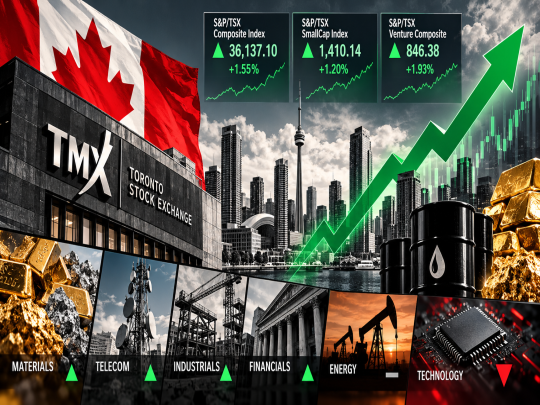
The S&P/TSX Composite, the benchmark of the Toronto Stock Exchange (TSX), is built differently. Energy, materials and banks weigh far more in it than software does, and Friday’s session showed the difference. By late morning the index had climbed more than 100 points on the back of oil and base metals, touching an intraday high near 36,462. It then surrendered most of the gain, hovered around the previous close of 36,137.10 for much of the afternoon and managed a slight uptick at the bell.
The support came from crude. December futures rose by about $2.52 to roughly $99 a barrel in one report, and producers and pipeline firms cheered. Ovintiv (TSX: OVV) gained about 4.4%, Vermilion Energy (TSX: VET) 4.13%, Pembina Pipeline (TSX: PPL) 3.52%, Keyera (TSX: KEY) 3.30%, Canadian Natural Resources (TSX: CNQ) 3.19% and TC Energy (TSX: TRP) about 3%. Producers and midstream firms rose together, as they do when the price is the story rather than any one company.
The losers were the mirror image. Shopify (TSX: SHOP) fell 5.1% to about C$239.70 and Celestica (TSX: CLS), which builds hardware for the AI industry, lost 3.9% to about C$429. Kinaxis (TSX: KXS) shed four to five percent. BlackBerry (TSX: BB) dropped 7.7% to about C$11.41, a sour footnote for a firm that once stood for Canadian technological ambition. There was little company news behind any of this. They fell because the Nasdaq fell.
The hidden link
The tidy split of tech down and energy up hides the interesting part: the two moves are not independent. Oil near $100 is a tax on every consumer and a cost for almost every business. It feeds inflation, and inflation keeps central bankers cautious. Tiff Macklem, governor of the Bank of Canada, spoke on Friday about persistent energy-price pressures and what they imply for interest rates. Whatever he meant in detail, traders heard what they expected to hear: money will stay dear for longer. That is precisely what stretched technology valuations dislike.
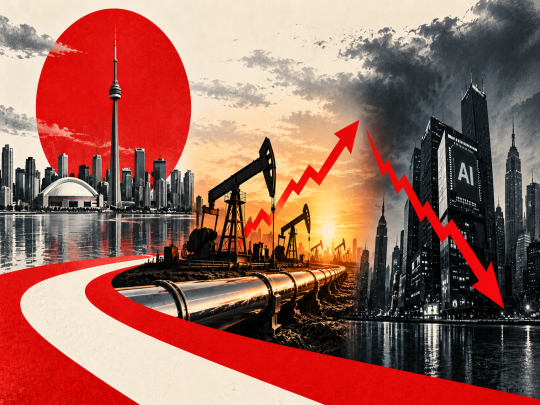
So the same barrel that lifted Pembina helped sink Shopify, by way of the bond market. Canada’s index did not escape the AI wobble because it was immune to it. It escaped because its largest sectors sit, in effect, on the other side of the trade. To own Canadian energy is to hold insurance against the very conditions that hurt American tech, an insurance that pays out when the oil price rises.
The currency said as much. The Canadian dollar firmed slightly to about 70.65 US cents, the customary sign of a country enjoying dearer commodities.
Three cautions
First, one session proves little. Daily moves of one or two percent are unremarkable in markets of this size, and a gain of 0.11% in Toronto lies well within the noise. Second, a bad week is not a bear market. The Nasdaq and the S&P 500 have had their worst seven days since June, which is unpleasant but a long way from a rout, and the Dow’s finish above its starting line is a reminder that damage was concentrated rather than general. Third, explanations for a day’s trading are assembled after the fact. Markets rarely announce their motives, and the story above is the likeliest account, not a proven one.
What to watch
The question for the coming weeks is whether the doubt about AI and the price of oil stay linked. If crude holds near $100, rates are likely to stay high, and the discount applied to technology profits will stay heavy. If oil retreats, Toronto’s hedge unwinds and its lead with it. Investors who enjoyed both ends of Friday’s seesaw should note that the two cannot easily be won together for long.
In markets, as in plumbing, what goes into a pipeline tends to come out somewhere else. On Friday the Nasdaq paid for the barrel that Toronto sold.
Tickers mentioned
|
Name |
Market |
Ticker |
Friday move |
|
S&P/TSX Composite Index |
Toronto Stock Exchange |
^GSPTSE |
+0.11% |
|
Nasdaq Composite |
US |
^IXIC |
-2.14% |
|
S&P 500 |
US |
^GSPC |
-1.09% |
|
Dow Jones Industrial Average |
US |
^DJI |
-0.34% |
|
Russell 2000 |
US |
^RUT |
about -1.7% |
|
Ovintiv |
TSX |
OVV |
about +4.4% |
|
Vermilion Energy |
TSX |
VET |
+4.13% |
|
Pembina Pipeline |
TSX |
PPL |
+3.52% |
|
Keyera |
TSX |
KEY |
+3.30% |
|
Canadian Natural Resources |
TSX |
CNQ |
+3.19% |
|
TC Energy |
TSX |
TRP |
about +3% |
|
Shopify |
TSX |
SHOP |
-5.1% |
|
Celestica |
TSX |
CLS |
-3.9% |
|
Kinaxis |
TSX |
KXS |
about -4% to -5% |
|
BlackBerry |
TSX |
BB |
-7.7% |