The Wall Street Wrap: October 16, 2026
US stocks fell on Friday as AI-financing fears hit chipmakers and CoreWeave, leaving the Nasdaq with its worst week since June, while oil settled above $100. The Dow still gained for a second week, the Treasury reported a $1.99 trillion deficit, and Apple's iPhone Duo drew heavy preorders.

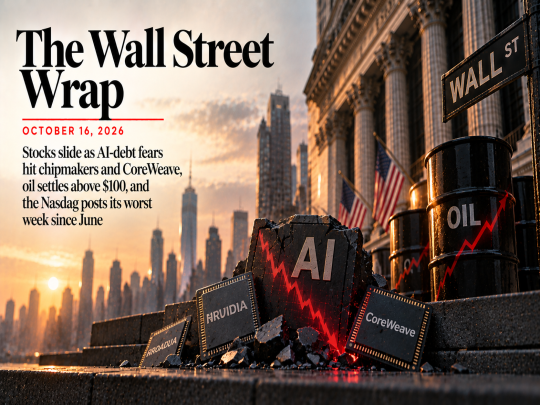
Stocks slide as AI-debt fears hit chipmakers and CoreWeave, oil settles above $100, and the Nasdaq posts its worst week since June.
Welcome to Wall Street Wrap, your quick end-of-day rundown of what moved US markets today, plus what's shaping global sentiment overnight.
MARKETS TODAY
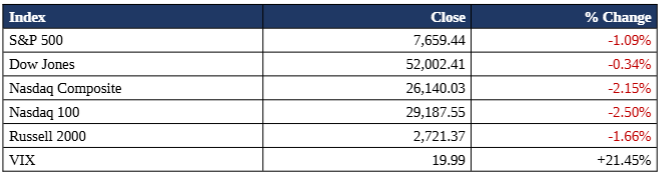
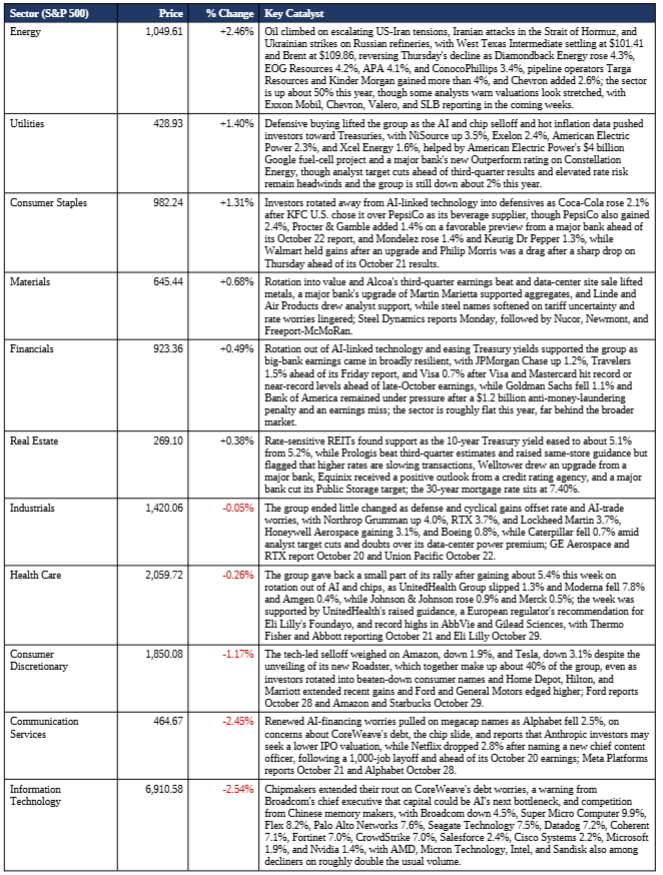
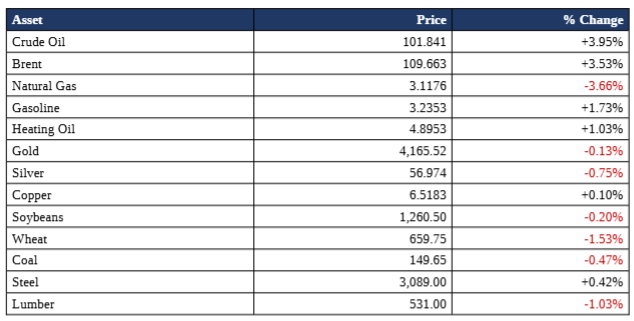
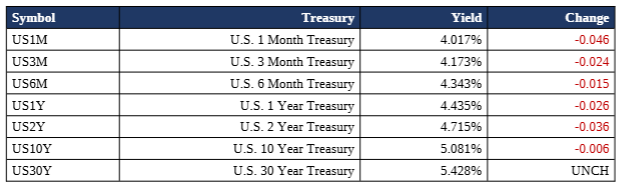
US stocks fell on Friday as the selloff in AI-linked shares deepened and oil climbed above $100, with the S&P 500 losing 1.09% to 7,659.44 and the Nasdaq Composite shedding 2.15% to 26,140.03, both closing below their 50-day moving averages. The Dow Jones Industrial Average lost 0.34% to 52,002.41 as Chevron (NYSE:CVX) and JPMorgan Chase (NYSE:JPM) limited its decline, the Nasdaq 100 fell 2.50% to 29,187.55, the Russell 2000 dropped 1.66% to 2,721.37, and the VIX jumped 21.45% to 19.99. For the week, the S&P 500 fell about 1.95% and the Nasdaq 4.48%, their deepest weekly declines since June, while the Dow gained 0.67%. CoreWeave (NASDAQ:CRWV) sank nearly 12% and Broadcom (NASDAQ:AVGO) fell 4.5%, and the PHLX chip index declined for an eighth straight day, its longest losing streak since 2008. The 10-year Treasury yield eased to 5.081%, West Texas Intermediate settled up 3.5% at $101.41, and Brent closed up 3.7% at $109.86. Energy, utilities, and consumer staples led the sectors, while information technology and communication services fell the most.
ANALYTICAL VIEW
The selloff was about financing, not earnings. Information technology fell 2.54% and communication services 2.45%, while energy rose 2.46%, utilities 1.40%, and consumer staples 1.31%, a rotation that kept the Dow close to flat while the Nasdaq 100 lost 2.5%. The damage clustered where borrowed money meets AI spending: CoreWeave, whose total debt has climbed above $51 billion, lost about a quarter of its value in five sessions, its bonds yield more than 15%, and chip stocks have now fallen eight sessions in a row. A report that some Anthropic investors are weighing a lower valuation for its coming listing added to the unease, and the Nasdaq recorded 353 new lows against 51 new highs.
Oil supplied the second blow. West Texas Intermediate settled above $100 for the first time since September just as a week of hot consumer and producer price readings had shown inflation spreading beyond energy, and one wealth-management strategist said high oil tends to weigh on stock multiples. The 10-year Treasury yield eased to 5.081% after Fed Chair Kevin Warsh declined to signal his next move, and futures put the chance of an unchanged rate at the October 27 to 28 meeting near 82%, though one major bank now expects 25 basis point hikes in December and January. The S&P 500 is still up about 12% this year, but the median stock has gained only about 6% and roughly 185 members have lost ground.
What could change the picture: Whether earnings from Tesla (NASDAQ:TSLA), Meta Platforms (NASDAQ:META), and Procter & Gamble (NYSE:PG) next week ease worries over AI financing, and whether oil above $100 pushes the Fed toward a hike at its October meeting.
SECTOR PERFORMANCE
WINNERS & LOSERS
Top 5 Gainers (across S&P, Nasdaq, Dow):
- Targa Resources Corp. (NYSE:TRGP): +4.371%
- Diamondback Energy, Inc. (NASDAQ:FANG): +4.269%
- EOG Resources, Inc. (NYSE:EOG): +4.228%
- Kinder Morgan, Inc. (NYSE:KMI): +4.205%
- APA Corporation (NASDAQ:APA): +4.065%
Top 5 Decliners:
- Nebius Group N.V. (NASDAQ:NBIS): -12.176%
- CoreWeave, Inc. (NASDAQ:CRWV): -11.91%
- Twilio Inc. (NYSE:TWLO): -10.618%
- Super Micro Computer, Inc. (NASDAQ:SMCI): -9.86%
- Strategy Inc. (NASDAQ:MSTR): -9.558%
Note: The five gainers are all energy producers or pipeline operators and rose as oil climbed, and Nebius and CoreWeave fell with other AI cloud names on worries about debt and borrowing costs; no specific cause was provided for the moves in Twilio, Super Micro Computer, or Strategy.
COMMODITIES & RATES
US TREASURY YIELDS
TOP STORIES: US
CoreWeave sinks nearly 12% as AI financing fears push chipmakers to their longest losing streak since 2008. The data-center operator, whose total debt has risen above $51 billion, lost about 25% over five sessions, and its bonds sold off sharply, pushing yields above 15%. Broadcom fell 4.5% and the PHLX chip index 3.8%, its eighth straight decline, while a semiconductor fund slid about 10% on the week for its biggest weekly drop since April 2025, led lower by Micron Technology, Advanced Micro Devices, and Sandisk. Chip stocks have also been rattled by jitters over Chinese competition and, according to people familiar with the matter, some current and prospective Anthropic investors are weighing a lower valuation for its coming listing. One investment chief asked whether the debt issue is systemic and said the sector is "not remotely close" to excessive levels, though it bears watching.
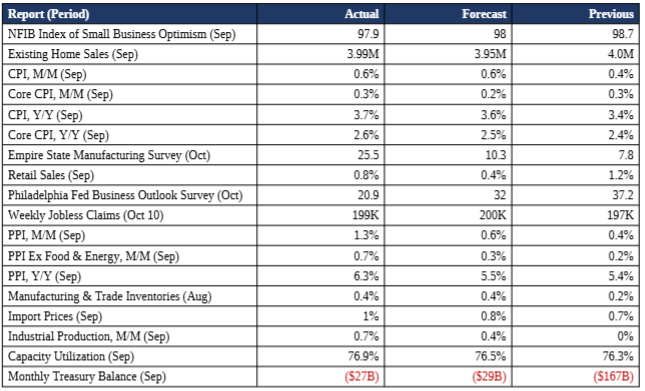
The US budget deficit swells to nearly $2 trillion in fiscal 2026, the third largest on record. The shortfall reached $1.99 trillion for the year ended September 30, up from $1.78 trillion in fiscal 2025 and the biggest since 2021, with receipts at a record $5.40 trillion and outlays at a record $7.40 trillion. Debt-service outlays rose 12% to a record $1.36 trillion, now exceeded only by Social Security and the combined cost of Medicare and Medicaid, while net tariff receipts fell $22 billion to about $173 billion after $145 billion of refunds following a Supreme Court ruling against many of the tariffs. Defense spending rose 6% to $917 billion, and the Treasury estimates the deficit at 6.2% of GDP against 5.8% a year earlier. September alone produced a $27 billion deficit, against a $198 billion surplus a year earlier, and it is the 25th straight fiscal year in the red.
Fed rate-hike bets fade after Warsh stays noncommittal, though a hot inflation week leaves the path uncertain. Futures put the chance that the Fed holds rates at its October 27 to 28 meeting near 82%, with the odds of an October hike having fallen to the low teens from 28% earlier in the week, and the 10-year Treasury yield eased to about 5.1% from above 5.3% recently. September consumer prices rose 0.6% on the month and 3.7% from a year earlier, against forecasts of 0.6% and 3.6%, and producer prices jumped 6.3% from a year earlier, the biggest gain since 2022 against a forecast of 5.5%, driven largely by energy costs during the US-Iran war. One major bank now expects 25 basis point hikes in both December and January, and the Fed chair said he was surprised by how well global economies have held up.
Apple's iPhone Duo draws heavy preorders as launch-day pickup inventory sells out. Apple's first foldable phone, which starts at $1,999 and passes $3,000 at the 2TB tier, went up for preorder with some delivery estimates already slipping into late January, and the company called demand "nothing short of extraordinary." A research firm expects foldables to make up just over 2% of smartphone units but nearly 7% of industry revenue this year, and a second firm expects initial demand to exceed the roughly 6 million or fewer units available near term. Analysts see the bet as one on value rather than volume, with the phone aimed at existing iPhone owners who might otherwise have bought a Pro Max, and one analyst firm said Apple needs the Duo to lift revenue against tough comparisons in its strongest upgrade cycle in years.
Tesla shows its long-delayed Roadster, but the shares fall 3.1%. Tesla unveiled the next-generation sports car on Thursday evening at a SpaceX test site in Texas, where a prototype raced up a curved ramp, flipped in mid-air, and hovered before landing on rocket thrusters, with Tesla's timer showing zero to 60 miles per hour in under a second. Elon Musk said production would begin in 2028, no price was announced, and the car omits the company's automated driving system, with Musk calling it the last Tesla intended to be controlled by a human driver. Tesla has taken $50,000 deposits since 2017 and missed every delivery target, and the event added to speculation of a Tesla-SpaceX merger that an analyst at a major bank said could come before the end of 2026. Tesla reports third-quarter results after the close on Wednesday.
Also today: Katie Zacharia is leaving her post as White House press secretary after five days, after a shaky first briefing and scrutiny of her legal background, with President Donald Trump saying he suggested she reconsider and would let her decide; Union Pacific said Chief Financial Officer Jennifer Hamann will retire in early 2027 after 35 years, with succession plans to follow as its $85 billion deal for Norfolk Southern remains under regulatory review; SoftBank is considering buying security services provider Allied Universal in a deal that could value it at about $18 billion, according to a person familiar with the matter, though deliberations are preliminary; Air Canada and United Airlines will launch new transborder routes for summer 2027, including Toronto to Louisville, Montreal to Indianapolis, and Edmonton to Newark, and agreed to renew and expand their joint business agreement subject to regulatory approval; and City Therapeutics, an early-stage developer of RNAi-based drugs, raised $200 million in a US initial public offering priced at the midpoint of its marketed range.
TOP STORIES: GLOBAL
Oil tops $100 in New York as Iran escalates attacks near Hormuz and Houthi missiles target Saudi Arabia. West Texas Intermediate rose 3.5% to settle at $101.41, its first settle above $100 since September, and Brent touched $110 for the first time since May before closing up 3.7% at $109.86, with WTI up more than 10% on the week and Brent nearly 5%. Saudi Arabia intercepted several missiles fired over the Red Sea, including one heading for the Yanbu export terminal, after the Iran-allied Houthis hit an Aramco administrative building in Dhahran on Tuesday and attacked Riyadh's international airport on October 10, killing 12. At least nine tankers and cargo ships have been attacked near the Strait of Hormuz since Sunday, Iran sank the container ship GFS Pride on Wednesday, and crude shipments through the strait fell to 9.4 million barrels a day, about 70% of the prewar average. Ukraine said it would resume strikes on Russian refineries after an energy ceasefire quickly unraveled, US diesel averaged $6.33 a gallon, more than 70% above a year ago, and commercial crude inventories fell by more than 8 million barrels in the week ended October 9 as Hurricane Isaias shut in Gulf Coast production.
US officials press Beijing on market access for Mastercard, Visa, and Citigroup. A US Treasury official said a delegation led by Deputy Secretary Francis Brooke raised the issue in at least two meetings with the People's Bank of China and the finance ministry on the sidelines of the G20 and IMF-World Bank gatherings in Bangkok, following China's October 13 approval for Visa to start preparing a wholly owned domestic card-clearing business, with up to a year before it applies for an operating license. Mastercard now operates yuan card payments through a local joint venture, while Citigroup, which applied in late 2021, is seeking a wholly owned onshore securities license and plans to lift its China securities staff to about 100, according to two people familiar with the matter. One China analyst called licensing US financial firms a "limited concession" that should marginally bolster confidence in Chinese assets, and Trump and Xi Jinping are expected to meet in Shenzhen for the Asia-Pacific Economic Cooperation summit in November.
Trump denies ordering Starlink limits on Ukraine's military as Musk points to Washington. Ukrainian officials said SpaceX restricted Starshield, the military-grade version of Starlink, without warning on Tuesday and Wednesday, cutting connectivity for drones and vehicles moving faster than 160 kilometers per hour, and an adviser to President Volodymyr Zelenskyy said the lack of warning "led to the failure of a number of missions." Musk wrote that "Starshield systems are owned and controlled by the US government," while Trump told reporters "it wasn't me, and I don't think it was Elon." Poland's deputy prime minister criticized Musk over the restrictions, and SpaceX shares are down about 11% this week ahead of results on Tuesday.
MANAGEMENT & FED SPEAK
Kevin Warsh, Chair, Federal Reserve, on the global economy and AI:
Warsh voiced optimism about US economic strength and surprise at how well global economies have been "hanging in there" through an energy shock and tighter monetary policy, without signalling the Fed's next move. On a panel with the IMF chief, he joked about Washington's push to rebrand the technology as "super intelligence," telling her "In the US we now pronounce it SI."
Kristalina Georgieva, Managing Director, International Monetary Fund, on AI safeguards:
Georgieva said "If there are no safeguards, then the risks may exceed the opportunities," backing a blend of industry self-regulation and input from the governments of the biggest AI economies. She likened AI's rapid development to Formula One cars racing with no barriers to protect the audience and listed access to electricity and digital infrastructure as preconditions for broad benefits.
Jack Clark, Co-Founder, Anthropic, on AI standards:
Clark picked up Georgieva's analogy, calling it "Formula One at night, without maybe brakes in the cars," and said setting standards is possible and already starting through early European Union frameworks and voluntary US commitments. He said he does not believe testing and disclosure should be entirely voluntary and called for "common sense standards" as the way to build confidence in the technology.
Joachim Nagel, President, Bundesbank, on AI and global imbalances:
Nagel said AI has the potential to increase global imbalances, pointing to the large investments in hardware and software the technology requires.
CORPORATE ACTIONS & EARNINGS CALENDAR
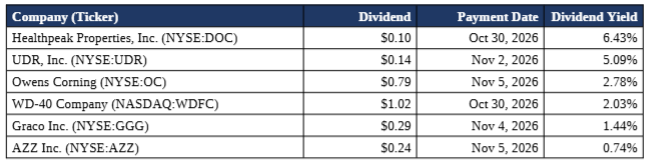
Top Ex-Dividend Companies for Monday, October 19:
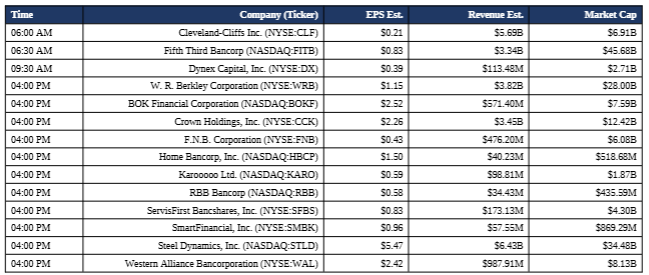
Upcoming Earnings (Monday, October 19):
Economic Calendar (Monday, October 19):

MACRO DATA RECAP
That's the wrap for today! Attention turns to Monday's earnings from Cleveland-Cliffs, Fifth Third, W. R. Berkley, and Steel Dynamics, a heavy week of results from SpaceX, Tesla, Meta Platforms, and Procter & Gamble, and whether the AI-financing selloff and oil above $100 push the 10-year Treasury yield, now near 5.08%, and Fed rate-hike odds higher before the October 27 to 28 meeting.