The Patient Hinge: iPhone Duo - Why Apple let everyone else fold first?
Samsung folded first in 2019, and Apple waited. The future, it turned out, had a crease in it.

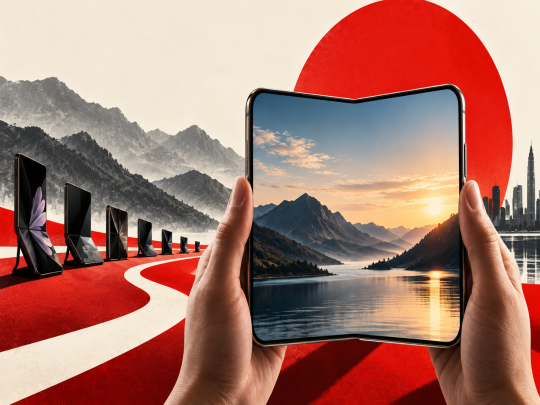
In February 2019, in a San Francisco hall hushed with expectation, Samsung’s executives unveiled a phone that opened like a book. The Galaxy Fold was a thing of wonder: a seven-inch screen that collapsed into a pocket-sized slab. The audience gasped. The headlines gushed. Somewhere in Cupertino, a handful of Apple engineers watched the livestream, took notes, and, by most accounts, went back to work without hurrying.
They had reason to be calm. Within weeks, reviewers who received early units of the Fold found their screens bulging, flickering or dead. Some had peeled off what looked like a protective film, which was in fact part of the display. Samsung postponed the launch by five months and redesigned the hinge and the screen’s edges. The future, it turned out, had a crease in it.
It still does. That is the odd thing about foldable phones. Seven years on from the first commercial models, the category has sold millions of units yet remains a niche, and the world’s most valuable phone company spent nearly all of that time watching from the sidelines. To impatient observers, this looked like a failure of imagination. It was nothing of the kind.
The anatomy of a delay
Start with the physics, which is unkind. A conventional phone screen is a sheet of rigid glass. A folding one must bend thousands of times without cracking, so it swaps glass for a flexible polymer layer, which scratches at the touch of a fingernail and dents under a pen. Where the screen folds, a crease appears, faint on a good day and unmissable on a bad one. The hinge, a marvel of miniature engineering, is also a doorway for dust.
Then comes the matter of bulk. Fold a phone and you have two bodies, a hinge and a battery that must be split or squeezed. Early foldables were thick when closed and heavy in the hand. Apple, a company that has built its religion on the feel of an object, regards such compromises as heresy.
Finally, there is arithmetic. Apple does not make a few hundred thousand of anything. It sells well over 200m iPhones a year and needs suppliers able to produce a new kind of display in vast quantities, at consistent quality, on a schedule it controls. In 2019 no one could do that for foldable panels. Rivals shipped what they could. Apple waited for what it needed.
A habit, not an accident
Here the story turns from engineering to temperament, for waiting is something Apple does on purpose.
In 1998 a firm called Diamond Multimedia sold the Rio, a pocket-sized MP3 player that held a dozen songs. Others followed. Apple turned up in October 2001 with the iPod, and its pitch was not that it was first but that it held a thousand songs and was navigable with a thumb. In 2002 Microsoft began pushing tablet computers on a sceptical public; the iPad arrived in 2010 and defined the category. Pebble raised millions for a smartwatch in 2012, and Apple’s version came in 2015. Each time the pioneer got the applause, and the follower got the market.
The pattern has a logic. An early mover pays to educate customers, absorbs the embarrassing failures and discovers, at its own expense, what people actually want. A late mover collects all of that knowledge for free. It can skip the false starts, wait for components to mature and arrive with a product that makes the pioneers look like rough drafts. The risk is that the pioneer builds a moat first. The reward, if the moat proves shallow, is everything.
The question is whether the moat is shallow. To see how dramatically it can be, consider a cold January morning in 2007.
The morning the room went quiet
The mobile phone business then belonged to others. Nokia sold roughly two of every five handsets on earth. BlackBerry, with its tiny keyboard and its cult of addicted executives, owned the smartphone and the loyalty of Wall Street. Microsoft’s Windows Mobile ran on a scattering of clunky devices. These firms were early, rich and confident. They had, as the business books say, scale.
On January 9th, in San Francisco, Steve Jobs walked onto a stage in black polo neck and jeans and told the audience he would introduce three products: a widescreen iPod with touch controls, a revolutionary mobile phone and a breakthrough internet communicator. He repeated the list. Then he revealed that these were not three devices but one.
In Waterloo, Ontario, the story goes, executives at the firm that made the BlackBerry watched with growing unease. Its co-founder is reported to have wondered whether the thing could really work as shown, given the drain it would put on a network and a battery. In Espoo, Nokia’s engineers had touchscreens and internet prototypes of their own; what they lacked was an organisation that could turn them into one clean idea. In Redmond, Microsoft’s phone chief laughed at the price.
The laugh did not age well. Apple had been late to phones; it had watched a decade of keyboards, stylus pens and clumsy menus. It had waited for touch screens that responded to a finger, for processors that could run a real operating system in a pocket and for mobile networks fast enough to make the web bearable. When it finally moved, it did not add a feature to the old design. It discarded the old design. Within six years, the market leaders had either collapsed or been sold for scrap. Nokia’s handset business went to Microsoft in 2014, and BlackBerry’s share of the market fell to a rounding error.
The tortoise had not merely caught the hares. It had waited until the hares ran off a cliff.
The reckoning
The lesson is delicious but easily over-learned, and so the rest of the story needs a warning label.
Being late is not a strategy. Plenty of latecomers arrive, shrug and fail, for the simple reason that waiting is useful only if you spend the time learning. Apple’s delay on foldables was not idle. The company reportedly spent years testing hinges, prototyping screen coatings and pressing its suppliers to cure the crease. It was not sleeping; it was studying. The advantage of a late start belongs to firms that use the intervening years to build something the pioneers cannot easily copy: better components, tighter software, a bigger base of loyal customers and a supply chain bent to their will.
Being early, meanwhile, is not a curse. Samsung’s foldables made it a pioneer in a segment that will grow, and its engineers learned lessons that rivals can only buy with time. A first mover with deep pockets and a willingness to fix its mistakes can hold on to a lead for a long time. The ones that lose are those who mistake priority for protection, who ship a half-finished idea, rest on the headlines and let someone else perfect it.
There is also a subtler point about customers. People do not buy firsts; they buy products that work. A buyer who has been burned by a cracked screen will not forgive the next one lightly. In a new category, the first impression often belongs to the pioneer, but the lasting impression belongs to whoever gets the product right.
The crease and the closing
Which brings us back to the hinge. Whether Apple’s foldable, when it arrives in full, will prove as decisive as the original iPhone is a question for the market, and for the coming quarters, to answer. The company has form, but form is not destiny. It must still persuade buyers that a folding screen is worth its premium, convince developers to build for a shape-shifting display and keep the crease out of sight.
But the larger lesson stands, and it applies to far more than phones. Markets are not races to the starting line; they are races to the finish. The pioneer teaches the world what it wants. The patient rival, watching, learning and refining, sometimes teaches it what it should have wanted all along.
In that quiet hall in 2019, as the Galaxy Fold bowed to a polite roar, a few engineers in Cupertino did not clap. They simply wrote down where it would break.