Rare Earth Elements: What They Are, Why Rare, Who Categorizes and Controls Them, and Key Companies
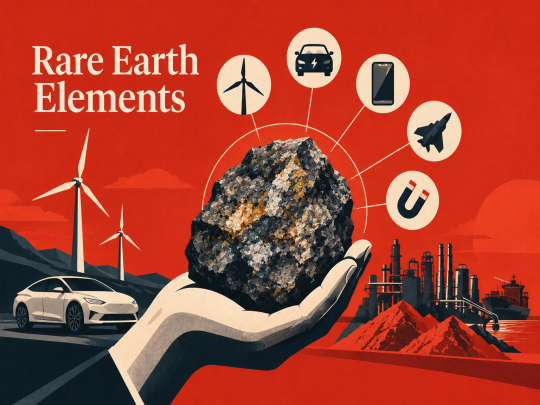
They are neither rare nor earths. Yet the 17 metals known as rare earth elements (REEs) sit at the heart of almost every technology that defines the 21st century, from the magnets in electric-vehicle motors and wind turbines to the phosphors in smartphone screens, the catalysts in oil refining and the alloys in fighter-jet engines. For retail investors, understanding these materials is no longer a niche curiosity. It is a window into the geopolitics of the energy transition, the fragility of global supply chains and the handful of companies that dominate an industry worth tens of billions of dollars a year and growing fast.

What exactly are rare earth elements?
The rare earths comprise the 15 lanthanides on the periodic table, lanthanum through lutetium, plus scandium and yttrium. Chemists group them this way because they share similar properties: they are silvery-white metals that occur together in the same mineral deposits and are notoriously difficult to separate from one another.
They are commonly divided into two commercial categories:
- Light rare earths (lanthanum, cerium, praseodymium, neodymium and sometimes samarium) are relatively more abundant and dominate production by volume.
- Heavy rare earths (europium, gadolinium, terbium, dysprosium, holmium, erbium, thulium, ytterbium, lutetium, plus yttrium) are scarcer, more valuable and critical for high-performance permanent magnets and specialised defence applications.
Neodymium and praseodymium (often sold together as “didymium”) and dysprosium and terbium are the stars of the current boom because they are essential ingredients in the powerful permanent magnets used in EV traction motors and offshore wind turbines. Without them, the green-energy transition as currently designed would stall.
Why are they called “rare”?
The name is a historical accident. In the late 18th and 19th centuries, European chemists isolated oxides (then called “earths”) of these metals from uncommon minerals. The metals themselves were later found to be more widespread than the original minerals suggested, but the label stuck.
In absolute terms they are not especially scarce. Cerium is roughly as abundant in the Earth’s crust as copper; neodymium is more common than lead. The real constraint is geological concentration. Economically viable deposits are few, and the elements almost always occur mixed together in complex ores such as bastnäsite, monazite and xenotime. Separating them requires long, chemically intensive processes that generate large volumes of toxic and sometimes radioactive waste. Environmental permitting is therefore difficult and expensive almost everywhere except China, which for decades accepted the pollution costs that others refused.
Scarcity, in other words, is more about processing capacity and political willingness than about the rocks themselves.
Who decides what counts as a rare earth?
There is no single global authority that “owns” the definition. The list of 17 elements is a scientific convention that crystallised in the mid-20th century and is accepted by bodies such as the International Union of Pure and Applied Chemistry (IUPAC).
What matters more for markets and policy is which governments designate them as “critical minerals.” The United States (via the Department of Energy and the US Geological Survey), the European Union, Japan, Australia and Canada all maintain critical-minerals lists that include most or all of the rare earths. These designations unlock subsidies, stockpiling programmes and faster permitting. China’s Ministry of Industry and Information Technology (MIIT) and Ministry of Natural Resources effectively set global production quotas and export rules, giving Beijing de-facto control over the official narrative of supply.
Who controls the supply?
For three decades the answer has been simple: China.
According to the latest data from the US Geological Survey, China accounts for roughly 60-70% of global mined rare-earth production and an even higher share, around 85-90%, of the far more valuable separation and refining capacity. Most of the world’s permanent-magnet manufacturing also sits inside China. The country achieved this dominance through a combination of low labour and environmental costs in the 1980s and 1990s, deliberate industrial policy, and the gradual exit of Western producers who found the economics and regulation too painful.
Outside China, production is concentrated in a few places:
- Mountain Pass in California (the only significant US mine),
- Mount Weld in Western Australia,
- smaller operations in Myanmar (much of whose output is informally processed in China),
- and emerging projects in Canada, Brazil, Africa and Vietnam.
Even when ore is mined elsewhere, a large fraction is still shipped to China for separation. This creates a structural chokepoint that Western governments are now trying, expensively and slowly, to break.
The companies that matter
For retail investors the investable universe is small, volatile and geographically skewed. The pure-play listed companies fall into three rough groups: Chinese majors that still dominate, Western developers trying to build alternative supply chains, and a handful of processors and magnet makers.
Chinese producers (most trade primarily on mainland exchanges; some have Hong Kong listings):
- China Northern Rare Earth Group High-Tech (SSE: 600111), the world’s largest producer by volume, controlling the vast Bayan Obo deposit in Inner Mongolia.
- China Rare Earth Group, a state-orchestrated consolidation of several southern producers focused on heavy rare earths.
- Shenghe Resources (SSE: 600392), active in both domestic production and overseas offtake agreements.
These firms operate under production quotas set by Beijing and benefit from the full suite of Chinese industrial policy. Their shares are accessible mainly to investors who can trade A-shares or via Hong Kong.
Western and allied producers:
- MP Materials (NYSE: MP), operator of Mountain Pass, California. It is the largest rare-earth producer in the Western hemisphere and is building downstream separation and magnet capacity with US government support.
- Lynas Rare Earths (ASX: LYC; OTC: LYSDY), Australian company that mines at Mount Weld and operates the only significant separation plant outside China (in Malaysia, with a new facility under construction in the United States). It is currently the most important non-Chinese source of separated rare-earth oxides.
- Iluka Resources (ASX: ILU), primarily a mineral-sands company that is developing a rare-earth refinery in Australia using feedstock from its own deposits.
- Arafura Rare Earths (ASX: ARU) and several smaller Australian and Canadian developers (Energy Fuels, Ucore, etc.) that remain pre-production or early-stage.
Further down the value chain, companies such as Vacuumschmelze (Germany) and emerging American magnet makers are trying to recreate the manufacturing steps that China currently monopolises. Most remain private or are subsidiaries of larger industrials.
Why the market is so sensitive
Rare-earth prices are notoriously volatile. Neodymium-praseodymium oxide, the key magnet feedstock, has swung from under $40/kg to over $150/kg and back again within a few years. Demand is rising steadily with EV and wind-turbine installations, but supply responds slowly because new mines and separation plants take 7-15 years and face intense environmental opposition. Export restrictions or quota cuts from China can send prices soaring overnight; a sudden release of stockpiles or a slowdown in Chinese manufacturing can crash them just as quickly.
Western governments have responded with a mix of subsidies, defence-driven offtake agreements and “friend-shoring” initiatives. The US Inflation Reduction Act, the European Critical Raw Materials Act and similar Australian and Japanese programmes are pouring public money into alternative supply chains. Whether these efforts can create commercially viable, non-Chinese capacity at scale remains an open question, and the central uncertainty for investors.
The investment case, stripped of hype
For a retail investor the rare-earth story is not a simple “buy the metals, they will only go up” narrative. It is a concentrated bet on three things:
- The speed of the energy transition (especially EV adoption and offshore wind).
- The willingness of Western governments to keep subsidising higher-cost domestic or allied production.
- China’s future export and production policy.
The listed pure-plays are few, often highly leveraged to a single commodity price, and prone to sharp drawdowns when sentiment turns. Diversified mining companies with rare-earth exposure offer a milder way in, but they dilute the thematic pure-play. Physical metal or exchange-traded products exist but are illiquid and carry storage and purity risks.
As with any strategic material, geopolitics can override geology and economics for long periods. That makes rare earths both more interesting and more dangerous than ordinary industrial metals. Investors who treat them as a straightforward growth story risk learning the old mining maxim the hard way: the best cure for high prices is high prices, until politics intervenes again.
The metals that are not rare will continue to shape the technologies that matter most. The question for capital markets is whether the West can rebuild enough of the supply chain to stop relying on a single country’s willingness to keep shipping them.
FAQs
Q1: What are rare earth elements?
Rare earth elements are a group of 17 metals. They include the 15 lanthanides plus scandium and yttrium. These metals power magnets in electric vehicles and wind turbines. They are also used in electronics, catalysts and defence systems.
Q2: Why are rare earth elements called “rare”?
The name comes from history. Early chemists found them in uncommon minerals. Most are not scarce in the Earth’s crust. Viable deposits are few, and separating the elements is difficult and costly.
Q3: Who categorises rare earth elements?
International chemistry bodies such as IUPAC define the list of 17 elements. Governments decide which ones count as critical minerals. The United States, European Union, Japan, Australia and China all maintain such lists.
Q4: Who controls the supply of rare earth elements?
China leads global supply. It produces 60-70% of mined rare earths and 85-90% of refined output. Other production comes from the United States and Australia. Much of that ore is still processed in China.
Q5: Which major companies control rare earth supply and what are their tickers?
Top Chinese firms include China Northern Rare Earth (SSE: 600111) and Shenghe Resources (SSE: 600392). Key non-Chinese producers are MP Materials (NYSE: MP) and Lynas Rare Earths (ASX: LYC; OTC: LYSDY).
The Wall Street Wrap: September 17, 2026
Related post