President Trump’s new stick against Russia and Iran, and what it means for Inflation
Congress has sent Trump a bill that pairs tougher Russia sanctions with tariffs of up to 100% on countries still buying Russian oil — mainly China and India. For retail investors, the real story isn't the geopolitics; it's what this means for energy prices, import costs, and inflation in the months ahead. A guide to the signals worth tracking, and the ones not worth trading.

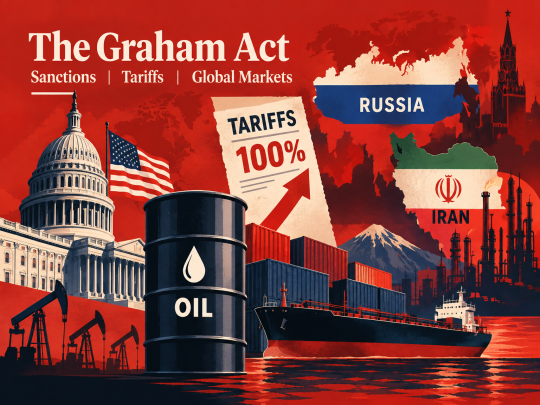
Congress has just handed the White House a sharper set of tools to squeeze Russia and keep pressure on Iran. The Lindsey O. Graham Sanctioning Russia and Iran Act of 2026 passed both the Senate and the House in recent weeks and now sits on President Trump’s desk. It is expected to become law. For retail investors the bill matters less as high politics and more as a potential source of market volatility in energy, trade and inflation.
Here is what the law does, how it arrived, where things stand, and how ordinary investors should think about it.
What the Act actually does
The law has two main aims. First, it tries to cut the money Russia earns from oil and gas, the main cash flow that funds its war in Ukraine. Second, it keeps existing sanctions on Iran’s energy and weapons activities from expiring.
On Russia the measures are broad. They require sanctions on senior officials, including the Russian president, certain military commanders, oligarchs and their families. They hit Russian banks and companies linked to the defence industry or energy sector. They target the “shadow fleet” — the network of ageing tankers, shell companies and insurers that help Russia sell oil despite earlier restrictions. American firms face new bans on investing in Russia, buying its government debt, or trading certain Russian securities on US exchanges. US energy exports to Russia are also blocked.
The most novel part is the tariff power. The President can place duties of up to 100 percent on all goods coming into the United States from countries that rank among the five largest buyers of Russian oil or gas, if those countries keep making new purchases. China and India are the biggest buyers today. Turkey and a few others also feature. Separate rules allow even higher tariffs on goods that come directly from Russia. The President keeps the right to waive or pause these measures and can end many of the Russia sanctions once a peace deal accepted by Ukraine is in place.
On Iran the law simply extends the Iran Sanctions Act of 1996 until 2031. That keeps pressure on Iran’s energy sector and certain weapons programmes without creating entirely new rules.
How the bill came about
Senator Lindsey Graham and Senator Richard Blumenthal began pushing a tougher Russia package in 2025. Existing sanctions had slowed but not stopped Russian oil sales. The shadow fleet and willing buyers in Asia filled the gap. Graham spent more than a year building bipartisan support and negotiating with the White House. He secured administration backing shortly before his death in July 2026. The bill was then named in his honour. Iran language was added because of the growing military links between Moscow and Tehran. The Senate passed it 86-11 in early August. The House followed 262-159 in mid-September. Some Democrats objected mainly to the wide tariff authority given to the President.
Where things stand
As of mid-September 2026 the bill has cleared Congress and gone to the President. The administration has said it supports the measure and expects to sign it. Once signed, many of the tariff and sanctions powers can start to be used within about a month, though the White House will decide the timing and intensity.
How America can use the new tools
The law gives the President leverage in three practical ways. He can raise the cost of doing business with Russia’s energy and financial networks. He can threaten or impose steep tariffs on the biggest buyers of Russian oil — mainly China and India — to push them to cut purchases. And he can keep Iran under sustained economic pressure. These tools can be applied gradually, waived, or held in reserve as bargaining chips in talks over Ukraine. They are designed to increase the economic pain on Moscow while leaving room for diplomacy.
What this could mean for inflation and markets
Retail investors should watch two channels: energy prices and broader import costs.
If the new sanctions and shadow-fleet measures reduce Russian oil flows, or if big Asian buyers cut purchases, global oil supply could tighten. Higher crude prices feed into petrol, diesel, shipping and many everyday goods. The United States is a large energy producer, so the direct hit is smaller than in Europe, but Americans still feel global price moves at the pump and in the cost of transported goods.
The tariff power is the bigger wild card for inflation. Duties of up to 100 percent on goods from major trading partners such as China or India would raise the price of a wide range of imports. Companies often pass those costs on to consumers. Existing tariffs have already added a noticeable but limited amount to core inflation in recent years. New, broad tariffs could add more upward pressure, especially if applied for a long period. The Federal Reserve would then face a harder job keeping inflation near its 2 percent goal.
Markets will react to signals, not just the law itself. Oil and energy stocks can swing on any news that Russian exports might fall. Shares of big US oil producers such as ExxonMobil (NYSE: XOM) and Chevron (NYSE: CVX) often move higher when crude prices rise. Defence companies including Lockheed Martin (NYSE: LMT) and RTX (NYSE: RTX) may draw attention if investors expect longer geopolitical tension. On the other side, firms with heavy exposure to China or India, such as Apple (NASDAQ: AAPL) or Caterpillar (NYSE: CAT), could face pressure if new tariffs look likely. Shipping and industrial names tied to global trade may also see volatility.
None of this is automatic. The President has wide discretion. Tariffs may be threatened more than used. Waivers can soft-pedal the impact. A faster path to a Ukraine settlement would remove much of the pressure. The inflation effect will depend on how aggressively the tools are deployed and how energy markets respond.
What retail investors should do
Stay calm and focus on what you can control. Do not try to trade every headline about sanctions or tariffs. Geopolitical bills create noise; lasting portfolio damage usually comes from sustained higher inflation or a sharp rise in energy costs.
Review your exposure to energy prices and to companies that earn large shares of revenue from China or India. Diversification across sectors and geographies remains the simplest protection. Keep an emergency cash buffer so you are not forced to sell investments if markets wobble. If your time horizon is long — five years or more — short-term volatility from sanctions rarely changes the case for owning a broad mix of stocks and bonds.
Watch three practical signals in the coming months: whether the President signs the bill quickly, how soon any new tariffs or shadow-fleet sanctions are announced, and the direction of oil prices and US inflation data. Those will tell you more than the text of the law itself.
The Act gives Washington stronger economic leverage against Russia and Iran. For investors the real question is not the politics but the size and duration of any resulting rise in energy and import costs. Preparation and perspective matter more than prediction.
Frequently Asked Questions
Q1: What is the Lindsey O. Graham Sanctioning Russia and Iran Act of 2026?
It is a US law that adds sanctions on Russian officials, banks, energy networks and the shadow fleet of oil tankers. It also lets the President put high tariffs on countries that buy large amounts of Russian oil or gas. It extends existing Iran energy and weapons sanctions until 2031.
Q2: Has the bill become law yet?
Both the Senate and House have passed it. It has been sent to President Trump. He is expected to sign it, but as of mid-September 2026 it is still awaiting his signature.
Q3: How could this affect petrol prices or inflation in the US?
Tighter limits on Russian oil could push global crude prices higher, which often raises petrol and shipping costs. New tariffs on goods from big Russian-oil buyers such as China or India could make many imported products more expensive. The final impact depends on how strongly the rules are enforced.
Q4: Which countries face the biggest risk of new US tariffs?
The top buyers of Russian oil and gas, currently led by China and India. The President can choose to apply tariffs of up to 100 percent on their goods if they keep buying Russian energy.
Q5: What should ordinary investors do right now?
Avoid sudden moves based on headlines. Check how much of your portfolio is tied to energy prices or to companies heavily exposed to China and India. Stay diversified, keep some cash for flexibility, and watch oil prices and inflation data in the months ahead.