Stocks Trade, Cash Treasuries Rest: Columbus Day Tests Liquidity Before Bank Earnings
US stocks trade on Columbus Day while the cash Treasury market closes and futures keep trading on thinner volume. With yields near multi-decade highs and bank earnings due Tuesday, the gap raises questions on liquidity, price discovery and valuation.


Key Highlights
- US stocks trade normally on Columbus Day while cash Treasury trading is closed.
- Treasury futures stay open, so rate price discovery moves to a thinner market.
- Settlement and collateral movements pause until Tuesday.
- Liquidity risk rises as Japan and Canada are also closed.
- Large US banks report Tuesday into a 10-year yield near 5.24 percent.
The Split: One Holiday, Two Calendars
On Monday, October 12, the NYSE and Nasdaq open at 9:30 am Eastern and trade a full session. The cash Treasury market, the benchmark for the price of money, does not. For one day, equity investors value companies while the most closely watched discount rate goes without an official daytime print.
In a calm market the gap would be a footnote. This week it is not. Longer-dated yields sit near multi-decade highs, oil is elevated, and third-quarter earnings begin on Tuesday. The questions that follow are practical: why the calendars differ, what actually stops, and where the risk sits.
What Columbus Day Is, and Why It Reaches Markets
Columbus Day began as a civic observance. New York's Tammany Society marked the 300th anniversary of the 1492 landing in 1792, and President Benjamin Harrison issued a national proclamation for the 400th in 1892. Franklin Roosevelt made it a federal holiday in 1937, and the Uniform Monday Holiday Act moved it to the second Monday of October from 1971. Many states and cities now mark Indigenous Peoples' Day on the same date, and the name of the day remains contested.
The label matters less to markets than the legal status. A federal holiday closes the Federal Reserve, and that determines which markets can function.
Why Bonds Close and Equities Do Not
The Federal Reserve observes the holiday, which shuts Fedwire, the system that settles Treasury trades. The Securities Industry and Financial Markets Association (SIFMA) therefore recommends a full close for US fixed income, and it confirmed that for October 12 on September 29. The advice is voluntary, but the cash market follows it.
Equity exchanges set their own calendars and do not observe Columbus Day, so stocks trade regular hours. Veterans Day on November 11 produces the same split. Structure explains the habit. Stocks trade on centralised exchanges with fixed hours, while Treasuries trade over the counter through dealers and electronic venues that depend on working settlement rails.
What Stops and What Keeps Trading
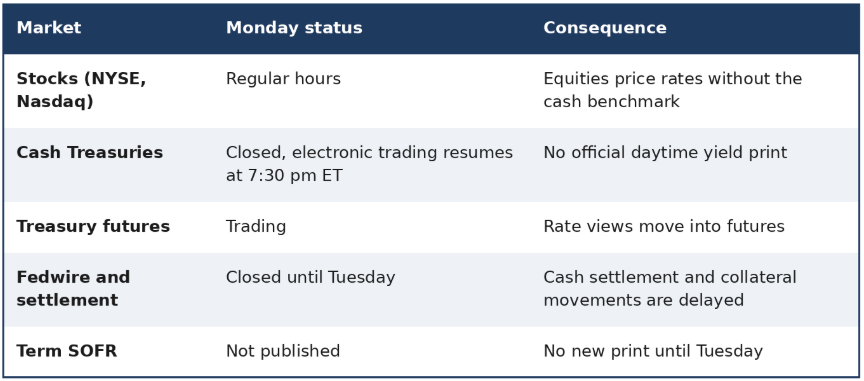
The effect is a relocation of price discovery, not a blackout. CME Group (NASDAQ:CME) says it will publish settlement prices for its futures at normal times, so rate views can still be expressed. Foreign exchange trades, as do US listings of Canadian companies, even though Toronto is shut. What is missing is the official cash benchmark. Friday's close remains the last reading until cash trading restarts, with the 2-year yield at 4.80 percent, the 10-year at 5.24 percent and the 30-year at 5.60 percent. The 10-year sits about 45 basis points above the 2-year.
Why Thin Liquidity Is the Real Risk
Closure is not the danger. Thin depth is. Japan's Health and Sports Day and Canada's Thanksgiving shut two more markets. Nothing notable is scheduled for North America on Monday, and Tuesday's main release is existing home sales. With fewer participants and no scheduled catalyst, a single headline can move prices further than usual, and spreads can widen.
Two market-structure effects deserve attention. Futures can react to news, but on holiday volume, and they need not track the cash market perfectly. Bond exchange-traded funds trade on equity exchanges, and their prices can drift from the value of their holdings while the underlying market is shut. Neither effect is new, but both are easier to see on a day like this.
The Backdrop: High Yields, High Oil, Fragile AI Sentiment
Thin liquidity matters more because the backdrop is not calm. Last week the 10-year yield touched about 5.36 percent, its highest since 2002. West Texas Intermediate crude settled near 92 dollars a barrel and Brent finished above 104 dollars, with the Middle East conflict still a supply risk. Thursday's slide in AI-linked shares was the Nasdaq's largest daily loss since mid-August. Friday's rebound lifted the S&P 500 by 0.59 percent to 7,811.54, the Nasdaq Composite by 0.64 percent to 27,366.17 and the Dow Jones Industrial Average by 0.83 percent to 51,654.95.
The VIX closed at 14.84, a level consistent with modest priced-in stress, which leaves little cushion if a shock arrives. Higher discount rates reduce the present value of distant earnings, which matters most for long-duration growth stocks. A steeper curve changes the arithmetic for lenders in a different way, and that is where Tuesday's calendar becomes relevant.
Earnings Season Meets a Reopening Bond Market
Tuesday's calendar is dense. Johnson & Johnson (NYSE:JNJ) reports around 6:45 am Eastern, JPMorgan Chase (NYSE:JPM) and Wells Fargo (NYSE:WFC) at 7:00, Goldman Sachs (NYSE:GS) at 7:30 and Citigroup (NYSE:C) at 8:00. UnitedHealth (NYSE:UNH) also reports before the open, with its call at 8:00. Bank of America (NYSE:BAC) and Morgan Stanley (NYSE:MS) are listed for Wednesday.
Cash Treasury trading is scheduled to resume on Monday evening, with BrokerTec reopening at 7:30 pm Eastern, so fresh post-holiday yields should arrive before the opening bell. That narrows the timing risk but sharpens a different question: how much of Tuesday's move belongs to earnings, and how much to the bond market catching up?
Bank results are tied to the curve in several ways. Net interest income, deposit costs, loan demand and the value of securities portfolios all respond to the level and shape of yields. Trading and investment banking revenue tends to reflect activity and volatility in markets. Management guidance on these lines may matter more than the headline earnings figure. The two health care reports offer a read outside the financial sector.
Risks on Both Sides
A quiet session is plausible if headlines stay muted and futures hold near Friday's levels. A disorderly one is also possible if an oil or geopolitical headline lands on thin liquidity before cash markets can respond, forcing a catch-up repricing alongside bank results. Neither outcome is assured, and past reactions do not guarantee future ones.
What to Watch
- Where Treasury yields print when cash trading resumes, relative to Friday's close.
- How Treasury futures and bond ETFs behave on holiday volume.
- Net interest income and deposit cost guidance from the large banks.
- Oil and geopolitical headlines that arrive while cash markets are shut.
The Bottom Line: Infrastructure Sets the Terms of Price Discovery
Columbus Day is not a market event. It is a calendar quirk that exposes how markets are built. Equities and Treasuries run on different rails, and when the rails that settle government debt close, price discovery does not stop. It relocates to venues with fewer participants, and the cost appears as liquidity.
That is why a holiday with no scheduled data matters this week. Yields near multi-decade highs, elevated oil and a fragile AI trade raise the price of a thin session, and Tuesday's bank earnings will test how quickly futures, ETFs and the reopened cash market realign. An orderly session is plausible. The structural point holds either way: the benchmark that discounts every equity cash flow is only as dependable as the infrastructure beneath it.
Related post