The Wall Street Wrap: September 26, 2026
US stocks closed out a volatile week with gains as oil prices retreated on hopes for a phased US-Iran deal to reopen the Strait of Hormuz, even as Treasury yields held near 2007 and 2004 highs; Iran offered to reopen the waterway within seven days, Barry Diller's People Inc. withdrew its MGM Resorts buyout bid, and a federal appeals court upheld the Pentagon's blacklisting of Anthropic.

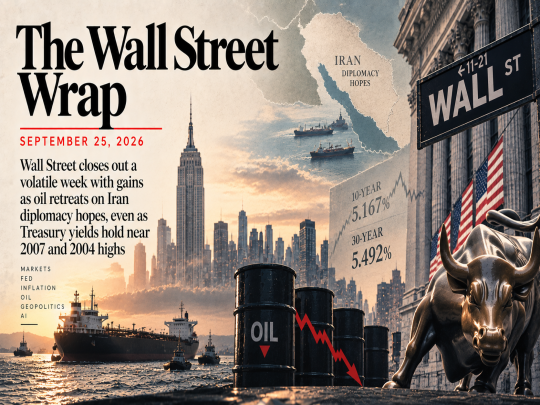
Wall Street closes out a volatile week with gains as oil retreats on Iran diplomacy hopes, even as Treasury yields hold near 2007 and 2004 highs
Welcome to Wall Street Wrap, your quick end-of-day rundown of what moved US markets today, plus what's shaping global sentiment overnight.
MARKETS TODAY
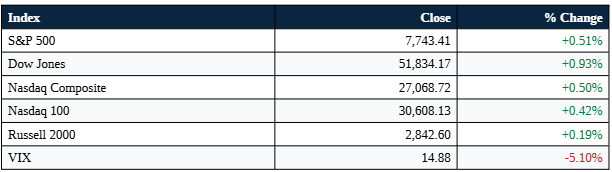
US stocks rose on Friday to close out a volatile week, helped by a pullback in oil prices and a modest easing in the Treasury bond selloff, mainly in shorter-dated maturities. The S&P 500 climbed 0.51% to 7,743.41, the Nasdaq Composite added 0.5% to settle at 27,068.72, and the Dow Jones Industrial Average rose 0.93% to 51,834.17. For the week, the S&P gained 1.2%, the Nasdaq jumped 2.1%, and the Dow improved 0.3%. The advance was powered by a resurgence in mega-cap technology names, led by Meta Platforms, whose new Muse AI agent has driven a nearly 14% weekly gain for the stock. Information technology was the best-performing S&P sector for the week, up 3.1%.
ANALYTICAL VIEW
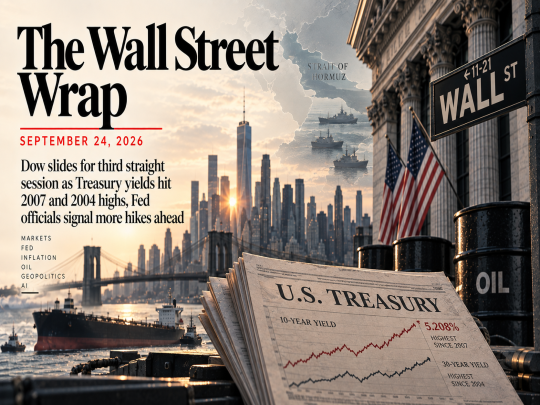
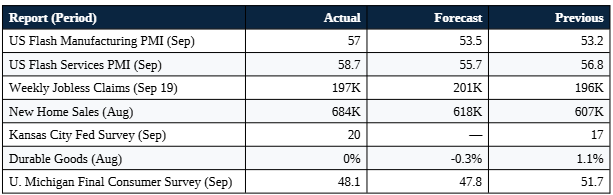
Friday's gains capped a week defined by a stark divergence between resilient equities and a bruising bond-market rout. The 10-year Treasury yield touched its highest level since June 2007 earlier in the week before easing slightly to 5.167%, while the 30-year yield reached levels last seen in 2004 before settling near 5.492%. The moves were driven by hawkish commentary from Fed Governor Michael Barr, who said further policy adjustments would likely be needed to bring inflation to target, alongside stubbornly high oil prices and a purchasing managers' survey that hit its strongest level in more than four years. Traders are now pricing in roughly a 64% chance of an October rate hike, according to the CME FedWatch tool, up from about 58% a week earlier. Consumer sentiment told a different story: the University of Michigan's final September reading fell to 48.1 from August, with one-year inflation expectations climbing to 4.6%, the highest since June, even as durable goods orders held roughly flat against expectations for a decline.
Equity strategists described the resilience as remarkable given the scale of the bond-market moves. LPL Financial's Adam Turnquist attributed much of the strength to a comeback in mega-cap technology stocks after early-year underperformance, while Truist's Keith Lerner noted the market has undergone "a meaningful internal reset in both prices and valuations," with only about 26% of stocks trading above their 50-day moving average, a sign of broad, indiscriminate selling in rate-sensitive corners even as headline indices held firm. Both strategists cautioned that continued yield increases would eventually weigh more heavily on performance, even as elevated rates begin to restore income opportunities for investors after years of near-zero yields.
What could change the picture: Whether Iran's offer to reopen the Strait of Hormuz within seven days translates into a durable de-escalation that further eases oil prices and inflation pressure, and whether Monday's promised details on US-China trade agreements bring the clarity businesses have been waiting for on tariff carve-outs.
SECTOR PERFORMANCE
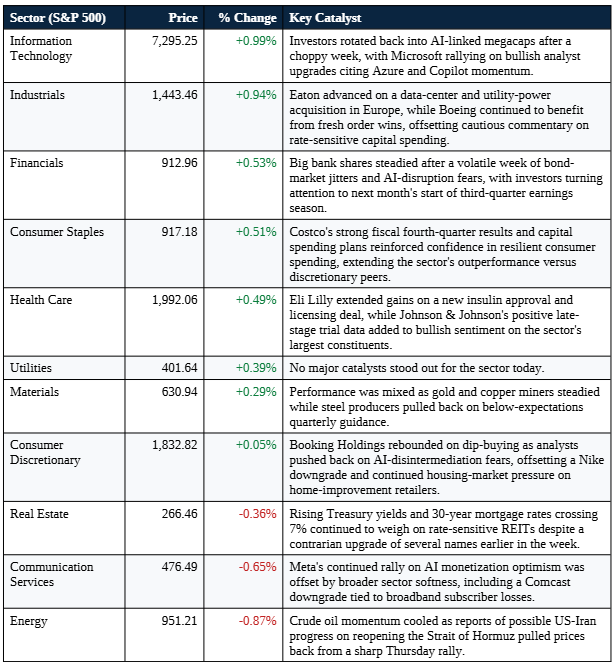
WINNERS & LOSERS
Top 5 Gainers (across S&P, Nasdaq, Dow):
- Bloom Energy Corporation (NYSE:BE): +8.269%
- ON Semiconductor Corp (NASDAQ:ON): +5.537%
- Microchip Technology Inc (NASDAQ:MCHP): +5.356%
- Generac Holdings Inc. (NYSE:GNRC): +5.095%
- Dell Technologies Inc (NYSE:DELL): +5.013%
Top 5 Decliners:
- Gen Digital Inc (NASDAQ:GEN): -6.285%
- Charter Communications, Inc. (NASDAQ:CHTR): -3.947%
- Palo Alto Networks, Inc. (NASDAQ:PANW): -3.893%
- Devon Energy Corporation (NYSE:DVN): -3.783%
- GoDaddy Inc. (NYSE:GDDY): -3.641%
Note: Energy transition, semiconductor, and hardware names led gainers as the AI trade broadened out, while cybersecurity and cable names faced the steepest declines despite the market's overall weekly advance.
AFTER-HOURS MOVERS
Gainers:
- Mirum Pharmaceuticals, Inc. (NASDAQ:MIRM), +1.62% after hours: Shares ticked higher after closing up 0.38% in regular trading, as investors focused on Saturday's FDA decision date for zilurgisertib, the company's oral therapy for fibrodysplasia ossificans progressiva, a rare bone disorder. The stock had rallied roughly 17.6% over the prior week ahead of the binary catalyst before cooling into the after-hours session, with algorithmic sentiment models flagging weakening near-term momentum.
Decliners:
- Circle Internet Group (NYSE:CRCL), -2.72% after hours: Shares extended a 4.30% regular-session decline as investors digested a wave of company news, including an announcement that CFO Jeremy Fox-Geen will step down by year-end after five years in the role, alongside continued scrutiny of dilution and deal economics tied to Circle's recent Binance investment and Tazapay acquisition. The stock's slide followed a sharp intraday drop after traders reassessed the terms of Binance's $100 million equity purchase at a discount to market price and Circle's stock-funded $400 million Tazapay deal.
COMMODITIES & RATES
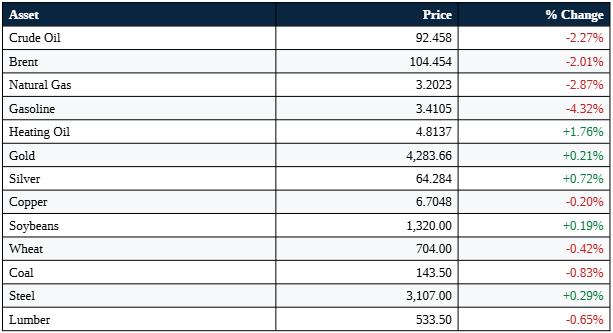
US TREASURY YIELDS
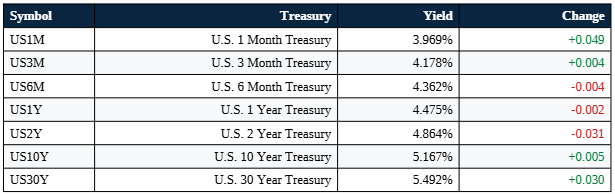
TOP STORIES: US
Wall Street closes volatile week with gains as oil retreats and mega-cap tech leads. The S&P 500 climbed 0.51% to 7,743.41, the Nasdaq Composite gained 0.5% to 27,068.72, and the Dow rose 0.93% to 51,834.17, with all three indexes posting weekly gains of 1.2%, 2.1%, and 0.3% respectively. The advance was led by information technology, up 3.1% for the sector's best weekly showing, as Meta Platforms surged nearly 14% on excitement over its Muse AI agent. Eric Diton, president of The Wealth Alliance, said the market has been "incredibly resilient" even as bearish sentiment has risen sharply over the past two weeks, cautioning that continued yield increases would eventually weigh more heavily on performance.
Iran offers to reopen Strait of Hormuz within seven days as Saudi Arabia faces fresh Houthi attacks. Iran's foreign minister Abbas Araghchi said Tehran would reopen the strategically vital waterway and resume nuclear talks with the US within seven days if Washington accepts conditions largely mirroring the collapsed June Islamabad memorandum of understanding. The offer came as Houthi militants fired dozens of missiles and drones at Saudi cities including Mecca, Jeddah, and Yanbu, prompting emergency alerts and a planned joint chiefs-of-staff meeting between Saudi Arabia, Turkey, and Pakistan. Oil prices fell on the diplomatic signal even as vessel transits through Hormuz slid to just nine, far below peacetime levels, with Iranian President Masoud Pezeshkian saying in a Fox News interview that "it's America that must choose whether it wants to end this or not."
Barry Diller's People Inc. rescinds MGM Resorts buyout offer over deal complexity and debt concerns. People Inc., which owns roughly a 26.1% stake in MGM Resorts International, withdrew its four-month-old proposal to acquire the casino operator for $48.30 per share. Chairman Barry Diller said in a statement that "the mix was [not] coming together in the way we had hoped," while a person familiar with the matter told CNBC the significant debt load the deal would have required was a key factor. Diller left the door open to a future transaction, saying People Inc. "remains open to and interested in the possibility of a strategic transaction with MGM Resorts." The news came in the same week that Caesars Entertainment shareholders approved Tilman Fertitta's $17.6 billion acquisition of that casino operator.
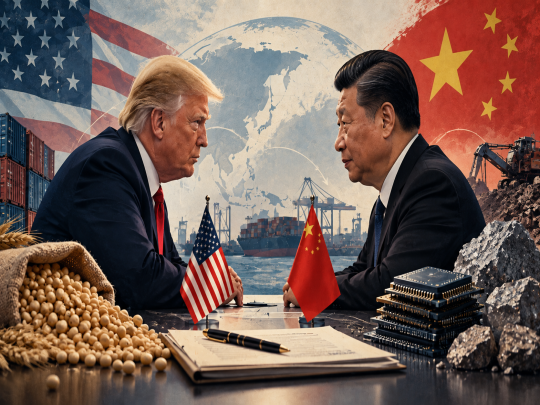
US and China to detail trade agreements Monday as Xi signals openness to AI cooperation. US Trade Representative Jamieson Greer said Washington and Beijing have reached agreements covering a subset of nonsensitive goods, including US agricultural products and medical devices, that will trade on more favorable terms, with fuller details expected Monday. The announcement follows this week's extension of the broader US-China trade truce by two months and Chinese President Xi Jinping's comment to Trump during their White House meeting that AI presents "more opportunity for cooperation than competition." Greer said the two-month truce extension functions as a "compliance period" to assess whether China is following through on earlier soybean and rare-earth purchase commitments, adding that the US goods trade deficit with China has fallen nearly 40% as trade flows shift toward other countries including Mexico.
Federal appeals court upholds Pentagon's blacklisting of Anthropic as a supply chain risk. A divided US Court of Appeals for the District of Columbia Circuit panel ruled 2-1 that the Department of Defense's March designation of Anthropic as a national-security supply chain risk was lawful, rejecting the company's argument that the ban was arbitrary and unconstitutional. The designation, which bars the military and its contractors from using Anthropic's Claude models, followed a breakdown in talks over unrestricted military access to the technology. Judge Gregory Katsas, writing for the majority, said the Defense Department "did not transgress any limits on its authority." An Anthropic spokesperson said the company is "considering all options, including further review," noting that a separate federal court had already found a parallel designation unlawful.
Also today: Saudi Arabia's crude exports rose to 6 million barrels per day in September, the highest level since the Iran war began, as Riyadh rerouted shipments back through the Strait of Hormuz following damage to its East-West pipeline; Microsoft unveiled a revamped Copilot "super app" combining coding and productivity agents to compete with Anthropic and OpenAI; Danish intelligence warned of a "low but growing risk" that Russia could launch a limited attack on a NATO member in the coming months; crypto exchange Bitget said it suspects North Korean hackers were behind a roughly $352 million breach of its wallet infrastructure, with customer losses fully covered by its protection fund; the FDA approved Mirum Pharmaceuticals' zilurgisertib for a rare bone disorder; and insurance allocator TFP Group filed for a US initial public offering on the NYSE under the ticker "TFP."
TOP STORIES: GLOBAL
Nearly 80 countries' worth of pressure builds on Iran as Hormuz traffic collapses to nine vessels. Vessel transits through the Strait of Hormuz, which normally carries about a fifth of global oil supply, fell to just nine according to preliminary ship-tracking data, as Houthi attacks on Saudi energy infrastructure compounded the disruption from the seven-month Iran war. Saudi Arabia's Grand Mufti told troops to be ready "to lay down their lives" fighting the Houthis, a starkly different tone from Pezeshkian's attempt to distance Tehran from the escalation by saying "the Houthis are responsible for their own actions."
Danish intelligence warns Russia could strike a NATO member within months. The Danish Defence Intelligence Service said Russia appears increasingly willing to take risks after more than four and a half years of war in Ukraine, warning of a "low but growing risk" of isolated strikes on infrastructure critical to Ukraine's support or a limited, unmarked troop deployment into a bordering NATO state. The assessment joins recent warnings from Baltic intelligence chiefs and European lawmakers, and came as Poland said a fire at a Starlink ground station was an act of sabotage "aligned with Russia's new doctrine of attack."
China's Xi tells Trump AI offers more room for cooperation than competition. In a White House meeting, Xi said "the two sides can continue AI dialogue, exchange views on risks and benefits, and together guard against the misuse or malicious use of AI," according to a Chinese state media readout, while stressing that humans should maintain control of the technology. China's Commerce Ministry confirmed its senior trade negotiators held their first talks with the US on artificial intelligence this week, following Treasury Secretary Scott Bessent's earlier proposal for a joint "US-China AI Dialogue" with an incident alert system.
Japanese yen snaps five-day losing streak after Tokyo discloses Trump's currency concerns. The yen rallied to its best day against the dollar in nearly three weeks after Japanese Finance Minister Satsuki Katayama revealed that Trump had raised concerns about yen weakness during a September 22 meeting with Prime Minister Sanae Takaichi. The currency had been under pressure after the Bank of Japan's recent rate hike was seen as insufficiently aggressive, with Katayama confirming Tokyo and the US Treasury remain in close contact following their joint spot-market intervention in July.
Global bond selloff extends as Japanese, UK and German yields hit fresh multi-year highs. Japan's 10-year government bond yield climbed to its highest level since August 1996, while UK gilts and German bunds also reached multi-year highs this week, mirroring the surge in US Treasury yields to 2007 and 2004 highs on the 10-year and 30-year respectively. ING's Padhraic Garvey and Benjamin Schroeder wrote that government bond yields are "primed to remain under pressure on a pure debt dynamic theory," even as they see enough rate-hike risk already priced into markets.
MANAGEMENT & FED SPEAK
Jamieson Greer, US Trade Representative, on US-China trade talks:
"We've actually reached agreement with the Chinese on a number of these things."
Barry Diller, Chairman, People Inc., on withdrawing the MGM Resorts bid:
"We didn't feel the mix was coming together in the way we had hoped."
Gracy Chen, CEO, Bitget, on the suspected North Korea hack:
"Private key compromise has been ruled out."
CORPORATE ACTIONS & EARNINGS CALENDAR
Top Ex-Dividend Companies for Monday, September 28:
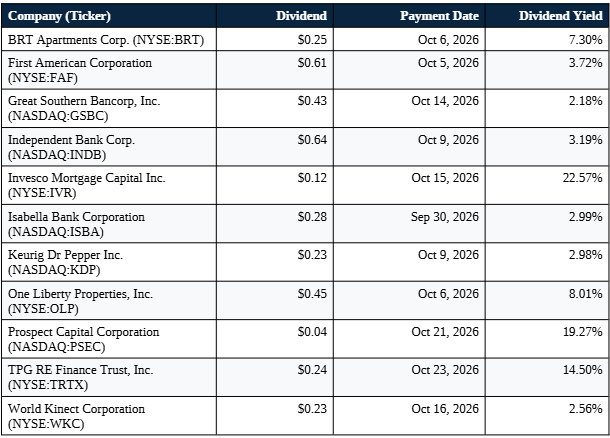
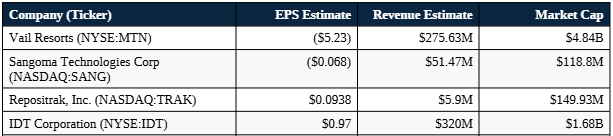
Upcoming Earnings (Monday, September 28):
MACRO DATA RECAP (Week of September 21-25)
Attention now turns to Monday's promised details on US-China trade agreements and whether Iran's seven-day offer to reopen the Strait of Hormuz produces the kind of durable de-escalation that could finally take sustained pressure off oil prices, even as markets continue to weigh just how much longer equities can shrug off Treasury yields sitting at multidecade highs.