Trump-Xi Summit: 5 Stocks Investors Should Watch as Truce Extends to January 2027
Trump and Xi extended their trade truce to January 2027, but the two-month extension and public friction over AI and Taiwan point to unresolved risk. Five questions for investors across agriculture, energy, aerospace, rare earths and semiconductors.

Key Highlights
- Trump and Xi extended their trade truce to January 10, 2027, keeping lower tariffs and rare earth flows in place.
- The two-month extension fell short of the six months or longer many expected, which CSIS analyst Scott Kennedy read as pressure on Beijing.
- China's trade surplus is running near $100 billion a month, which has narrowed Washington's negotiating leverage.
- Bessent says China is meeting its 25 million tonne soybean pledge but lagging on a separate $17 billion farm-goods commitment.
- Rare earth licensing remains unresolved even with the truce extended, with no standardized approval process yet in place.
A Truce Extended, but Only Just
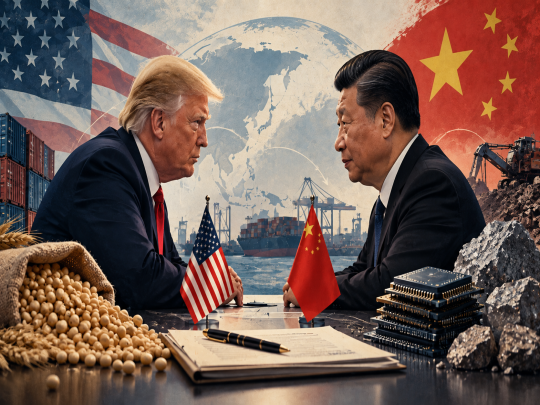
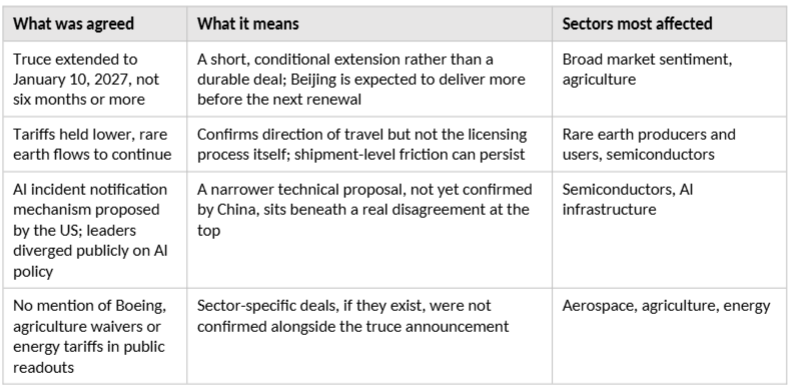
President Donald Trump hosted Chinese President Xi Jinping in Washington today, four months after their talks in Beijing in May. The outcome matched the low-expectations script, and the edge was sharper than the trade headline alone suggests: the two leaders publicly diverged on artificial intelligence, and Xi again invoked the "Thucydides Trap," the theory that a rising power and an established one tend toward conflict. The two sides extended their trade truce, first agreed in South Korea last October, to January 10, 2027, US Treasury Secretary Scott Bessent said, keeping tariffs lower and rare earth exports flowing. That is shorter than the six months or longer many had expected heading into the summit, and some analysts read the gap as a signal in itself: Washington keeping pressure on because it remains unsatisfied with Beijing's follow-through on prior commitments. Bessent said separately that Beijing was meeting its 25-million-ton soybean commitment but lagging on a separate $17 billion agricultural pledge, and US officials said rare earth deliveries were falling short too, a sign real gaps remain beneath the truce.
On artificial intelligence, the two leaders did not align. Mr Trump said in a social media post that he wants US AI policy left "exactly where it is," opposes new guardrails, and would rely on the Department of Justice rather than fresh regulation, adding that he believed Beijing held the same view. Xi said the opposite the same day, calling on both countries to manage AI's growth responsibly and keep its development "under human control." That public gap sits above a narrower, more technical result from preparatory talks between Mr Bessent and Chinese Vice Premier He Lifeng: a proposed notification mechanism for AI incidents that rise to a national security level, which China has not yet publicly confirmed.
The balance of leverage had shifted since May regardless of the outcome. China's exports kept growing despite US tariffs, with the trade surplus running near $100 billion a month through mid-2026, while Mr Trump faced a costly conflict involving Iran, weaker approval ratings, and midterm elections in November. Both leaders had reasons to prefer stability over confrontation, and a short, renewable truce fits that incentive better than a durable settlement would.
The Truce Was Extended. What Does the Short Timeline Signal?
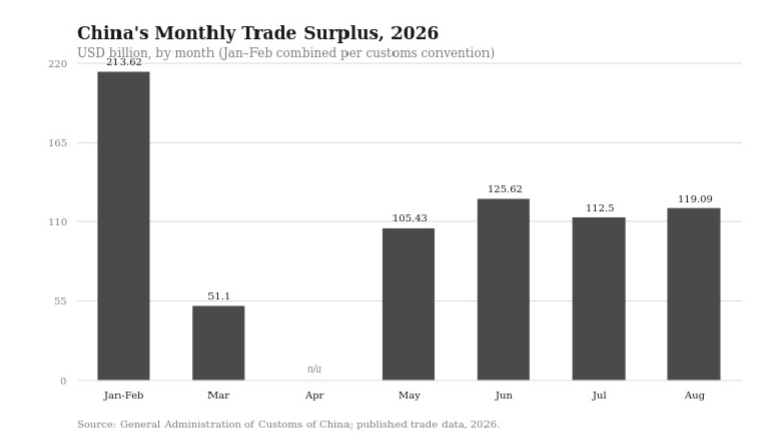
Chart 1: China's monthly trade surplus, 2026 (USD billion)
China's trade surplus has run close to or above $100 billion in most months this year, and full-year 2025 already set a record of $1.19 trillion. Exports have grown even as tariffs rose. Tariffs have not slowed China's export momentum, which weakens the case that Washington could extract large concessions, and helps explain why the extension was short rather than sweeping.
For investors, the truce is best read as a macroeconomic backdrop, and January 10, 2027 now gives that backdrop a specific expiry. The shorter-than-expected extension keeps tariff uncertainty from disappearing entirely from corporate guidance, particularly for importers and industrial companies with Chinese supply chains, since the next negotiation is only months away rather than a year out. The signal worth tracking is whether Beijing delivers the additional purchase and licensing commitments Washington says it still expects; a short extension tied explicitly to further deliverables raises the odds of renewed friction if they fall short again.
Can Agricultural Purchases Keep Rising?
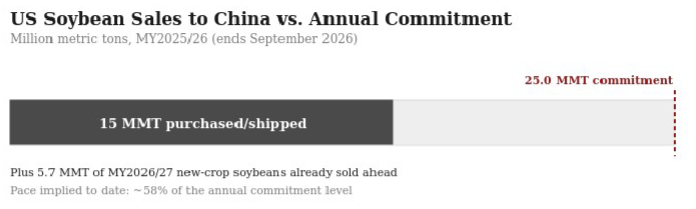
Chart 2: US soybean sales to China against the 25 million tonne annual commitment (million metric tons)
Agricultural goods, led by soybeans, were among the largest US exports to China before the trade war, reaching $29 billion in 2024. At last year's Busan summit, China agreed to buy 25 million metric tons of US soybeans annually through 2028. Mr Bessent said this week that Beijing was meeting that commitment, with purchases past the halfway mark for the year, though he added China was lagging on a separate pledge to buy $17 billion in other US farm goods agreed in May.
China's additional 10% tariff on US soybeans, on top of its existing 3% import duty, has still pushed some commercial buyers toward Brazilian and Argentine supply, and Brazil sent record volumes between June and August. The $17 billion broader farm-goods pledge, not the soybean commitment, is the harder target: closing that gap would likely require exempting more goods from tariffs, with corn and sorghum the likeliest candidates for waivers. Companies with exposure include Archer-Daniels-Midland (NYSE:ADM) and Bunge Global (NYSE:BG), whose grain handling volumes are sensitive to export demand. Confirmation that Beijing hit the full-year soybean target would be a modest positive; continued silence on the $17 billion pledge would be the clearer warning sign.
Will Tariffs on US Energy Come Down?
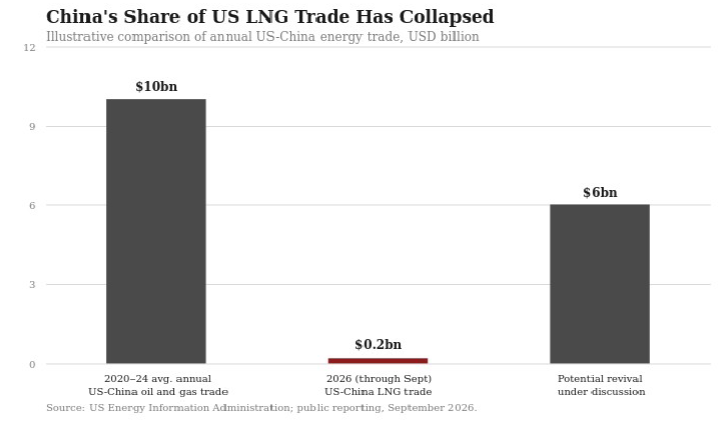
Chart 3: China's near-zero share of US LNG exports versus prior trade levels
China imported between $7.5 billion and $12 billion of US oil and gas a year from 2020 to 2024, but purchases essentially stopped after Beijing imposed a 15% tariff on US LNG in February 2025. Energy sits inside a broader mechanism agreed at the May summit, a so-called Board of Trade meant to define a roughly $30 billion basket of tariff-cut goods on each side, with LNG among the items on the table. That basket remains undefined: the two sides are still disputing scope, with roughly 10 product categories under discussion, and a companion Board of Investment has reportedly stalled entirely. US LNG exports overall kept growing regardless, up 23% in the first half of 2026, but China's share of that trade has been close to zero for most of the year.
A revival would matter more as a signal than as a near-term windfall. A full restart is being discussed in the range of $6 billion a year, a fraction of total US LNG exports, and much new US supply is not due to start flowing until the end of the decade. Companies with exposure include Cheniere Energy (NYSE:LNG) and Exxon Mobil (NYSE:XOM). For both, broader oil and gas prices, elevated by disruption in the Middle East, are likely to affect earnings more than any single tariff change. A concrete tariff cut would signal renewed long-term contracting; a stalled package would leave the near-zero baseline unchanged.
Is a Boeing Order Part of the Bargain?
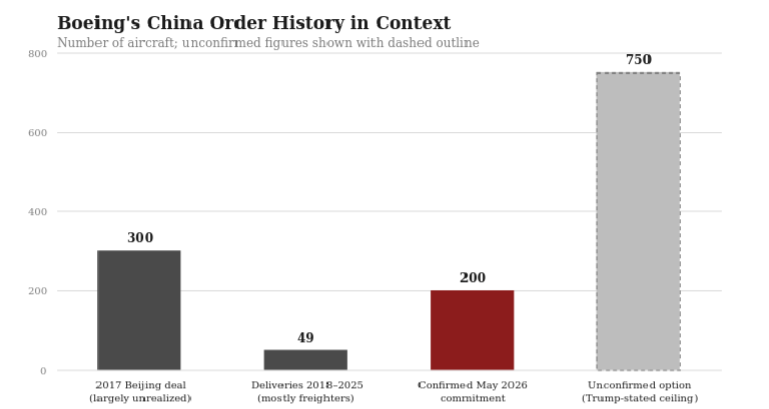
Chart 4: Boeing's China order history against the confirmed May 2026 commitment
After the May summit, Boeing confirmed a Chinese commitment for 200 aircraft, its first major sale there since 2017 and the end of an eight-year freeze during which it delivered only about 49 jets to China, mostly freighters. Mr Trump said China had also reserved the right to buy as many as 750 in total, a figure not confirmed by Boeing or Beijing. Markets had expected more: reporting pointed to negotiations for at least 500 narrow-body jets plus wide-body aircraft, and shares fell by more than 4% the day the smaller 200-plane figure emerged.
Boeing Company (NYSE:BA) is the direct exposure. The September visit came and went with no confirmed new order, but the existing 200-plane commitment is progressing: US Trade Representative Jamieson Greer said days before the summit that about 140 of the aircraft were "in a good state," with another 10 moving through documentation, leaving roughly 50 still unresolved amid disputes over engines, spare parts and maintenance access. That does not rule out a fresh order still being finalized separately, but it means the clearer positive signal, a confirmed new order with delivery timelines, has not yet arrived. Risks remain on both sides: after-sales support concerns have weighed on Chinese buying decisions before, and officials in Taipei and Tokyo worry Mr Trump could use a pending $14 billion Taiwan arms package, which he has called a negotiating chip, to extract Boeing or farm purchases later.
Are Rare Earth and Chip Supply Chains Really Open?
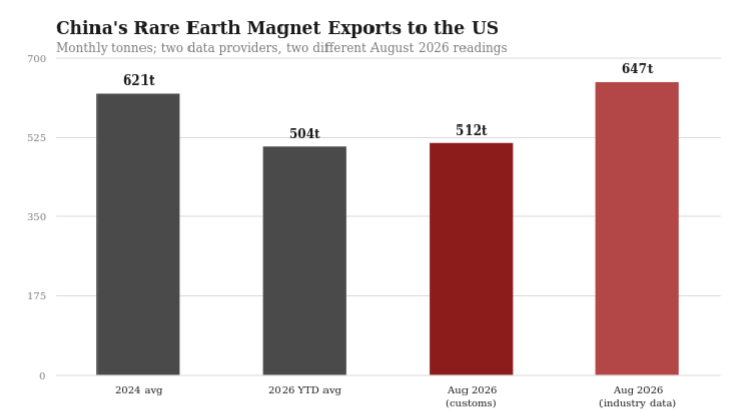
Chart 5: China's rare earth magnet exports to the United States, monthly tonnes
Rare earths is where the data is most contested and most consequential, and it is one of the areas US officials say is falling short of Beijing's commitments even after the truce extension. Customs figures put August magnet shipments to the US at 512 tonnes, a 21% drop from July. A separate industry-data reading, not drawn from official customs figures, puts the same month at 647 tonnes, the first month since October 2025 to top the 2024 average; the two should not be treated as equally authoritative. Both readings agree on the broader pattern: 2026 volumes remain below the roughly 621-tonne monthly pace seen in 2024, before controls were introduced, and some Chinese suppliers are reportedly refusing to ship even after licenses clear, for fear of repercussions from Beijing if relations sour again.
People familiar with Beijing's planning say more export licenses are being weighed as a bargaining chip, and the truce extension commits both sides to keeping rare earth flows moving. But a commitment to keep exports flowing is not the same as fixing the underlying process. European industry groups have pointed out that extending the truce does nothing to address the lack of a standardized approach to applying for rare earth export licenses, a gap that leaves individual shipments exposed to delay regardless of the top-level agreement. Companies with exposure include MP Materials (NYSE:MP), the only integrated rare earth producer of scale in the Western Hemisphere, and Lynas Rare Earths (ASX:LYC). MP Materials shares have moved sharply on rare earth headlines this year, trading near $50 with sell-side targets well above that level, reflecting supply-chain uncertainty as much as settled fundamentals. A durable easing of license backlogs, not just a truce headline, would be needed to reduce the scarcity premium priced into these names.
Semiconductors look the least likely area to see change, though the topic is more central to the summit than earlier framing suggested. Officials have reportedly ruled out further chip-control concessions, and no chip export controls were discussed at the two leaders' May meeting at all. For Nvidia (NASDAQ:NVDA), whose chief executive attended the accompanying state dinner alongside other US technology leaders, H200 shipments to China were under 1% of second-quarter revenue, limiting the earnings effect of any near-term change. Equipment makers Applied Materials (NASDAQ:AMAT), Lam Research (NASDAQ:LRCX) and KLA (NASDAQ:KLAC) face a similar picture, with bipartisan pressure in Congress pointing toward tighter rules. The more relevant near-term risk may be enforcement actions and licensing delays rather than formal policy reversal.
What the Outcome Signals Ahead of January 2027
The summit landed closest to the mildest of the scenarios investors had been weighing beforehand: a truce extension with few sector-specific details, rather than a package of targeted deals. Xi's own arrival statement made no mention of tariffs, rare earths or artificial intelligence, describing the two countries as partners rather than rivals, consistent with a summit built to preserve stability rather than resolve specifics. No Chinese technology executives attended Thursday's state dinner even as their US counterparts did, a small asymmetry that fits the same pattern: the commercial and diplomatic tracks are not yet moving at the same pace.
Risks Beyond Trade
Several risks sit outside the trade agenda itself. Taiwan is the most sensitive: China's ambassador to the US, Xie Feng, restated Taiwan and human rights as Beijing's "red lines" in the days before the summit, and Xi asked Mr Trump directly to have the US "oppose" Taiwan independence, a tougher formulation than Washington's longstanding position of not "supporting" it, with no sign the US plans to shift its language. Xi also invoked the "Thucydides Trap" again, the theory that a rising power and an established one tend toward conflict, and called for regular military dialogue and stronger crisis-prevention mechanisms, though he said the risk "can be overcome." Mr Trump said on arrival that Iran would be among the subjects he raised with Mr Xi. Iran-linked sanctions are another factor, with Washington floating both easing some and imposing new ones on Chinese entities, though none have yet been applied despite earlier threats. A surprise on either front could move markets faster than the formal trade agenda. Finally, the truce extension is not the same as the deliverables it is conditioned on, and some past commitments remain unconfirmed by Beijing months later.
What to Watch Before January 2027
Five signals will show whether the short extension holds or comes under strain: whether Beijing confirms the $17 billion farm-goods pledge alongside the soybean commitment it is already meeting; whether rare earth licenses are fulfilled at the shipment level, not just approved; any confirmed detail on energy tariffs or a further Boeing order, none of which appeared in the public readouts; whether China responds formally to the US proposal for an AI incident notification mechanism; and whether the two leaders meet again at APEC in Shenzhen in November or the G20 in Miami in December, the latter seen by some as more likely given the shorter truce timeline. Markets may react as much to what is left unsaid as to what is formally announced.