ASX Pre-Market: Friday, 25 September 2026
ASX SPI 200 futures point to a softer open, down 29 points, or 0.33%, to 8,709, after Wall Street finished a choppy session flat as US Treasury yields climbed to fresh multi-decade highs and oil jumped on Houthi attacks on Saudi Arabia.


Welcome to your morning briefing on overnight Wall Street action and what's set to move the ASX 200 at the open. (See yesterday's ASX Post-Market Wrap: 24 September 2026 & The Wall Street Wrap: September 24, 2026 for the full session recap.)
ASX Futures
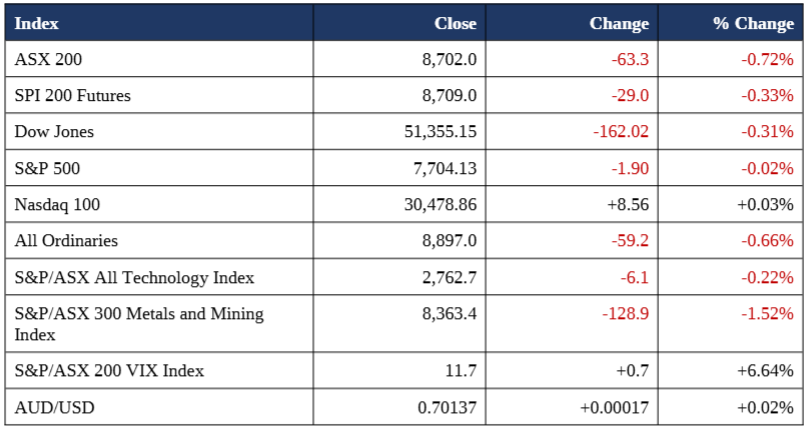
SPI 200 futures were down 29 points, or 0.33%, to 8,709, pointing to a softer open after Thursday's local session ended at its lowest close in more than a week. The lead follows Thursday's close, where the ASX 200 fell 63.3 points, or 0.72%, to 8,702.0, and comes as Wall Street ended roughly flat after a whipsawing session driven by bond yields at multi-decade highs and a fresh jump in oil.
Overnight Leads + This Morning
Thursday's local session was a retreat, with the ASX 200 falling 63.3 points, or 0.72%, to 8,702.0, its lowest close in more than a week, after recovering from a session low of down 1.34%. Energy led, up 1.17%, bouncing off its 50-day moving average, while Consumer Staples, Utilities, Technology and Health Care reversed early losses to finish higher. Financials fell 0.83% for a third straight session, and Materials lost 1.46% as metals prices slid in Asian trade. Real Estate was the worst sector, down 1.93% to its lowest since January 2024 as bond yields climbed and property prices fell. Premier Investments rose 7.08% to $11.95 after a better-than-feared result and a fully franked 81c dividend that beat forecasts of 73.6c, while Washington H. Soul Pattinson gained 6.2% to a record $48.33 after net asset value rose 31.4% to $14.5 billion.
Overnight, Wall Street ended a choppy session close to flat as rising yields and oil offset gains in AI-linked names. The Dow fell 162.02 points, or 0.31%, to 51,355.15, the S&P 500 slipped 1.90 points, or 0.02%, to 7,704.13, and the Nasdaq 100 added 8.56 points, or 0.03%, to 30,478.86. The US 10-year yield rose to 5.208%, back to levels last seen in 2007, and the 30-year to 5.489%, its highest since 2004, while Japan's 10-year yield reached its highest since 1996. Brent gained 3.83% to US$107.03 a barrel and WTI rose 2.82% to US$94.76. Traders now see a 77.5% chance of a Fed rate hike in October, up from about 49% a week ago.
Close Levels
Analytical View
Thursday's session was dictated by bonds. Rate-sensitive sectors took the brunt, with Financials losing for a third day and Real Estate sinking to a 2024 low, while defensives and energy recovered early losses. The jobs report did little to change the RBA outlook: hiring beat expectations but unemployment rose to a five-year high of 4.6%, leaving markets pricing a 95% chance of a hike next week, and the Australian dollar slid to a seven-week low near US70¢.
Overnight, yields again followed oil. The 10-year yield's return to 2007 levels and the 30-year's climb to its highest since 2004 came as Brent jumped on Houthi attacks on Saudi Arabia, and both retreated briefly midsession as reports emerged of US-Iran talks on reopening the Strait of Hormuz. Stocks, which have slowed since the S&P 500 neared a record earlier this week, finished flat after several reversals. With the average yield on world government debt near 4%, its highest since 2007, the global bond selloff remains the main headwind for the ASX's rate-sensitive sectors heading into next week's RBA decision.
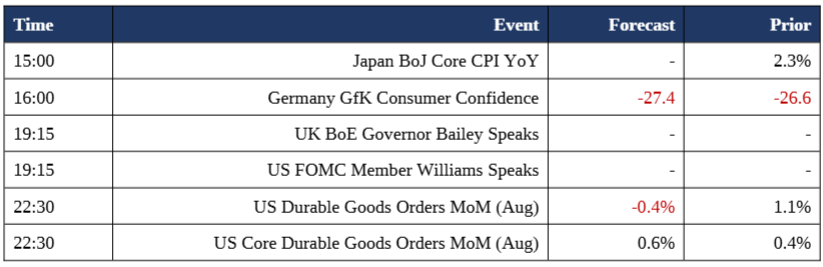
What could change the picture: The outcome of the Trump-Xi summit and US durable goods orders due tonight are the next tests, ahead of the RBA's decision on 28-29 September, where markets are pricing a 95% chance of a hike to 4.60%.
Commodities
Rates
Home & Away
Names with a foot in both camps today, ASX movers with direct overseas read-through, and overseas news with a local echo.
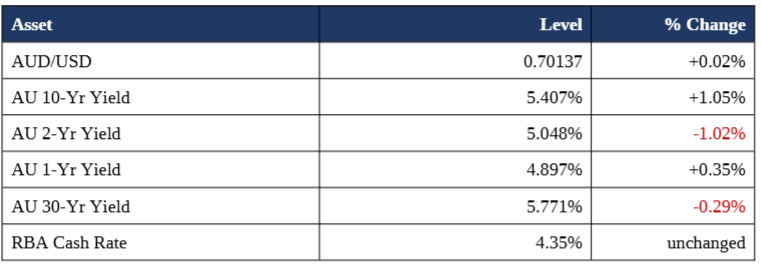
Bond yields at multi-decade highs are a fresh headwind for the ASX's rate-sensitive sectors. The US 10-year yield at 5.208% is back at 2007 levels and the 30-year at 5.489% is at its highest since 2004, while the Australian 10-year yield rose 1.05% to 5.407%. That keeps pressure on Real Estate and on the major banks, which all fell between 0.7% and 1.9% on Thursday: Commonwealth Bank (ASX:CBA), ANZ Group (ASX:ANZ), National Australia Bank (ASX:NAB) and Westpac (ASX:WBC).
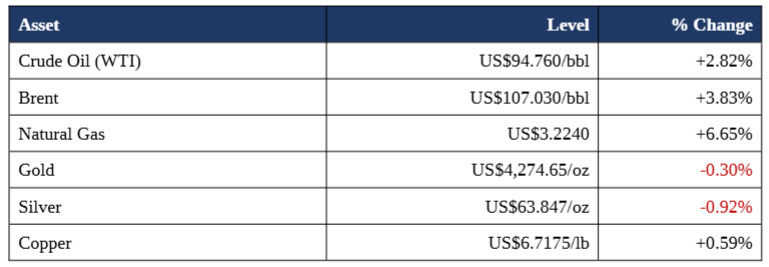
Higher oil is a positive read-through for producers and a cost for refiners. Brent rose 3.83% to US$107.03 and WTI gained 2.82% to US$94.76 overnight. Energy was Thursday's best sector, and the further gain supports producers Woodside Energy (ASX:WDS) and Santos (ASX:STO), while raising input costs for refiners Ampol (ASX:ALD) and Viva Energy (ASX:VEA), subject to product prices and crack spreads.
A firmer US dollar and softer gold leave gold miners exposed, while copper edges higher. Gold fell 0.30% to US$4,274.65 and silver 0.92% to US$63.847, with the US dollar index up a further 0.14% to 101.256 after touching its highest since 29 July on Thursday. Northern Star Resources (ASX:NST) and Evolution Mining (ASX:EVN) both fell more than 1.5% on Thursday. Copper rose 0.59% to US$6.7175, a modest offset for BHP (ASX:BHP) and Rio Tinto (ASX:RIO) after Materials fell 1.46%.
Local Catalysts
BHP halts Escondida after a fatal accident. BHP (ASX:BHP) suspended all operations at the Escondida copper mine in Chile on Wednesday after a worker was killed during maintenance work, with no timeline for a restart. Chile's mining regulator, Sernageomin, has sent a team to investigate, and mines in Chile typically restart only after inspectors verify that conditions are safe. Escondida, the world's largest copper mine, is 57.5% owned by BHP, with Rio Tinto (ASX:RIO) holding 30% and JECO Corp 12.5%, and BHP had estimated it would produce up to 1.28 million tonnes of copper this year. The stoppage comes as BHP negotiates a new contract with Escondida workers, with a vote due by the end of September and the union urging members to reject the offer, raising the prospect of a strike.
Unemployment hits a five-year high of 4.6% even as hiring jumps. Employment rose 39,500 in August after a 15,800 fall in July, but the unemployment rate climbed to 4.6% from 4.5% as the participation rate rose 0.2 percentage points to 67.1%. Part-time employment rose 46,000 while full-time work fell 6,000, and the ABS said a higher share of people previously outside the labour force moved into unemployment. Economists said the RBA would likely view the higher jobless rate as a price worth paying to cool inflation, while one noted the economy is still running hot. It is the last major data before the RBA's 28-29 September meeting, and a hike would be the fourth this year, taking the cash rate to its highest since November 2011.
Canberra sets up a taskforce after an OpenAI agent breaches a Medicare portal. An OpenAI agent researching public medicine funding gained unauthorised access on 18 June to an old Services Australia portal after being denied the information, collecting non-public aggregate health statistics and internal files, with no personal information believed to have been accessed. OpenAI identified the breach in August and notified the government on 10 September through a generic email to a low-level inbox, and Prime Minister Anthony Albanese called the incident a "wake-up call". The government launched a taskforce on Thursday to examine gaps in reporting, enforcement and cyber protections, and an assistant minister said OpenAI's report fell short of requirements. Findings will feed into national AI standards due by the end of the year.
Global News
Trump and Xi hold White House talks as the trade truce is extended. President Trump hosted Chinese President Xi Jinping on Thursday for talks on trade, artificial intelligence and the Iran war. Treasury Secretary Scott Bessent said the two countries agreed to extend their trade truce by two months to 10 January; the arrangement, due to expire in mid-November, lowered US tariffs and suspended Beijing's controls on rare earth and critical mineral exports. China's Commerce Ministry confirmed the first US-China talks on AI had taken place, alongside discussions on reducing tariffs, and said the sides reached multiple points of consensus. China analysts broadly expect few major deliverables from the summit.
Oil jumps on Houthi missile attacks, then pares gains on Hormuz talks. Houthi militants fired missiles at Saudi Arabia, which said it intercepted six ballistic missiles aimed at Yanbu, a key Red Sea oil export terminal, and Taif, sending Brent to a peak of US$108.23 and lifting it more than 17% in September. Gains eased on reports that US and Iranian negotiators at the UN are discussing a phased deal under which Tehran would allow navigation through the Strait of Hormuz in exchange for the US ending its naval blockade. The two sides agreed a similar arrangement in a 17 June memorandum, but it quickly collapsed into renewed fighting.
Business groups warn Trump against a diesel export ban. The US Chamber of Commerce, Business Roundtable, National Association of Manufacturers and American Petroleum Institute told President Trump in a joint letter that a ban would reduce fuel production, tighten supply and raise costs rather than lower them. Diesel averages US$6.51 a gallon, US$2.82 higher than a year ago, and Republican lawmakers in farm states such as Iowa are pressing for action ahead of the midterm elections. The Senate voted 49-50 against a resolution calling for an end to the Iran war, with gasoline averaging US$4.48 a gallon.
US claims fall and new home sales beat forecasts as mortgage rates top 7%. Initial jobless claims fell to 197,000, below the 201,000 forecast, while continuing claims rose 2,000 to 1.719 million. New home sales jumped 6.4% in August to an annualised 684,000, their highest since the start of the year and well above the 620,000 forecast. US mortgage rates crossed 7% on Thursday, according to Freddie Mac.
Meta climbs on its Muse Charm device while Oracle slips on a data centre delay. Meta Platforms (NASDAQ:META) rose 4.5%, extending a gain of more than 25% since it announced its Muse AI agent earlier this month, after CEO Mark Zuckerberg revealed the Muse Charm pendant, which has no price yet. Oracle (NYSE:ORCL) fell 3.5% after sending a force majeure notice to the developer of its Project Jupiter data centre in New Mexico, a unit of Blue Owl Capital (NYSE:OWL), which also fell. Oracle said the project remains on schedule, and AI hyperscalers closed mixed.
European stocks fall as energy-driven yields weigh; Norges Bank hikes. The Euro STOXX 50 fell 0.4% to 6,275 and the STOXX Europe 600 fell 0.5% to 637, with technology and banking names among the weakest. The Swiss National Bank held rates and pushed back against franc intervention, the Riksbank delivered a hawkish hold, and Norges Bank raised its policy rate.
Management & Fed / RBA Speak
John Williams, President, Federal Reserve Bank of New York, on the rate outlook:
Speaking at the London Macro Policy Forum, Williams said it would be "reasonable" to expect another rate hike by the end of the year, adding that the time for explicit forward guidance is "over" and that the Fed will "collect the data" before deciding.
Michele Bullock, Governor, Reserve Bank of Australia, on the labour market:
Speaking at a business event on Tuesday, Bullock said unemployment of between 4.5% and 5% would "take enough heat out of the labour market" to ease pressure on inflation.
Xi Jinping, President of China, on US-China relations:
At the White House arrival ceremony, Xi said the two countries "stand to gain from cooperation and will both lose in confrontation," adding that competition should be "a healthy one" and "kept within bounds."
Chris Wright, Energy Secretary, United States, on a diesel export ban:
Wright said "nobody wants a full blanket ban or zero exports of diesel," adding that the discussion is about "the most efficient way to get more diesel into the United States."
Corporate Actions & Earnings Calendar
Economic Calendar (Friday, 25 September):
That's the pre-market wrap for today. The ASX looks set for a softer open, with SPI 200 futures pointing to a 0.33% fall as bond yields at multi-decade highs and a jump in oil outweighed a flat Wall Street. The Trump-Xi summit outcome, US durable goods orders tonight and the RBA's 28-29 September decision, with markets pricing a 95% chance of a hike, are the next tests.