AI Stock Bubble 2026: Inside the $700 Billion Bet Wall Street Can't Verify
Concentration in Big Tech has hit records not seen since the dot-com era, and the payoff that is supposed to justify it has yet to show up

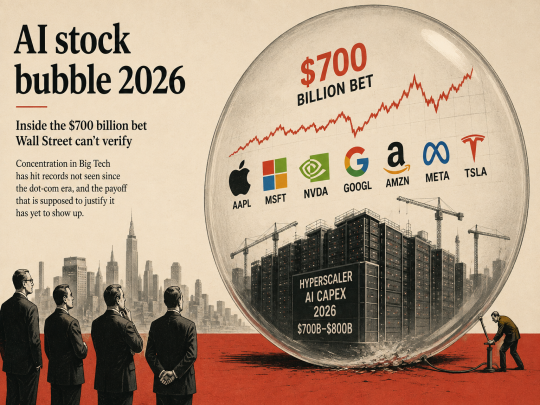
FOR A trade that is supposed to change the world, the AI boom has developed a distinctly circular quality. Nvidia (NASDAQ: NVDA) sells chips to hyperscalers. Hyperscalers borrow and spend billions building data centres to run those chips. Investors bid up the shares of both, on the assumption that the resulting services will eventually be sold to someone, somewhere, for a profit. That last step—monetisation—remains the one part of the chain nobody can quite verify. Everything else is arithmetic; that part is faith.
By early September 2026 the arithmetic had become extraordinary. The “Magnificent Seven”—Apple (NASDAQ: AAPL), Microsoft (NASDAQ: MSFT), Nvidia (NASDAQ: NVDA), Alphabet (NASDAQ: GOOGL), Amazon (NASDAQ: AMZN), Meta Platforms (NASDAQ: META) and Tesla (NASDAQ: TSLA)—accounted for 31.8% of the S&P 500's total market value, having peaked near 35% in early June. For context, the same group of names commanded roughly 13% of the index in 2018 and 19-20% in 2022. Widen the lens to the top ten stocks in the index and the figure climbs to 38-40%, comfortably above the 25% concentration recorded at the very peak of the dot-com bubble in 2000. Nvidia alone is worth close to 8% of the entire S&P 500—larger, by some sectoral comparisons, than several whole industries combined.
None of this proves a crash is imminent. But it does mean that the fortunes of the world's most-watched stockmarket are now tied, to a historically unusual degree, to a single unresolved question: will artificial intelligence generate enough revenue, quickly enough, to justify what is being spent building it?
Building the machine
The scale of that spending is the first thing to grasp. Amazon (NASDAQ: AMZN) has guided towards $200bn-220bn in capital expenditure for 2026, the bulk of it aimed at AWS data centres and custom AI silicon. Alphabet (NASDAQ: GOOGL) has raised its own guidance repeatedly through the year, towards $175bn-205bn. Microsoft's (NASDAQ: MSFT) figure sits around $175bn-190bn, though comparisons are complicated by how the company accounts for long-term data-centre leases. Meta (NASDAQ: META) has guided towards $125bn-145bn, having raised its outlook more than once as Mark Zuckerberg has pushed the company deeper into “superintelligence” infrastructure. Oracle (NYSE: ORCL), a newer entrant to the hyperscaler front rank, is spending in the range of $55bn-70bn, a smaller absolute number but a startling one relative to the size of the underlying business.
Combined, the core group of hyperscalers is on track to spend somewhere between $700bn and $800bn in 2026 alone—commonly cited around $725bn—up 70-89% from roughly $410bn in 2025. Wall Street analysts, Goldman Sachs among them, have modelled cumulative capital spending running into the multiple trillions of dollars by 2030-31 if current trajectories hold.
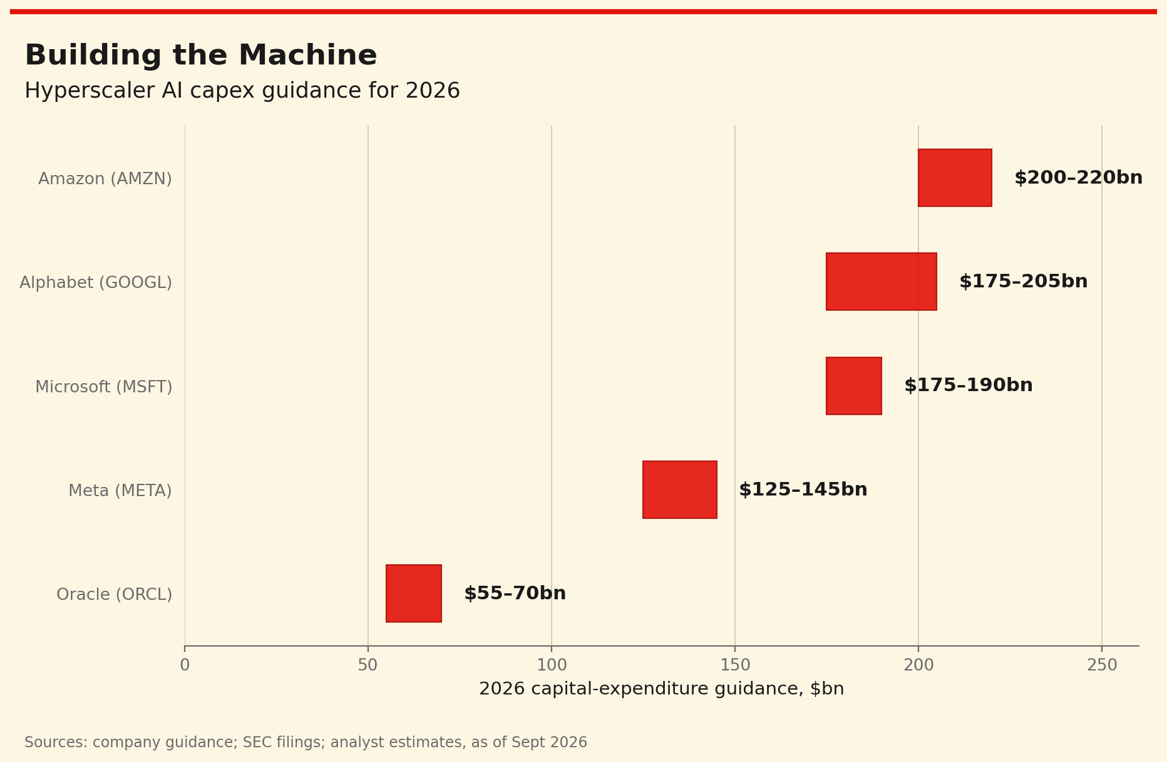 Hyperscaler AI capex guidance for 2026, by company
To put such numbers in perspective: the combined 2026 capex guidance of just five companies now approaches the entire annual GDP of a mid-sized advanced economy. And the growth rate of that spending is itself remarkable. Trend analyses through 2026 put capex growth at an annualised rate approaching 70%, against operating-cash-flow growth of roughly 23%—a widening gap that cannot persist indefinitely without consequence for either balance-sheets or investor patience.
Cash flows in opposite directions
That consequence is already visible in free cash flow, the money left over after a company pays its bills and its capital projects. Among the big hyperscalers—Microsoft, Amazon, Alphabet, Meta and Oracle—aggregate free cash flow has been trending toward zero, and in some individual quarters through 2026, Amazon and Alphabet each reported free cash flow that was negative or sharply reduced, as capital spending outran the cash their operations were generating. Trend-line projections suggest the crossover point, where combined free cash flow turns negative in aggregate, could arrive around mid-to-late 2026.
Contrast that with Nvidia (NASDAQ: NVDA), sitting on the supply side of the boom rather than the demand side. The company posted free cash flow of roughly $21.3bn-21.4bn in a single quarter (Q2, fiscal year 2027), with trailing annual figures remaining in the tens of billions, despite some working-capital volatility. It is, in other words, a close to textbook case of the “picks-and-shovels” dynamic that characterises every gold rush: the company selling the equipment is minting cash, while the companies buying it are burning through theirs, betting on a payoff still some years away.
That asymmetry is not inherently alarming—suppliers to booming industries are supposed to do well. What matters is whether the buyers' bet pays off before their cash cushions, or their access to debt markets, run thin.
The valuation gap that isn't quite 2000
Optimists have one strong card to play: valuations, while elevated, are not at dot-com extremes. As of late August 2026, the Magnificent Seven traded at an aggregate forward price-to-earnings ratio of roughly 24.8 times—well below the 50-100-times-plus multiples that the largest dot-com names commanded at their 2000 peak. Individual pictures vary widely. Nvidia (NASDAQ: NVDA) has traded in a forward P/E range of roughly 17-28 times across various reports through the year, arguably modest for a company growing revenue as fast as it has been. Other names in the group carry higher multiples, in the mid-20s to 30s-plus, with Tesla (NASDAQ: TSLA) a persistent outlier on the high side. The broader S&P 500 has traded around 20-21 times forward earnings, meaning the AI cohort carries a premium but not an outlandish one by the standards of past bubbles.
This is the crux of the bull case: today's leaders are nothing like the loss-making dot-com strugglers of 1999. Microsoft, Alphabet, Amazon and Meta are all substantially and durably profitable, throwing off enormous cash from core businesses—search advertising, cloud computing, e-commerce, social media—that have nothing to do with speculative AI monetisation. Their balance-sheets, even after a year of extraordinary capital spending, remain far stronger than those of the median 1999 dot-com constituent. A repeat of the 2000-02 wipeout, in which trillions of dollars of market value in unprofitable companies simply vanished, is not the base case here.
Where the doubt creeps in
The doubt concerns not the health of the companies but the payoff of the specific bet they are all making simultaneously. Multiple surveys conducted through 2026 have found that the large majority of enterprises deploying generative AI tools are not yet seeing a meaningful net return once costs are tallied—estimates of the share reporting limited or no ROI range from roughly 70% up to as high as 95% in some analyses. The complaints are strikingly mundane for a technology billed as revolutionary: the ongoing cost of running large models (so-called token costs), difficulty integrating AI tools into existing workflows, patchy or siloed internal data, and in some cases runaway spending on AI coding assistants that outpaced any budget originally set for them. Some companies have already begun capping or cutting AI spending as a result.
Frontier AI labs, meanwhile—OpenAI chief among them—continue to report losses that would alarm the shareholders of almost any conventional company, funded instead by successive, enormous private fundraising rounds. Infrastructure spending across the sector, in aggregate, still far exceeds the current revenue base of AI software and cloud services built on top of it. For the hyperscalers' capital spending to make sense at current levels, consensus forecasts effectively require several of them to roughly double revenue within a few years while holding a lid on costs—an assumption that reads as optimistic rather than conservative once set against the ROI data emerging from actual deployments.
Echoes of railways, canals and fibre-optic cable
This is the part of the story regulators have started to worry about openly. The Bank for International Settlements has warned explicitly that the scale of AI-related investment is building up financial vulnerabilities capable of amplifying a future economic shock, and has drawn the comparison to previous infrastructure manias by name: the canal-building booms of the early 1800s, the railway mania that followed, the electrification of American industry, and the dot-com telecoms build-out of the late 1990s. Each of those episodes followed a broadly similar arc—rapid, FOMO-driven overbuilding, a conviction that only a small number of players would ultimately dominate the new infrastructure, and then a period of excess capacity and painful repricing once demand failed to keep pace with what had been built.
There are early signs of that pattern in the AI cycle: an unusually rapid capacity build-out, circular financing arrangements in parts of the AI ecosystem (chipmakers investing in the very customers who buy their chips, for instance), and a revenue base still small relative to cumulative capital spent. Data-centre economics—the cost of building and running a facility against the achievable revenue over a GPU's realistic useful life—look challenged under conservative assumptions about both utilisation and pricing.
Markets have already shown some sensitivity to this narrative. Sell-offs in mid-2026, concentrated in memory-chip and broader semiconductor names, demonstrated how quickly sentiment can turn on any hint of slowing demand growth or a less accommodative path for interest rates. Michael Burry, the investor best known for correctly wagering against the 2008 housing bubble, has disclosed short positions tied to AI-related names and warned publicly of the risk of a sharp drawdown. Away from public markets, secondary-market pricing for private AI companies has shown signs of the same froth that characterised earlier speculative cycles.
What the evidence actually supports
None of this amounts to a forecast that a crash is coming, still less that it is coming immediately, and it would be a mistake to read it that way. The companies at the centre of the AI build-out are, unlike the median casualty of 2000-02, genuinely and substantially profitable outside their AI bets, hold stronger balance-sheets than most of their dot-com-era predecessors, and retain the option of slowing capital spending relatively quickly if returns continue to disappoint. It also remains entirely plausible that AI's productivity gains arrive with the kind of lag that characterised the payoff from electrification a century ago—a technology that took decades, not years, to reorganise industrial production and justify the investment poured into it.
Bubbles, moreover, have a well-documented habit of running longer than sceptics expect, and an all-or-nothing exit carries its own risk: missing further gains if enterprise monetisation does eventually catch up to the infrastructure being built for it.
What the data does support is a more measured conclusion: that the risk profile of a market this concentrated, financed increasingly through debt and circular vendor arrangements, and still waiting on enterprise adoption data that has yet to turn convincingly positive, is meaningfully elevated relative to a more diversified market—not a certainty of collapse, but not a risk to be waved away either. History's infrastructure booms rarely punished the underlying technology; canals, railways and fibre-optic cable all eventually proved their worth. What they punished was the assumption that everyone who financed the build-out on the original timetable would be repaid on schedule.
Investors currently betting that the AI capex cycle will be the exception to that pattern should, at minimum, be able to explain why—and should weigh diversification, careful position-sizing, and a preference for companies with visible, near-term paths to cash generation over a concentrated, all-or-nothing bet on names whose valuations already assume the payoff has arrived.
Sources: company capital-expenditure guidance and earnings releases; SEC filings; index-concentration data; analyst estimates from Goldman Sachs, Bank of America, Evercore and CreditSights; Epoch AI; Bank for International Settlements commentary. Figures are approximate and reflect data available as of early September 2026; exact numbers move with share prices, guidance revisions and reporting-period definitions.
Related post