Wall Street Wrap: Pre-Market, October 13, 2026
U.S. stock futures are mixed on Tuesday as bank and health-care earnings lift the Dow while a steep slide in South Korea's Kospi hits memory chip stocks. UnitedHealth jumps on a raised outlook, Goldman Sachs gains on a revenue beat, and Syndax and Six Flags tumble. Traders now look to Wednesday's consumer price report as the IMF warns of a disorderly rise in bond yields.


Memory chips slide as South Korea plunges and banks report mixed results, while UnitedHealth jumps and Syndax and Six Flags tumble
Wall Street looks set for a mixed open on Tuesday as bank and health-care earnings lift the Dow, while another slide in memory chips weighs on the Nasdaq.
Futures Snapshot
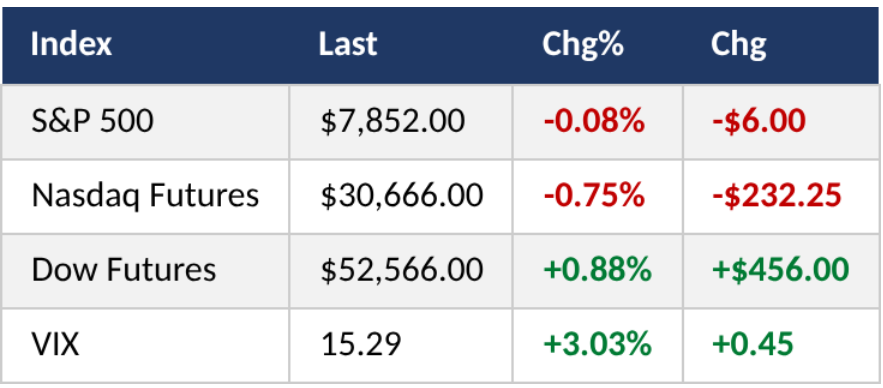
Futures were mixed early Tuesday, with the Dow leading on earnings and the Nasdaq lagging on chip stocks.
What's Driving the Open
Wall Street is coming off a mixed session. The Dow ended Monday more than 195 points higher, while declines in memory stocks pushed the Nasdaq Composite and the S&P 500 into negative territory. The pressure is continuing. South Korea's Kospi dropped 5.5% overnight to its lowest level since July 31, on valuation worries and growing competition from China, after China's CXMT said it plans to release a new, more powerful memory chip by the end of the year. Chip stocks are heading for a sixth straight losing day, and the chief executive of Broadcom (NASDAQ:AVGO) compared AI speculation to a casino.
Earnings season has started with high expectations. Analysts on average expect S&P 500 profits to have grown by nearly 30% from a year earlier, according to FactSet. Anthony Saglimbene of Ameriprise sees three groups shaping how investors read the season: banks, Big Tech and energy. The first results from the banks were mixed, with some beating on profit but missing on revenue and one posting its first profit miss in nearly three years. Bank stocks have sold off in recent weeks, and the KBW Bank Index is more than 12% below its August highs as rising yields raise concerns about loan growth and dealmaking.
Treasury yields are falling. The Treasury market reopened after Monday's holiday closure, and the 10-year yield is down 0.055 percentage points at 5.189% as oil slides. WTI is down 1.29% at $92.53 as hopes for more Russian diesel after the US-brokered "energy ceasefire" outweigh Houthi strikes on Riyadh and tanker attacks near the Strait of Hormuz. Wednesday's consumer price report is the next big test: September inflation is expected at 3.7%, up from 3.4% in August. Traders see about an 80% chance the Fed holds in October and roughly 85% odds of a hike by December.
What could change the picture: A hot consumer price reading on Wednesday could push yields back up and revive hike bets, another leg down in memory chips would drag on the Nasdaq, and renewed attacks in the Gulf would lift oil.
Overnight Markets
South Korea's Kospi fell 5.5% to its lowest level since July 31, led by memory chipmakers.
In Europe, shares were broadly higher, helped by falling oil and yields. The Stoxx 600 gained 0.7% in morning trading, and London's FTSE 100 led the major regional markets with a rise of 0.8%.
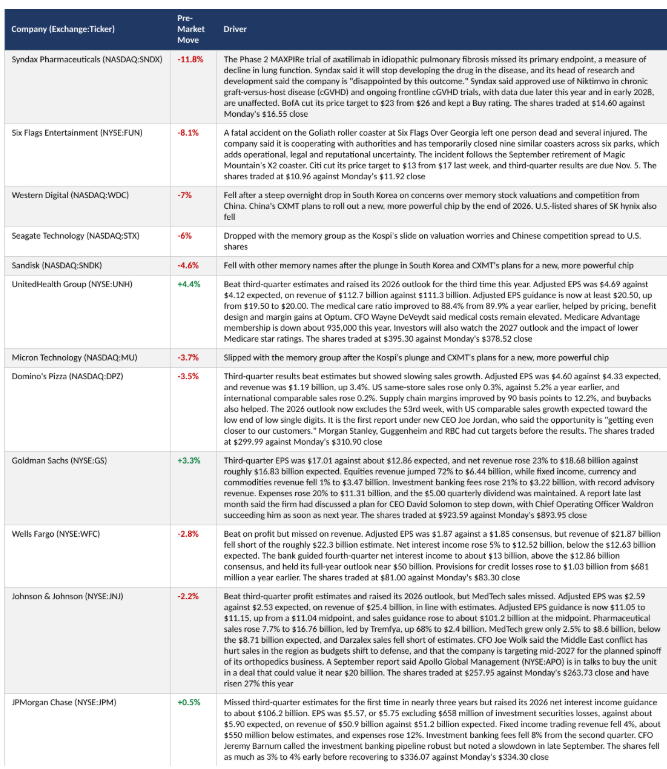
Pre-Market Movers
Rates, FX & Crypto
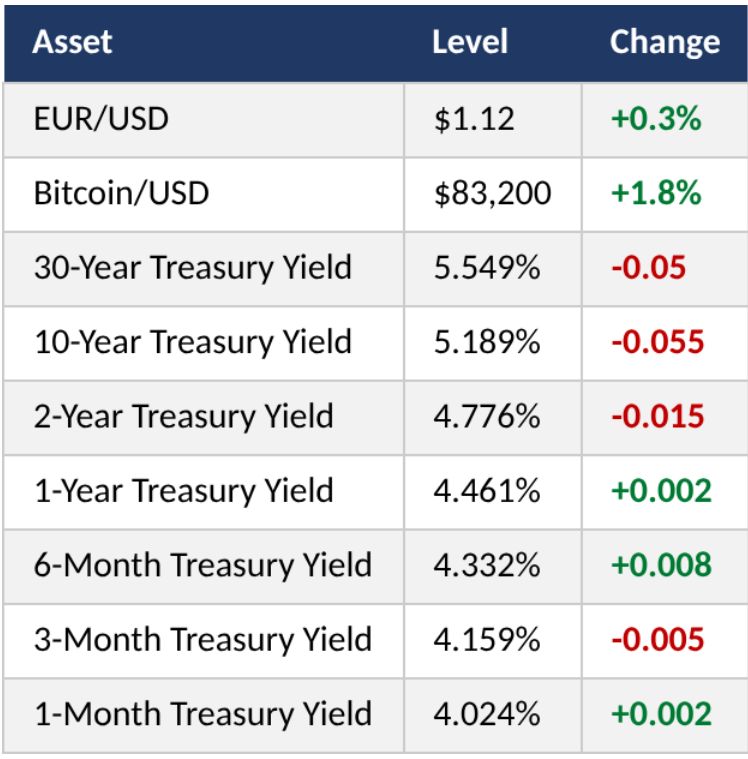
Treasury yield changes are in percentage points.
Yields fell as oil dropped, with the 30-year recently at a 2002 high near 5.70%. The euro touched $1.1150, a 17-month low, before bouncing as the dollar eased from an 18-month high. French budget stress, political uncertainty in Spain and Germany and elevated energy costs still weigh on the currency. Bitcoin is rebounding after dipping to roughly $81,200 overnight and touching its 50-day moving average. About $771 million of positions were liquidated, and spot bitcoin ETFs have seen $386 million of outflows so far in October. Strategy (NASDAQ:MSTR) bought another 250 bitcoin, lifting its holdings to 848,250 coins at an average cost of $75,444, and its shares fell 1.1% on Monday. Bitcoin funds saw about $700 million of weekly outflows, the most since June, and the Fear & Greed Index cooled to 56.
Commodities
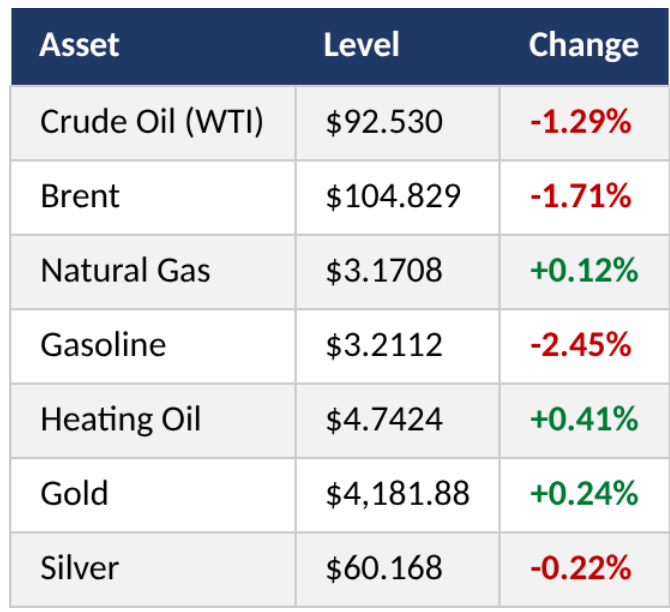
Oil and gasoline are slipping as Russian diesel hopes offset Gulf risks, while gold edges higher. President Trump's deal for Russian diesel supply has eased fuel worries, but Houthi strikes on Riyadh and tanker attacks near the Strait of Hormuz keep a risk premium in place. OPEC raised its forecast for 2027 oil demand growth, citing the need to rebuild stocks depleted by the Iran war, and cut its 2026 forecast for the sixth straight time. Saudi Arabia told OPEC it pumped 8.372 million barrels a day in September, up more than 2 million from August. The Baltic Dry Index of freight rates fell for a seventh straight session, down about 1.8% to 2,801, its lowest since Aug. 20.
Key Levels & Catalysts Today
Economic data
- Existing home sales are due today, along with comments from Fed officials Tom Barkin and Susan Collins.
- Wednesday brings September consumer prices, expected to show annual inflation of 3.7%, up from 3.4% in August. Excluding food and energy, prices are expected to rise 2.5%, up from 2.4%.
- Thursday brings the producer price index and retail sales for September.
- The IMF-World Bank annual meetings continue in Bangkok this week.
Already reported this morning
- Citigroup (NYSE:C) beat third-quarter estimates. EPS was $2.85 against about $2.65 expected, and revenue was $23.85 billion against $23.72 billion. Investment banking revenue rose 9% from a year earlier to $1.35 billion, though trading revenue fell 13% from the second quarter. The return on tangible common equity was 11.5%. The shares were little changed. Citi owns 51% of Banamex and expects to list it next year.
Corporate
- Meta (NASDAQ:META) released Muse Wonder, a large language model it says puts it at the frontier of AI development. The company entered the AI race late but has spent billions of dollars over the past year and a half to catch up with OpenAI and Anthropic. Its share price rose 4.7%.
Top Stories
The IMF warns that government bond yields could rise in a disorderly fashion. In its Global Financial Stability Report, released at the annual meetings in Bangkok, the fund said rising inflation, mounting debt and AI-related borrowing are pressuring sovereign bond markets, and that a sharp rise in yields would mark down asset values, including AI-related assets. Hedge funds hold about 9% of US Treasuries, up from about 4% in 2022, leaving the market open to a disorderly unwind. Hyperscalers' share of global investment-grade bond issuance has risen to 10% from less than 1% since 2024. The fund urged debt managers to lengthen maturities. Separately, in its World Economic Outlook, the IMF called on big economies to act urgently to cut deficits, with net borrowing in rich countries this year the highest since 2021. Managing director Kristalina Georgieva said AI would augment, downgrade or eliminate 40% of jobs.
The IMF sounds the alarm over "circular" AI financing. Since 2023, 14 publicly disclosed deals have channeled about $300 billion of equity, led by hyperscalers, into financially weaker AI firms, alongside $650 billion of debt. In exchange, the investors secured $1.4 trillion of future revenue commitments through services or chip orders. Jason Wu of the IMF said that if AI commercialization falls short, the losses could arrive as a "triple whammy": falling equity values, strained debt service and revenue promises that never materialize.
South Korea's Kospi plunges as China's CXMT rattles memory stocks. The benchmark fell 5.5% to its lowest since July 31 on valuation concerns in the space and growing competition from China. CXMT said this week that it plans to release a new, more powerful chip by year-end, built on a new memory-cell design. The selloff hit Samsung and SK hynix and spread to U.S. memory and storage stocks in pre-market trading.
Anthropic warns that small AI models are "months away" from replicating themselves across home devices. The company said on Monday that such models could infiltrate internet-connected devices such as smart ovens and Android TV boxes and use their computing power to run themselves without expensive data centers. It said there is not yet a fully rogue replicator. In one test, a small Google model was run across a network of 15 cheap off-brand Android TV boxes.
Eyes on today's existing home sales and Fed speakers, and on Wednesday's consumer price report, for the next read on whether yields keep falling and chip stocks find a floor.